
Highlights
- Myanmar’s rare earth deposits in Kachin State represent a critical geopolitical battleground involving environmental destruction, ethnic resistance, and global technology supply chains.
- The Kachin Independence Army (KIA) controls key mining territories, resisting Chinese exploitation while seeking international support for responsible resource management.
- The region’s rare earth elements are crucial for high-tech, defense, and clean energy industries.
- The KIA is fighting for self-determination and environmental protection.
In a recent in-depth conversation with Zung Ting (opens in a new tab)—a Kachin (Lachid (opens in a new tab)) environmental advocate—he shared insights shaped by decades of grassroots work. His career spans roles such as Environmental Education Officer at the Pestalozzi Children’s Foundation (2016–2024), Coordinator of Grassroots Grant Assistance for Human Security Projects at the Japanese Embassy in Yangon (2015–2016), and Program Officer for SWISSAID’s Kachin State Program (2004–2012). Now living in exile, Zung Ting continues to serve as a representative for Myanmar, and particularly for Kachin, on environmental and human rights issues, as well as a point person for discussions about rare earth elements (REE). Rare Earth Exchanges (REEx) gained firsthand insight into one of the world’s most opaque and misunderstood rare earth battlegrounds: northern Myanmar. Zung now resides in Thailand, having fled Myanmar after the 2021 military coup placed him at severe personal risk. His story—and the story of the Kachin and other ethnic peoples—reveals a powerful truth: Myanmar’s rare earth wealth lies buried beneath not just clay, but decades of broken promises, war crimes, and geopolitical betrayal.
Most of Myanmar’s REE sources, especially the heavy rare earth elements (HREEs) like terbium and dysprosium, occur in ion-adsorption clays found in weathered granite on mountain slopes.
These deposits are geologically similar to those in southern China, which dominate global HREE supply. In Kachin State and parts of northern Shan State, the REEs are bound to clay minerals rather than locked in hard rock. This makes them easier to mine and process — often through in-situ leaching — but also creates high risks of environmental damage, since the leaching process uses chemical solutions that can contaminate water and soil.
Because these clays are rich in HREEs, Myanmar has become a critical supplier to China’s magnet manufacturing industry, particularly after Chinese domestic ion-adsorption deposits faced resource depletion and stricter environmental regulation. And as we will share below, the rest of the world also depends on this location’s geological endowment.
A Nation Divided: Christianity, Colonialism, and the Forgotten Pact
Myanmar, once Burma, was carved out of British colonial rule in the aftermath of World War II. The Panlong Agreement (opens in a new tab)—signed in 1947 by General Aung San (opens in a new tab) (father of Aung San Suu Kyi (opens in a new tab)) and leaders of major ethnic minorities including the Kachin—promised autonomy and self-determination in exchange for unity under a new Burmese flag.
But independence in 1948 brought only broken commitments. Kachin communities—with all Christians due to American Baptist missionary Key figures like Ola Hanson and the Roberts family, influence—were sidelined by the rising tide of Burmese Buddhist nationalism. What followed was over seven decades of betrayal: marginalization, displacement, and ultimately armed rebellion.
The Northern Alliance and the KIA: Holding the Ground, Defending the Land
The Kachin Independence Army (opens in a new tab) (KIA), part of the larger Northern Alliance (opens in a new tab), has long resisted central military control. The KIA is fighting along with other ethnic groups primarily to establish a federal union in Myanmar and to defend its territory and resources against the Myanmar military junta. This includes asserting control over key areas like Kachin State's jade and HREE mining region and border trade posts with China.
Beijing gave tacit approval to launch Operation 1027 on Oct. 27, 2023.
Operation 1027 was a large-scale offensive by the Three Brotherhood Alliance (3BTA) (opens in a new tab) in northern Myanmar. The alliance, composed of the Arakan Army (opens in a new tab), Myanmar National Democratic Alliance Army (opens in a new tab), and Ta'ang National Liberation Army (opens in a new tab), targeted the military junta and its outposts in Shan State (opens in a new tab), near the Chinese border. The operation aimed to suppress online gambling and fraud operations, fight against the military junta, and eliminate the military dictatorship.
KIA’s operations ran in parallel, placing pressure on the junta from another front, forcing the military to fight on multiple geographic and political battlefields at once. KIA’s sustained offensives and shared anti-junta stance contributed to the broader momentum of Myanmar’s armed resistance.
However, as the alliance’s military gains mounted—culminating in the occupation of the junta’s strategically vital Northeastern Command in Lashio (opens in a new tab)—the prospect of a more pro-Western, democratic, and notably significant Christian-populated state began to emerge. This shift triggered concern in Beijing. China’s overriding priority has been, and remains, preserving stability and safeguarding its substantial economic interests in Myanmar, from large-scale infrastructure under the China–Myanmar Economic Corridor to the intensive rare earth exploitation in Kachin State.
The Kachin state mines rank literally at the top of the worldwide according to the _Rare Earth Exchange_s heavy rare earth element rankings worldwide, underscoring the region’s outsized strategic importance as a supplier of critical inputs for high-tech, defense, and clean energy industries.
For this reason, China mobilized extensive support to preserve the junta’s position, becoming visibly entangled in Myanmar’s internal dynamics. The Brotherhood Alliance, withdrew from Lashio, handing the territory back to the Junta as part of a ceasefire agreement brokered by China in January 2025.
Kachin State, Myanmar
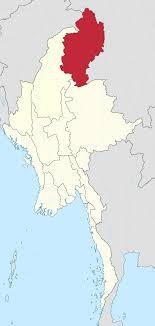
Source: Wikipedia
Today, the KIA controls vast swaths of Kachin State and plays a crucial role in the Spring Revolution of Myanmar (opens in a new tab). They manage overall, rare earth mining permissions and operations, and Chinese companies are allowed to continue existing rare earth and gold operations. But crucially, Zung says, “no new mining licenses are being granted to Chinese companies.” The KIA is asserting environmental control and resisting unchecked Chinese expansion—even as it grapples with the need for revenue to maintain its insurgency. As numerous international media have chronicled, the environmental disaster associated with the rare earth mining operations has been devastating.
The Environmental Cost: Mountains Punctured, Rivers Poisoned
“The Chinese methods are devastating,” Zung says. “Whole mountains are hollowed out. When the rains come, landslides bury farms, poison rivers, and flood villages.” The lack of environmental infrastructure—combined with minimal oversight—means that local communities bear all the externalities while the profits vanish across the border.
Despite this, many of the Chinese companies are “well organized” and operate through sophisticated intermediaries. Ultimately with the implicit (if not explicit) backing of the state—meaning ultimately the Chinese Communist Party.
According to Zung, Beijing directly manages rare earth interests in Myanmar via state-owned and front companies, learning from past backlash to keep operations politically insulated and militarily secure. REEx has already chronicled the anarchic nature of this region—a wild, wild west in the East, and now a dangerous place.
The Civilian Resistance: Bombs from the Sky, Hope on the Ground
Across the country, civilians have risen in protest against the military coup, 2021. The People’s Defense Force (opens in a new tab) (PDF), a citizen militia formed to resist the military junta that seized power in the 2021 coup. It is a key part of the resistance movement against the military junta, which has emerged since 2021—an armed youth-driven resistance born out of despair after peaceful protests were met with bullets.
The junta's response has been brutal. The military operation has carried out a violent nationwide crackdown on millions of people opposed to its rule. For example REEx has learned that junta security forces have carried out mass killings, arbitrary arrests, torture, sexual violence, and other abuses that amount to crimes against humanity.
Intensive airstrikes to indiscriminate assaults on civilians and civilian infrastructure. Communications blackouts, and collective punishment. “Entire regions have had internet, power, and aid cut off,” says Zung. And then there are the bombings of civilians. “These are war crimes.” In many regions, including southern Myanmar near the Thai border, the resistance is gaining ground—but faces a severe asymmetry in firepower, supplied to the junta by Russia and China according to the Myanmar sources.
A Cry for Engagement—Beyond China
Zung’s message to the international community, especially the U.S., India, Japan, and South Korea, is clear: “Support the KIA—not with weapons, but with technology, environmental expertise, and recognition.” The KIA controls key mining territories and could be open to dialogue and potential cooperation—and currently lack alternatives to Chinese capital. REEx reminds all that this part of Myanmar is China’s backyard and any overtures by the U.S. governmentitself could disrupt Chinese trade talks. Beijing continues to wield itsdominance in rare earth processing and magnet manufacturing as a strategic bargaining chip against the United States.
“The U.S. keeps its distance—perhaps because KIA lacks formal status—but if Washington is serious about responsible sourcing, it can’t ignore Kachin State,” points out REEx co-founder and CEO Daniel O’Connor. “KIA wants to build something better. And they know they can’t do it alone.” O’Connor emphasized the importance of human rights, freedom to practice religion—in this case often Christianity– and the legacy of broken promises faced by Myanmar’s rebels.
The KIA is a pivotal force in Myanmar’s Spring Revolution, again fighting to establish a federal union for the entire country. What if somehow, some way, a coalition of nations could support a peace deal and development investment?
Rare Earths, Real Stakes
Myanmar’s rare earth supply is not just a geopolitical chess piece—it is a humanitarian and ecological crisis hiding in plain sight. And with governments the world over sourcing HREEs, this now represents the apex source, at least for now. The KIA’s resistance goes beyond the battlefield—it is a fight for territorial rights, environmental justice, and fundamentally, self-determination.
The Kachin State mines ranking underscores the region’s outsized strategic importance as a supplier of critical inputs for high-tech, defense, and clean energy industries. Much of the world relies on the terbium and dysprosium sourced from these mountainside clays.
At REEx, we also note the fundamental human rights at stake and the fact that many KIA members are Christians.
At REEx, we’ve reported on countless deals, offtakes, and processing breakthroughs. But here in Kachin, the stakes are higher. It’s not just about the market—it’s about whether the global transition to green technology will uplift oppressed peoples or bury them beneath the minerals powering our future.


0 Comments
Discuss this article