
Highlights
- Morgan Stanley forecasts a massive humanoid robot economy with 1 billion robots by 2050, potentially generating $4.7 trillion in annual revenue
- Multiple tech companies like Tesla, Figure AI, and Agility Robotics are actively developing and scaling humanoid robot production, with varying timelines and challenges
- Critical challenges remain in technology, manufacturing, supply chain, and material sourcing
- The humanoid robot revolution is uncertain but potentially transformative
As reported by Rare Earth Exchanges (REEx), investment bank Morgan Stanley ignited debate with a report envisioning 1 billion humanoid robots worldwide by 2050, generating about $4.7 trillion in annual revenue – roughly twice the size of today’s auto industry. This “humanoid economy” scenario implies massive manufacturing scale-up over the next two decades. Crucially, it would also have material implications: Morgan Stanley estimates each human-sized robot could require ~1.3 kg of neodymium-praseodymium (NdPr) for high-performance electric motors, leading to +167% NdPr magnet demand above 2030 levels by 2050. Across all critical minerals (rare earths, battery metals, copper, etc.), humanoid production could drive $50–$120 billion in new annual demand mid-century. The bank even raised its long-term price forecast for NdPr oxide from $135 to $209 per kg in anticipation.
Rare Earth Exchanges (REEx), an industry observer, notes the thesis is compelling but uncertain. The forecast rests on many unproven assumptions (“assumption creep”) that all break favorably. For example, it assumes a rapid, AI-driven adoption of humanoids by the 2030s with minimal changes in design or material composition per unit. REEx questions whether Tesla-like robots can really be mass-deployed by 2035 given no supply chain exists today and the significant technical hurdles remaining.
The geopolitical risk is also flagged: Today, China controls ~74% of refined NdPr supply and over 90% of some heavy rare earths. A Western humanoid boom could mean reliance on Chinese minerals, which the Morgan Stanley report acknowledges but downplays. Moreover, emerging substitute technologies (like new iron-based Fe-N magnets that require no rare earths) could erode long-term demand – a possibility the report largely dismisses. Even if demand does spike, bringing new rare earth mines online is slow (average 17.8-year lead time), raising questions about how supply deficits (up to 35% by 2050 in Morgan Stanley’s own model) would be filled.
Bottom line
Morgan Stanley’s scenario underscores humanoids’ transformative potential for both industry and commodity markets, but REEx urges investors to treat it as a scenario, not a certain forecast. The narrative is “directionally credible but quantitatively aggressive” – a high-stakes hypothesis that needs further validation. In other words, a humanoid revolution could dramatically boost demand for rare earths like NdPr, but the timeline and scale are highly uncertain and contingent on technological and geopolitical variables.
Industry Players and Production Plans
While analysts debate long-term numbers, multiple companies have already begun building humanoid robots, suggesting that early manufacturing is imminent. Here are some notable examples, indicating how quickly (or slowly) humanoid production is ramping up:
- Tesla – “Optimus”: Elon Musk’s Tesla unveiled its Optimus humanoid prototype in 2022 and set an ambitious internal goal of 5,000 units in 2025. So far, reality has lagged ambition: as of mid-2025, Tesla had built only a few hundred Optimus bots (opens in a new tab), far behind schedule. Production bottlenecks (especially developing dexterous hands), leadership turnover, and technical challenges have delayed scaling. Musk now expects limited production of a next-gen Optimus to begin in 2026, and says Tesla will “scale as fast as possible” toward 1 million robots per year within roughly five years – an aspiration he acknowledges is not guaranteed. This pattern is familiar: Tesla often sets bold timelines that slip as engineering reality sets in. Optimus is still in R&D, but Tesla’s continued investment (and claims that humanoids could eventually outsize its vehicle business) shows it is serious about manufacturing robots at scale, even if the timeframe remains uncertain.
Tesla – “Optimus”
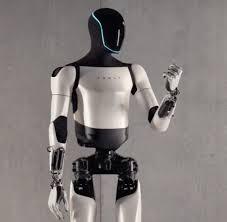
Source: Wikipedia
- Figure AI: (opens in a new tab) A well-funded startup (founded 2022) developing general-purpose humanoids for labor. In early 2025, Figure announced “BotQ,” a dedicated high-volume robot factory, aiming to eventually produce 12,000 humanoids per year once fully ramped. The company is already manufacturing about one robot per week in pilot runs and plans to use robots to build more robots (a virtuous scaling strategy). Figure has secured major partners – e.g., a deal with BMW to test robots in auto production – and as of 2025 it claimed to have a path to ship 100,000 units over the next 4 years by focusing on a few big customers. This is an extremely aggressive ramp, but the backing of investors like OpenAI, Microsoft, and NVIDIA indicates significant confidence in Figure’s vision. If they even come close to 100k units by ~2029, it would mark the first large-scale deployment of humanoids in industry.
- Agility Robotics (opens in a new tab) – “Digit”: Agility, known for its bipedal robot Digit, opened the world’s first purpose-built humanoid robot factory in Salem, Oregon in late 2023 (opens in a new tab). The facility (dubbed “RoboFab”) will employ humans alongside robots and is designed for 10,000+ units per year at full capacity. Initial output will be modest – Agility anticipated a few hundred Digits in 2024, with scale-up toward thousands in subsequent years. The challenge ahead is turning what were essentially hand-built R&D robots into an efficiently manufactured product. Agility openly notes that moving from making dozens of units to thousands “is a vastly different problem”, from supply chain for thousands of actuators to assembly streamlining. They expect to deliver the first Digits to pilot customers by 2024 and offer general availability in 2025. In fact, Agility’s robots have already been tested in real tasks (for example, Amazon began trialing Digit in warehouse operations in late 2024). Agility’s head start in manufacturing infrastructure is a positive sign that humanoid production is ramping up – albeit actual adoption will depend on proving ROI to buyers.
- Apptronik (opens in a new tab) – “Apollo”: (opens in a new tab) Austin-based Apptronik unveiled Apollo in 2023, calling it the “first mass-manufacturable humanoid” in design. Apollo is human-sized (1.7 m, 73 kg) and built with manufacturability and cost in mind from the outset. The company began pilot trials in 2023 and targeted commercial availability by end of 2024. As of its launch, only a handful of Apollo units existed (prototypes and test builds), but Apptronik’s approach is noteworthy: they redesigned actuators and components to be simpler and more modular, avoiding exotic, single-sourced parts, in order to streamline assembly and drive down cost. “A humanoid needs to cost less than $50,000,” says Apptronik’s CEO, noting that at scale the bill of materials could even make robots cheaper than cars (which weigh 25× more). This focus on affordability underscores that cost reduction is key to imminent mass production. Apollo’s makers believe the necessary technology (sensors, batteries, compute) is already available off-the-shelf – the real task is integrating it efficiently and finding the right initial use-cases (they are targeting dull, repetitive jobs like case handling in logistics). If Apollo meets its targets, it could pave the way for truly mass-market humanoids in the coming years.
- Sanctuary AI (opens in a new tab) – “Phoenix” and Others: Several other players worldwide are also pushing the envelope. Sanctuary AI (Canada) introduced its Phoenix humanoid in 2023, focusing on general-purpose dexterity. In a trial, a previous-gen Sanctuary robot successfully performed 110 tasks over a week in a retail store pilot (e.g. stocking shelves, cleaning) as cited in TechCrunch (opens in a new tab) – a small but important proof-of-concept for real-world utility. Sanctuary has not announced a production line yet, but its robots’ inclusion on Time’s Best Inventions of 2023 list shows rising recognition.
Meanwhile, in China, companies like Xiaomi (opens in a new tab) and Zhiyuan Robotics (opens in a new tab) (Agibot) have revealed humanoid prototypes. In 2024, Zhiyuan/Agibot claimed the capacity to produce 1,000 humanoids by year’s end, and China’s government launched a strategic plan to deploy humanoid robots across manufacturing by 2027.
Morgan Stanley indeed noted that China is currently leading in humanoid development, thanks to strong state support and investment. This global competition – U.S. tech giants and startups vs. Chinese initiatives – is accelerating progress. Each new partnership or pilot (whether it’s Mercedes using Boston Dynamics bots on factory floors, or Amazon testing Agility’s Digit) is bringing the era of humanoid manufacturing closer to reality.
Challenges on the Road to Mass Production
Despite impressive headlines and rapid advances in AI, batteries, and computing, the timeline for a true humanoid robot revolution is far from certain. Forecasts promising mass adoption by the 2030s may prove overly optimistic; even Morgan Stanley projects that real acceleration might not occur until the late 2030s after a slow start. Robotics history is littered with examples of delayed breakthroughs, from overhyped self-driving timelines to Tesla’s robotaxi and Optimus programs. Achieving tens of millions of humanoids in operation by 2040 will require dramatic gains in reliability, safety, and cost reduction—milestones that may take longer to achieve outside of controlled environments like labs and pilot programs.
The technical challenges are formidable. Designing one advanced humanoid is hard enough; manufacturing millions that are safe, affordable, and capable of meaningful work is exponentially harder. Core subsystems such as dexterous robotic hands and general-purpose AI “brains” remain in development. Tesla’s own Optimus program reportedly has a stockpile of robots missing functional hands, underscoring the complexity of creating manipulators that balance strength, precision, and cost. Scaling actuators, joints, and power systems while ensuring consistent safety will demand years of testing and refinement. As a result, early humanoids will likely be limited to narrow, repetitive tasks until the technology matures to handle more general and unpredictable workloads.
Even if the technology catches up, scaling production introduces another hurdle: the supply chain. Each humanoid requires dozens of motors, sensors, semiconductors, and high-performance batteries, as well as materials like rare earth magnets, lithium, and cobalt. With China dominating refining of key elements such as NdPr, and new mining projects taking 15+ years to come online, a sudden spike in demand could choke production and drive up costs. Manufacturers are already hedging—Apptronik, for example, is diversifying its component sources and experimenting with alternative materials—while researchers explore rare-earth-free motor designs. Economic viability will hinge on proving a strong return on investment in sectors like warehousing and manufacturing; if robots can consistently deliver productivity gains and cost savings, demand will justify the massive industrial buildout needed. If not, adoption could stall, keeping humanoids in niche roles for far longer than their most enthusiastic backers expect.
Outlook: Promise and Prudence
If engineers crack the code on building affordable, capable humanoids, the economic shockwaves could rival the Industrial Revolution. ARK Invest calls it “the next evolution in automation,” a moment when physical labor finally decouples from economic output. In that scenario, humanoids could plug gaping labor shortages in aging economies, take over dangerous or menial jobs, and create entirely new industries by doing work that humans can’t—or won’t—touch. Morgan Stanley envisions as many as 8 million humanoids in the U.S. by 2040, scaling to 63 million by 2050—labor worth a staggering $3 trillion. Whether those forecasts prove precise or wildly off the mark, they explain why governments are stockpiling critical minerals and companies
Sources: Morgan Stanley Global Insight report on “Humanoids and Global Materials”rareearthexchanges.comrareearthexchanges.com; Rare Earth Exchanges analysis and commentary (May 2025)rareearthexchanges.comrareearthexchanges.com; Quartz/The Information report on Tesla Optimus delaysqz.com (opens in a new tab)qz.com (opens in a new tab); Figure AI announcements (LinkedIn via IoT World Today)iotworldtoday.com (opens in a new tab); Agility Robotics press via IEEE Spectrumspectrum.ieee.org (opens in a new tab)spectrum.ieee.org (opens in a new tab); TechCrunch and company reports on Apollo and Sanctuary AItechcrunch.com (opens in a new tab)techcrunch.com (opens in a new tab); Interesting Engineering on Chinese effortsinterestingengineering.com (opens in a new tab)interestingengineering.com (opens in a new tab); and additional industry news sources as cited above.


0 Comments