
- Pensana Plc is developing the Longonjo rare earth project in Angola as the upstream foundation of a Western supply chain, targeting first production in 2027 with initial output of 2,400 tonnes NdPr annually, scaling to 4,200 tonnes by 2030.
- The project leverages the Lobito Corridor for trans-Atlantic logistics, enabling shipment of concentrate from Angola's interior to U.S. processing facilities and downstream magnet manufacturers.
- Pensana's strategy aims to create an integrated mine-to-magnet ecosystem linking Angolan mining, U.S. separation technology via ReElement, and American manufacturers serving defense, EV, and technology sectors—reducing dependence on Chinese dominance.
Pensana Plc (LSE: PRE (opens in a new tab)) is positioning its Longonjo rare earth project in Angola as the upstream cornerstone of a Western rare earth supply chain designed to serve U.S. industry. In recent investor communications, the company outlined a strategy to connect one of the world’s largest undeveloped rare earth deposits with a growing network of U.S. magnet manufacturers and advanced materials companies—an effort aimed at building a mine-to-magnet ecosystem less dependent on Chinese processing and manufacturing dominance.
At the center of Pensana’s strategy is the Longonjo rare earth deposit, located in Angola’s Huambo province. The company describes Longonjo as one of the largest undeveloped rare-earth resources globally, with ongoing exploration targeting a potential resource of approximately 1 billion tonnes. Construction of the mine and processing facility is advancing, with first production currently targeted for 2027.
Initial production is expected to reach approximately 2,400 tonnes per year of NdPr (neodymium-praseodymium oxide)—the key magnet material used in electric vehicles, wind turbines, and advanced electronics—along with about 73 tonnes per year of dysprosium and terbium. The company plans to scale output to roughly 4,200 tonnes of NdPr and 122 tonnes of Dy/Tb annually by 2030, positioning Longonjo as a significant future supplier of both light and heavy rare-earth elements.
A key element of the project is logistics. Pensana intends to ship concentrate through the Lobito Corridor, a rail-and-port infrastructure route linking Angola’s interior mining region to the Port of Lobito on the Atlantic coast, enabling export to downstream processing facilities.
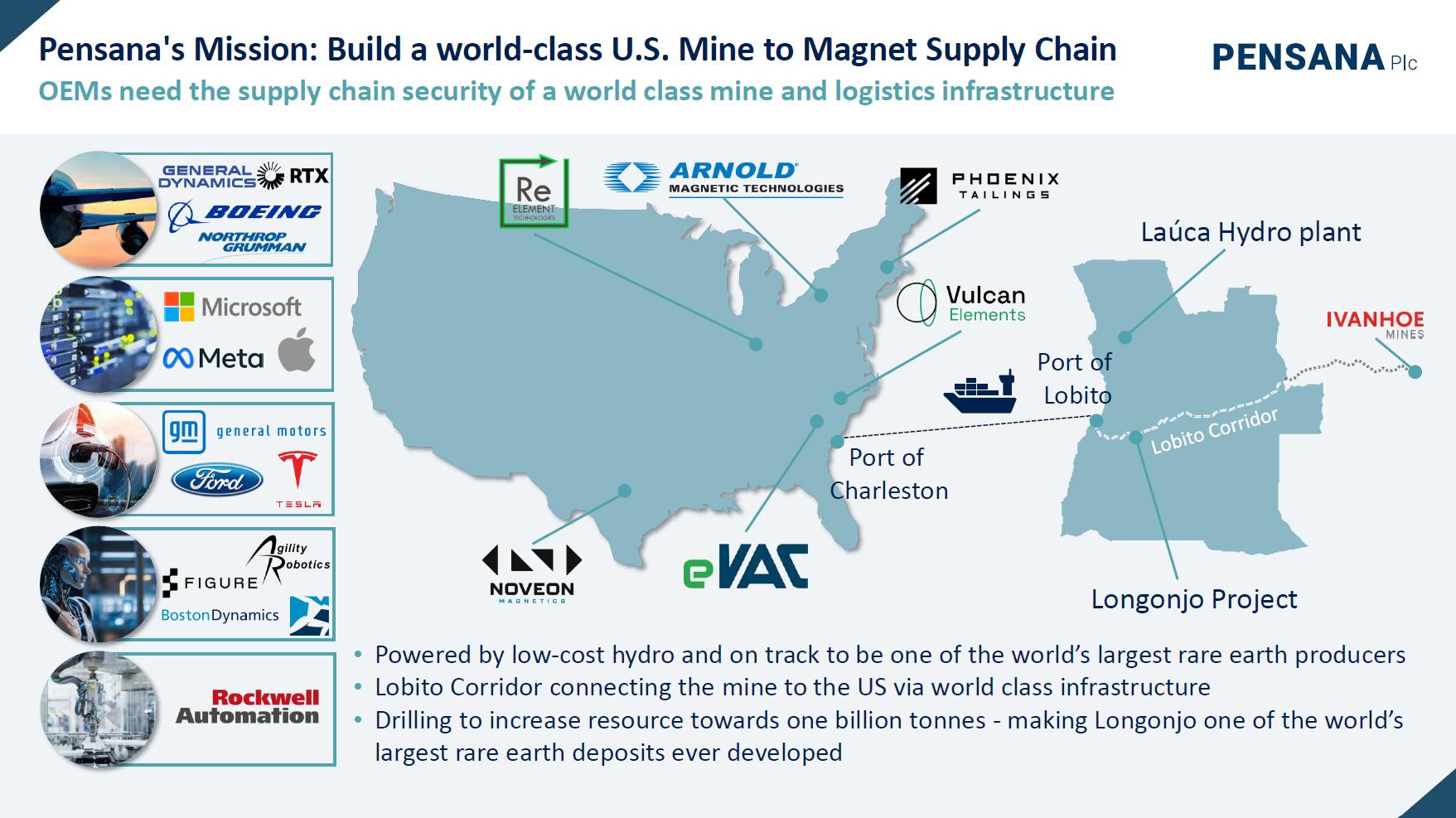
In the United States, Pensana has highlighted potential collaboration with ReElement Technologies, which is developing rare earth separation capacity using chromatographic technology. The company’s broader vision also includes partnerships with U.S. magnet manufacturers and advanced materials companies serving defense, electric vehicle, robotics, and technology sectors.
If realized, Pensana’s approach would link Angolan mining, trans-Atlantic logistics, U.S. separation technology, and American magnet manufacturing into a single integrated supply chain—one aligned with Western policy efforts to diversify rare earth supply and reduce strategic dependence on China.
Of course, much of the future now depends on execution.


2 Comments
2 replies
Loading new replies...
New member
New member
Join the full discussion at the Rare Earth Exchanges Forum →