
Highlights
- U.S. Strategic Metals signed a $500M investment deal with Pakistan's Frontier Works Organization to develop critical minerals.
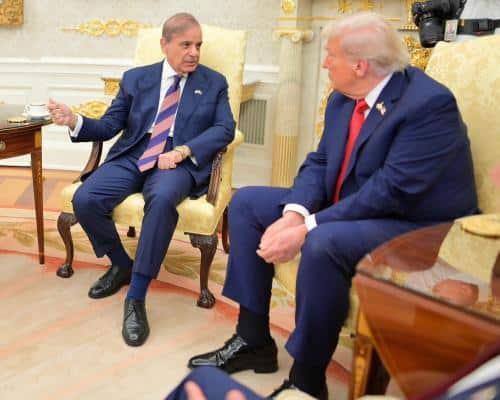
- A high-level White House meeting took place between President Trump, Pakistan's PM Shehbaz Sharif, and Army Chief Field Marshal Asim Munir, focusing on potential economic collaboration.
- The minerals deal represents a strategic move towards diversifying rare earth supply chains away from China, though the current project remains in early stages.
Yes, a high-level White House meeting happened on Sept. 25 between President Trump and Pakistan’s PM Shehbaz Sharif, joined by Army Chief Field Marshal Asim Munir—Reuters and AP both confirm the engagement and the investment pitch to U.S. firms. Separately (earlier in September), U.S. Strategic Metals signed a $500m investment deal with Pakistan’s Frontier Works Organization to develop critical minerals, with language that explicitly includes rare earth elements and a plan for a poly-metallic refinery.
Where the Fog Rolls In
News18’s “exclusive” (opens in a new tab) claims of a forthcoming “comprehensive agreement” spanning security, a “Joint Counter-Terrorism Command,” and rare earths lack corroboration in major wire readouts or official communiqués; they largely trace back to anonymous sources and amplification by affiliated outlets. Treat these as unconfirmed until a text or joint statement appears.
Some Reality Checks
References to discussions about Bagram Air Base and wider Afghanistan logistics appear in commentary and secondary reports, but the Taliban publicly rejected any U.S. return to Bagram—context that makes sweeping basing or logistics claims look speculative. Trump-era talk of “massive” Pakistan oil and minerals deals is also contested; independent analyses warn of political theater and thin geology for big oil, even as minerals MOUs advance.
Spin Watch
The piece leans on anonymous “top sources,” presents an “exclusive” narrative arc, and interlaces security breakthroughs with minerals headlines—classic signals of agenda-setting rather than verifiable deliverables. Compare this with wire-service language that’s more restrained on specifics and careful with attributions.
Why this matters for REE supply chains
The $500m USSM deal is real and minerals-focused—but Pakistan’s REE baseline is immature (geology is promising in places, yet projects are early), security risks remain acute (notably in Balochistan), and midstream separation/refining capacity would have to be built nearly from scratch. Expect progress via pilot exports and processing studies long before any magnet-grade REE supply shifts. Net-net: signal, not yet substance, but it fits Washington’s broader diversification away from China.
REEx verdict
Track documents, not whispers: (1) published agreement text, (2) refinery site/CapEx and environmental approvals, (3) named deposits and volumes, (4) REE-specific offtakes, (5) security guarantees on corridors. Until then, label sweeping “comprehensive” claims as provisional.
Selected sources: News 18, Reuters, AP, Guardian analysis, and AP/industry reports on the USSM deal.
Latest reporting on US–Pakistan minerals & security
©!-- /wp:paragraph -->


0 Comments
Discuss this article