
- Rare earth processing generates radioactive waste (TENORM) from uranium and thorium, creating regulatory and financial challenges that often determine project viability beyond metallurgy.
- U.S. regulatory classification hinges on whether ore is processed "primarily" for uranium/thorium, creating a fragmented oversight landscape across NRC, EPA, and state agencies.
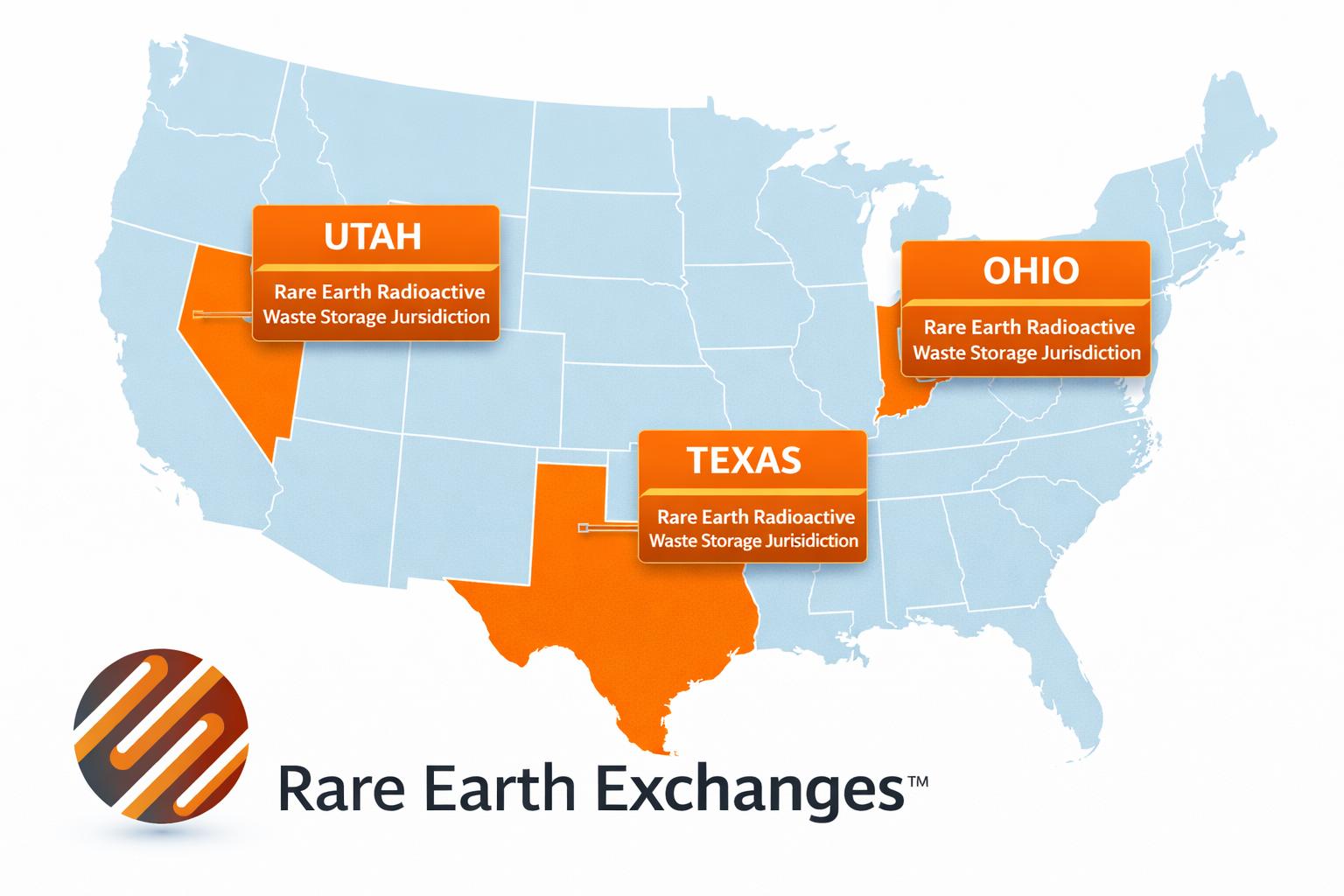
- Utah, Texas, and Ohio provide critical disposal infrastructure and clear regulatory frameworks, making waste management capability as strategically important as ore deposits themselves.
Rare earths are sold to the public as the metals of the future: the hidden force inside EV motors, wind turbines, precision weapons, and the electrified economy as a whole. That story is true. But it is not the whole story. Many rare earth deposits arrive with troublesome fellow travelers—uranium and thorium—and once processing begins, those companions can become the most important variables in the economics of the entire project. The Environmental Protection Agency (EPA) states plainly that rare earth processing often separates and removes uranium and thorium, generating Technologically Enhanced Naturally Occurring Radioactive Materials (TENORM) wastes. In this business, the glamour is in the magnet. The risk is often in the residue.
Where the Chemistry Turns Political
Geology sets the trap. Processing springs it.
Monazite and many xenotime-bearing systems commonly carry elevated thorium and uranium. USGS reports that monazite concentrates may contain about 3% to 14% thorium dioxide by weight, and in some geologic settings even more.
Bastnäsite systems are often less radioactive, but lower is not the same as irrelevant. Once ore is cracked, leached, precipitated, and refined through hydrometallurgical circuits, radionuclides can be pushed into tailings, filter cakes, sludges, and other waste streams. That is why regulators care less about marketing language around “clean energy minerals” and more about where the thorium and uranium end up.
For investors, this is where chemistry becomes finance. Radioactive residues can mean higher capex, more complex water and tailings controls, tougher closure obligations, and a permitting calendar that stretches far beyond the original mine plan.
America’s Regulatory Maze
In the United States, the key legal hinge is classification.
The NRC states that ores containing 0.05% or more uranium, thorium, or any combination by weight are “source material.” But a rare earth plant is not automatically treated like a uranium mill. The stricter 11e.(2) regime (opens in a new tab) applies to tailings or waste produced by the extraction or concentration of uranium or thorium from ore processed primarily for its source-material content. That single word—primarily—matters enormously. It can determine whether a project falls into a more conventional mining-and-environmental framework or into the much stricter long-tail stewardship world of uranium-mill regulation.
Complicating matters further, TENORM oversight in the U.S. is fragmented. EPA recognizes TENORM as a complex, multi-industry problem, and the broader low-activity radioactive waste landscape has evolved into what the National Academies describe as a regulatory patchwork. In practice, developers may face overlapping authority from the NRC or Agreement States, EPA hazardous-waste rules, state environmental permitting agencies, and DOT transport rules.
The Real Bottleneck: Where Does the Waste Go?
This is the question that quietly kills projects. A separation circuit may work beautifully on paper. A deposit may be rich. Offtake may even be plausible. But if developers cannot show regulators where thorium-bearing or uranium-bearing residues will go, the project can stall regardless of metallurgical elegance.
That is why Utah, the home state of Rare Earth Exchanges,™ matters so much.
Utah DEQ says the EnergySolutions Clive facility (opens in a new tab) is licensed to handle Class A low-level radioactive material, NORM, mixed waste, and uranium/thorium by-product material. That does not mean every rare-earth residue can simply be dropped at the gate; acceptance depends on waste form, license conditions, packaging, and site-specific criteria. But it does mean Utah offers one of the clearest commercial disposal pathways in the country for several radioactive waste classes relevant to rare earth processing. In a sector full of permitting ambiguity, that is, strategic infrastructure.
Texas is the other major American node. The Texas Commission on Environmental Quality and the Texas Department of State Health Services anchor a mature radiation-control environment (opens in a new tab), and Waste Control Specialists advertises treatment, storage, and disposal capabilities for LLRW, mixed waste, NORM/TENORM, hazardous waste, and byproduct material. Texas also brings decades of uranium regulatory experience, which matters because regulatory familiarity often reduces friction even when the chemistry is difficult.
Ohio, while not as nationally prominent as Utah or Texas in disposal infrastructure, deserves attention for a different reason: institutional fluency. Ohio’s TENORM framework is explicit in Chapter 3701:1-43 of the Administrative Code (opens in a new tab), which governs possession, processing, licensing, transfer, and disposal of TENORM. For rare-earth developers, that kind of preexisting rulebook is often better than a blank stare from regulators.
The Strategic Bottom Line
The rare earth supply chain is not just a chain of mines, refineries, and magnets. It is also a chain of tailings cells, disposal licenses, transport permissions, and long-term stewardship obligations.
That is the part too many headlines ignore.
In rare earths, metallurgy determines recovery. But radioactive waste management determines whether the project can be permitted, financed, insured, and scaled. The jurisdictions with the clearest advantage are not merely those with ore. They are the ones with rules, repositories, and regulators that know what they are looking at.
The future of ex-China rare earth capacity will be decided not only in flotation cells and solvent extraction banks, but in a harder, less glamorous place: the waste endgame.


0 Comments
No replies yet
Loading new replies...
Moderator
Join the full discussion at the Rare Earth Exchanges Forum →