
- China Rare Earth Group and China Nuclear Uranium Industry held strategic talks on March 12 to coordinate monazite resource utilization, combining rare earth extraction with nuclear-material management capabilities that Western competitors struggle to replicate due to regulatory and radioactive waste challenges.
- The meeting focused on comprehensive monazite utilization—a complex phosphate mineral containing light rare earths plus thorium and uranium—highlighting China's unique industrial advantage in processing radioactive rare earth ores that remain underutilized globally.
- Both state-owned enterprises discussed expanding cooperation through joint R&D, technology commercialization, and talent exchange, reinforcing China's structural advantage in strategic mineral processing and supply chain control.
China Rare Earth Group held a working meeting on March 12 with China Nuclear Uranium Industry Co., Ltd (opens in a new tab)., signaling deeper coordination between two of China’s most strategically important state-owned resource companies. The meeting brought together Liu Leiyun, Party Secretary and Chairman of China Rare Earth Group, and Yuan Xu, Party Secretary and Executive Director of China Nuclear Uranium Industry. Senior executives from affiliated mining and resource subsidiaries also participated.
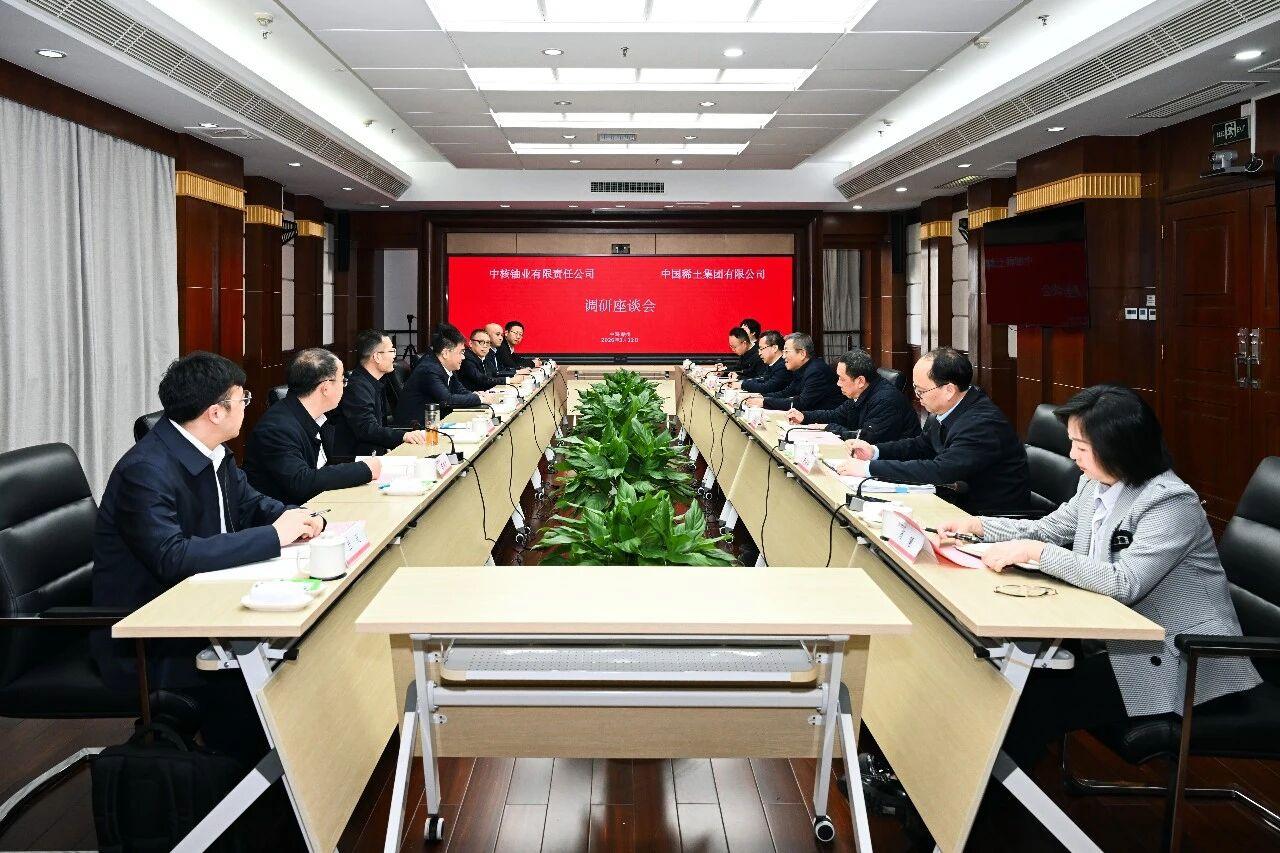
According to the official readout, discussions focused on monazite resource utilization, technology cooperation, and expanded industrial coordination between China’s rare earth and nuclear-resource sectors. No commercial agreements were announced, but the topic itself—monazite—makes the meeting notable.
The Monazite Advantage: Where Rare Earths and Radioactive Minerals Intersect
A key theme in the discussions was the “comprehensive utilization of monazite.”
Monazite is a phosphate mineral that hosts light rare earth elements such as cerium, lanthanum, and neodymium, but it also contains thorium and occasionally uranium, which complicates extraction and refining.
Because of these radioactive components, many Western mining projects avoid or restrict monazite processing due to regulatory hurdles, environmental concerns, and radioactive waste handling requirements. China, however, has spent decades developing industrial capabilities to process rare earth ores that contain radioactive elements, often integrating rare earth extraction with institutions experienced in handling nuclear materials.
China Nuclear Uranium Industry—part of the broader China National Nuclear Corporation (CNNC) system—plays a central role in the country’s uranium exploration, mining, and radioactive mineral management. The collaboration, therefore, points to a potential industrial advantage in processing complex rare earth ores that other jurisdictions struggle to develop.
State Coordination in Strategic Minerals
During the meeting, Liu emphasized China Rare Earth Group’s ongoing efforts in industrial consolidation, resource expansion, technological innovation, and national strategic mineral security.
Both sides discussed expanding cooperation in several areas:
- Monazite resource utilization
- Joint research and development
- Technology transfer and commercialization
- Talent exchange and technical collaboration
- Joint project development
Yuan Xu highlighted the two organizations’ existing cooperation base and called for deeper industrial and technological integration to support China’s rare earth industry and broader national energy security goals.
Why Western Supply Chains Should Pay Attention
While the meeting produced no immediate project announcements, it reflects a broader pattern in China’s resource strategy: tight coordination between geological research, state-owned mining companies, and strategic industrial sectors. The focus on monazite is particularly noteworthy. Globally, large volumes of monazite remain underutilized or treated as waste streams because of radioactive content.
China’s ability to combine rare-earth processing expertise with nuclear-material management capabilities may allow it to economically exploit resources that Western supply chains struggle to develop.
If that capability expands, it could quietly reinforce China’s structural advantage in rare earth processing and supply.
Source Transparency Notice: This report originates from media affiliated with Chinese state-owned enterprises and industry associations. The information reflects official communications and should be independently verified before being relied upon for investment or policy decisions. See the Association of China Rare Earth Industry (opens in a new tab).


0 Comments
No replies yet
Loading new replies...
Moderator
Join the full discussion at the Rare Earth Exchanges Forum →