
Highlights
- China and South Korea convened their 5th Ministerial Dialogue on Industrial Cooperation in Beijing on March 18, 2026, focusing on semiconductors, lithium batteries, green manufacturing, and aging-related industries, with both nations emphasizing deep supply chain interdependence despite geopolitical tensions.
- China prioritized stabilizing foreign investment and expanding high-tech cooperation, while South Korea took a pragmatic approach to preserve economic ties while managing supply chain risks, resulting in agreements to strengthen policy coordination but no major commercial breakthroughs.
- The dialogue underscores the durability of East Asian industrial integration, particularly in critical sectors like semiconductors and EV batteries, revealing limits to decoupling strategies as both nations navigate shared challenges including climate transition and demographic pressures.
On March 18, 2026, China and South Korea convened the 5th Ministerial Dialogue on Industrial Cooperation in Beijing, bringing together China’s Minister of Industry and Information Technology, Li Lecheng (opens in a new tab), and South Korea’s Minister of Trade, Industry and Energy, Kim Jung-kwan (opens in a new tab). Discussions centered on semiconductors, lithium batteries, green industrial development, and the “silver economy” (aging-related industries).
Chinese officials characterized the meeting as an implementation step following recent leader-level engagements, emphasizing that bilateral industrial ties are already highly integrated, complementary, and embedded in global supply chains.
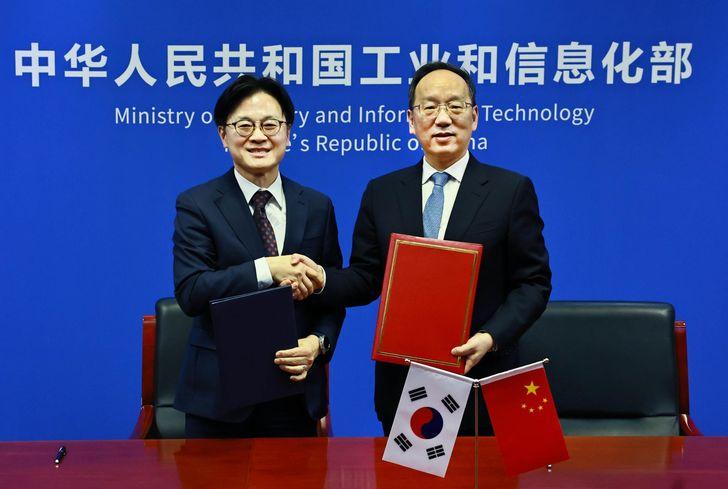
Source: Korea Times
China’s Position: Stabilize and Deepen Industrial Integration
Li Lecheng outlined three priorities:
- Capture strategic opportunities by expanding cooperation in high-tech and emerging industries
- Advance practical collaboration in key sectors, including semiconductors, EV batteries, green manufacturing, and aging-related industries
- Improve the investment environment, signaling that China will continue to support foreign enterprises—including South Korean firms—operating and investing in China
The language reflects a consistent policy objective: maintain foreign industrial participation within China’s manufacturing ecosystem, particularly in advanced sectors.
South Korea’s Position: Interdependence with Guardrails
Kim Jung-kwan reaffirmed that China and South Korea are critical trade partners with tightly linked industrial supply chains, driven by longstanding commercial cooperation.
He highlighted shared structural challenges:
- Climate transition and industrial decarbonization
- Demographic pressures, including aging populations and low birth rates
- Global economic uncertainty
South Korea’s framing suggests a pragmatic approach—preserving economic cooperation while navigating broader geopolitical and supply chain risks.
Concrete Outcomes: Coordination, Not Breakthroughs
Following the dialogue, both sides signed the official meeting minutes, agreeing to:
- Strengthen policy coordination and ministerial-level exchanges
- Explore cooperation in emerging and future industries
- Protect the legitimate commercial interests of enterprises
- Support the stability of global industrial and supply chains
The parties also confirmed that the 6th ministerial dialogue will take place in South Korea in 2027.
Notably, no binding commercial agreements or major new initiatives were announced.
Strategic Implications: A Quiet Countercurrent to Decoupling
While incremental in form, the meeting carries broader implications:
- Semiconductors and batteries: South Korea remains a central player in U.S.-aligned supply chains. Continued engagement with China underscores the limits of full “friend-shoring.”
- Supply chain strategy: China is signaling continuity—prioritizing integration over decoupling, even amid geopolitical tension.
- Next-generation industries: Green tech and aging-related sectors are emerging as new arenas of competition and collaboration in East Asia.
Bottom line: This was not a breakthrough event—but it reinforces a persistent reality: deep industrial interdependence in Asia is proving more durable than political narratives of separation.
Disclaimer: This report is based on information released by a Chinese government-affiliated industry source. While likely directionally accurate, key details and interpretations should be independently verified through third-party or international reporting.


0 Comments
No replies yet
Loading new replies...
Moderator
Join the full discussion at the Rare Earth Exchanges Forum →