
Highlights
- The US is pursuing Brazil for critical minerals access, targeting rare earths and lithium through both federal discussions and a direct agreement with Goiás state, home to the Serra Verde operation.
- Early execution shows friction: draft proposal errors, absent Brazilian federal officials at US forums, and concerns that state-level deals may bypass national coordination necessary for long-term investment stability.
- While strategically sound, replicating China's integrated rare earth system (60% mining share, 85–90% refining control) requires more than bilateral agreements—success depends on aligned federal policy and sustained industrial execution.
The United States is in discussions with Brazil to secure access to critical minerals—rare earths, lithium, and others—while simultaneously advancing a separate agreement with Brazil’s Goiás state. Rare Earth Exchanges™ suggests that Washington is seeking to reduce reliance on China by partnering with Brazil, but early efforts show signs of uneven coordination between diplomacy and execution.
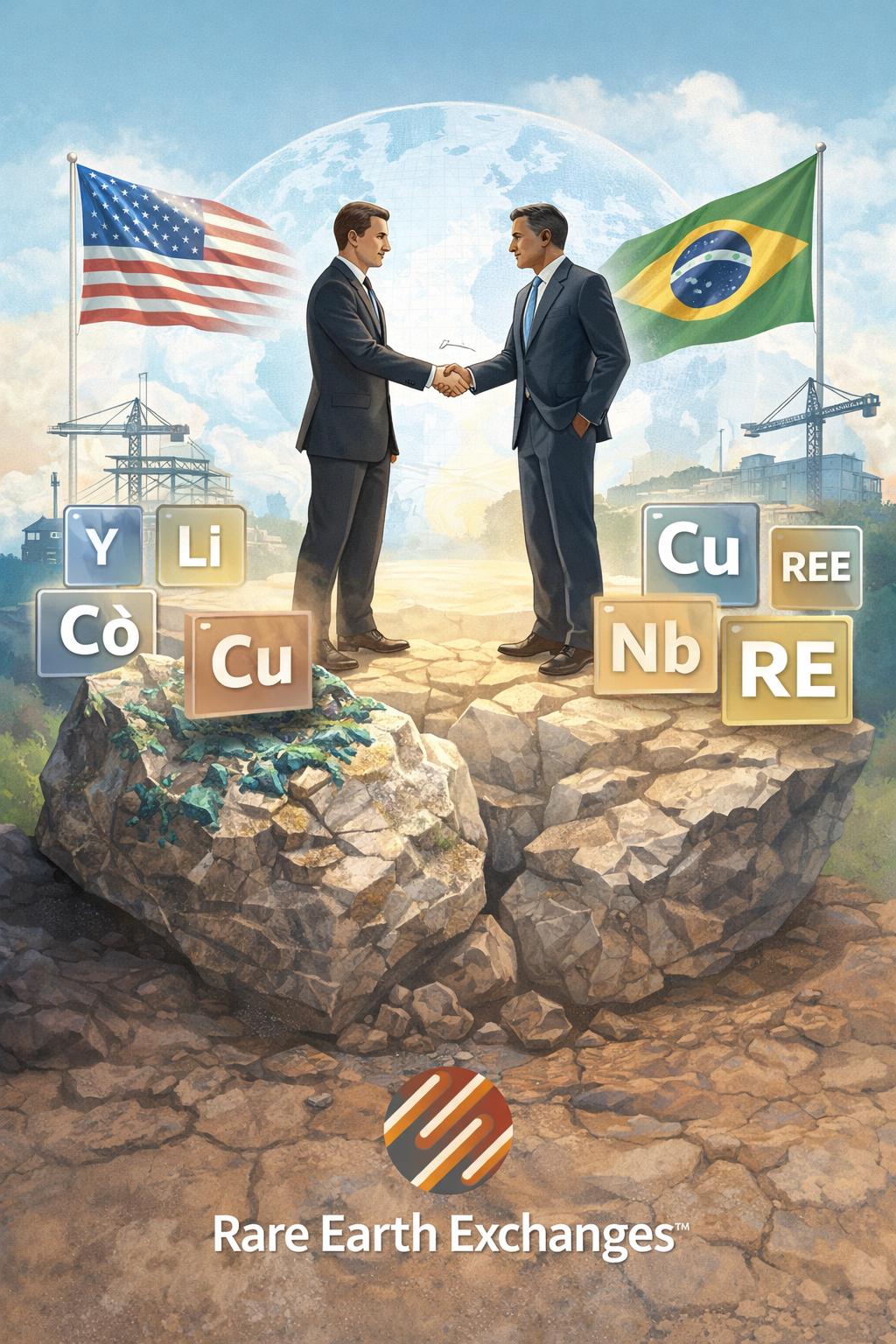
Ground Truth: What’s Real and Material
There is certainly real substance behind the headlines via Reuters (opens in a new tab) and other media. Goiás is not speculative—it is home to Serra Verde, one of the few commercial rare earth operations outside China.
Brazil’s broader relevance is also clear:
- Significant reserves of lithium, niobium, and rare earth elements
- More than 50 identified mining projects with development potential
- Approximately $600 million has already been deployed by U.S. institutions (DFC and EXIM)
Importantly, the Goiás agreement includes ambitions for rare earth separation—the most critical and capital-intensive step in the value chain. Mining alone does not confer control; processing does.
Execution Questions: Early Friction Points
However, the rollout highlights challenges:
- Reports of a draft proposal error in early U.S. communications
- Absence of Brazilian federal officials at a U.S.-backed forum
- Perception that the Goiás agreement may circumvent national-level alignment
These issues matter. Critical mineral supply chains require policy stability, regulatory clarity, and federal coordination. Without alignment in Brasília, long-term investment confidence may be constrained.
China’s Enduring Advantage: System, Not Just Scale
The reporting correctly cites China’s position but underplays its structure:
- ~60% share of global rare earth mining
- ~85–90%+ control of refining and separation capacity
China’s advantage lies in its integrated system—mining, processing, pricing, and downstream manufacturing. Replicating that system requires more than bilateral agreements; it demands sustained, coordinated industrial policy.
Investor Take: Strategic Potential, Early-Stage Reality
The strategic logic is sound. Localizing processing in Brazil could:
- Establish a non-China rare earth separation foothold
- Anchor a Western-aligned supply chain node in South America
But at present, this remains early-stage engagement with execution risk.
Directionally Right, Operationally Incomplete
The United States is moving in the right direction—Brazil is a credible partner, and Goiás is a meaningful entry point. But success will depend on alignment across federal policy, capital deployment, and industrial execution.
In rare earths, coordination—not intent—determines outcomes. China’s advantage remains systemic.


0 Comments
No replies yet
Loading new replies...
Moderator
Join the full discussion at the Rare Earth Exchanges Forum →