
Highlights
- Samarium ranks #1 out of 84 minerals for potential GDP impact under supply disruption at $4.5 billion, driven by its indispensable role in guided missiles and space systems despite being abundant and low-cost.
- China dominates the critical samarium supply chain with 90%+ control of refining and 95–98% of magnet manufacturing, creating a strategic chokepoint in defense systems that rely on samarium-cobalt magnets for extreme-condition reliability.
- The real vulnerability is processing capacity, not geology—until the West builds scaled separation, alloy manufacturing, and defense-qualified supply chains, samarium remains a single point of failure in advanced weapons systems.
Samarium is not scarce, nor is it expensive. Yet it ranks among the most strategically exposed materials in the U.S. economy. A 2025 U.S. Geological Survey (USGS) model (opens in a new tab) placed samarium #1 out of 84 minerals for potential GDP impact under supply disruption—estimated at $4.5 billion—driven largely by dependence on guided missile and space systems.
This is the paradox: samarium is economically “small,” but militarily indispensable.
The Defense Logistics Agency reinforces this reality. Its FY2025 materials plan (opens in a new tab) includes 60 metric tons of samarium-cobalt (SmCo) alloy, a direct signal that U.S. defense planners view samarium not as optional—but as mission-critical.
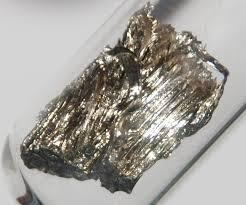
The Real Bottleneck: Processing, Not Geology
Samarium is relatively abundant and globally distributed. The vulnerability lies elsewhere.
The defense-critical pathway is:
Ore → oxide → metal/alloy → magnet → weapon system
The chokepoint is not mining—it is separation, refining, and magnet manufacturing.
China dominates this chain:
- ~70% of mining
- ~90%+ of refining
- ~95–98% of magnet production
This means even “non-Chinese” supplies often route through Chinese-controlled processing systems before reaching defense applications.
Compounding risk, China expanded export controls in 2025 to include samarium compounds, oxides, and alloys, formalizing what had already been structural leverage.
Why Defense Systems Depend on Samarium
The strategic importance of samarium comes down to one material class:
Samarium-Cobalt (SmCo) Magnets
These magnets are not the strongest—but they are often the most reliable under extreme conditions.
Key properties:
- High temperature stability (up to ~300°C+)
- Exceptional resistance to demagnetization (high coercivity)
- Strong corrosion resistance
- Long-term magnetic stability under stress and radiation
In defense systems, these are not “nice-to-have” traits—they are qualification requirements.
Where SmCo Shows Up in Weapons Systems
Public defense sources consistently point to SmCo use in:
- Missile guidance and fin actuators
- Jet engines and turbine-adjacent systems
- Radar and sonar systems
- Satellite communications
- Inertial navigation systems
- Traveling-wave tubes (TWTs) for electronic warfare
These are high-reliability environments where failure is unacceptable.
A single F-35 fighter jet reportedly contains tens of pounds of samarium-based magnets, underscoring the scale mismatch: tiny inputs, massive system dependency.
Why Substitution Is Hard
Neodymium magnets (NdFeB) dominate commercial markets—but they degrade under heat and require complex stabilization (often involving heavy rare earths like dysprosium).
SmCo magnets are used where:
- Temperature margins are tight
- Systems are sealed or inaccessible
- Long-duration stability is required
In these environments, substitution is not just technical—it is programmatic, requiring redesign, requalification, and certification. That can take years.
Lynas: Progress, But Not Yet a Solution
Lynas Rare Earths recently produced its first samarium oxide outside China at its Malaysia facility.
This matters—but not for the reason headlines suggest.
Samarium itself is not the prize. The real signal is:
Lynas is advancing separation capability—the true bottleneck.
However, key gaps remain:
- No disclosed production volumes
- Limited downstream alloy and magnet capacity outside China
- Long timelines for full qualification in defense systems
In short, oxide production does not equal supply chain independence
The Core Insight: Samarium Is a Leverage Material
Samarium’s risk profile looks irrational—until viewed through a defense lens.
- It is low cost → easy to overlook
- It is technically specific → hard to substitute
- It is processing-concentrated → easy to control
That combination creates leverage.
China does not need to dominate rare earth mining to exert pressure. Control of refining and magnet manufacturing is sufficient.
Bottom Line
Samarium is not about scarcity. It is about reliability under extreme conditions—and who controls the ability to deliver it.
Until the West builds:
- Scaled separation capacity
- Alloy and magnet manufacturing
- Defense-qualified supply chains
Samarium will remain a quiet—but very real—single point of failure in advanced weapons systems.


0 Comments
Discuss this article