
Highlights
- Neo Performance Materials beat 2025 Adjusted EBITDA guidance and is advancing one of Europe’s few integrated rare earth platforms, combining refining with magnet manufacturing, supported by strategic partnerships like the Bosch MOU.
- The company operates critical midstream separation in Estonia (Silmet) and opened its Narva permanent magnet facility in September 2025, positioning it as a key non-China player in securing Western supply chains for defense, EVs, and advanced manufacturing.
- Despite strategic progress, execution risks remain: Q4 2025 revenue and operating income fell, full-year operating cash flow was negative $54M, inventories surged to $205M, and the Estonia buildout requires successful customer qualification and ramp-up in 2026 to justify elevated valuations.
What do Neo Performance Materials’ latest results mean for retail investors? The good news is real: Neo beat its 2025 Adjusted EBITDA guidance and is advancing one of the few rare earth platforms in Europe that combines downstream refining with magnet manufacturing. The caution is real too. Fourth-quarter revenue and operating income weakened, operating cash flow was negative for 2025, inventories rose sharply, and the Estonia growth story still depends on qualification, ramp-up, and customer conversion in 2026. In plain English: the strategy looks credible, but the execution still needs to prove itself.
An Important Player
Neo Performance Materials is strategically important because it sits at the most critical—and most constrained—part of the rare earth supply chain: midstream refining and downstream magnet production outside China. While many companies focus on mining, Neo operates separation capabilities in Estonia (Silmet) and is advancing permanent magnet manufacturing in Europe, positioning it as one of the few non-China players capable of converting rare earth oxides into high-value end products. This matters for defense, EVs, and advanced manufacturing, where secure, localized supply chains are now a policy priority across the U.S. and Europe. In short, Neo is not just a materials company—it is part of the emerging Western infrastructure needed to reduce dependence on China’s ~90% dominance in processing and magnet manufacturing.
Neo’s Europe Strategy Has Substance
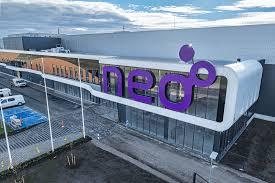
Neo reported full-year 2025 Adjusted EBITDA of $75.6 million, above guidance, while continuing to build its Europe-based rare earth supply chain. Its permanent magnet facility in Narva, Estonia (opens in a new tab) opened in September 2025, and the company says its Silmet operation is advancing a heavy rare earth separation line expected to produce dysprosium and terbium in 2026. Neo also signed a multi-year MOU with Bosch, reserving magnet capacity, reinforcing that downstream customer interest is not imaginary. Strategically, that matters: Europe needs both magnet capacity and refining capability, and Neo is one of the few listed companies trying to provide both.
Magnet Facility in Narva
The Promotion Gap Investors Should Not Ignore
The company’s press release is directionally positive, but it leans heavily on non-IFRS measures and optimistic language. The harder facts are more mixed. Q4 2025 revenue fell to $120.3 million from $134.9 million a year earlier, while operating income fell to $5.6 million from $12.4 million. For the full-year 2025, operating cash flow was a $54.0 million outflow. Inventories climbed to $205.4 million from $139.3 million, cash fell to $38.4 million from $85.5 million, and gross debt rose to $101.8 million from $71.5 million. None of that invalidates the strategy, but it does mean the Europe buildout is still being financed ahead of full proof at scale.
Review of Yahoo Finance
The company currently trades around C$20.47, implying a market cap of approximately C$851 million and an enterprise value of about C$896 million, reflecting strong share appreciation over the past year (+120%+). On a trailing basis, valuation remains elevated at 22x EV/EBITDA and a high P/E of ~82x, though the forward P/E compresses to ~25x, indicating market expectations of earnings normalization. Revenue stands near $493 million (TTM) with modest growth (9.8% YoY), while profitability remains mixed: operating margin ~6.8%, but net income slightly negative (-$6.4M TTM) and EPS -$0.22.
Balance sheet metrics are stable but tightening—cash $61M vs. debt ~$94M, with a manageable 23% debt-to-equity ratio and solid liquidity (current ratio 2.24). Cash flow is the key watch point: operating cash flow remains negative (-$4.1M TTM), though levered free cash flow is positive ($32M), suggesting working capital and investment timing effects. Technically, the stock shows strength—trading above its 50-day (C$22.09) and 200-day (C$18.12) averages recently, though off highs (~C$29.57). Neo is priced for execution, with improving revenue and strategic positioning, but profitability consistency and cash conversion remain critical for sustaining valuation.
REEx Investor Take
Our view: the strategic story we know is credible, but not yet fully de-risked. Neo is building something Europe and the United States badly need. The unanswered questions are volume, timing, qualification, and cash conversion. Until those are answered, this remains a promising downstream rare earth platform—not a finished winner.


0 Comments
No replies yet
Loading new replies...
Moderator
Join the full discussion at the Rare Earth Exchanges Forum →