
Highlights
- POSCO International is investing in heavy rare earth refining across Malaysia, Laos, and the U.S., targeting 10,000+ tons annually, but remains entangled with Chinese feedstock and processing networks despite geographic diversification.
- The company's multi-pronged strategy spans the full supply chain—from refining partnerships with ReElement Technologies to magnet production and recycling—aiming to replicate China's vertically integrated model.
- POSCO's transition from steel giant to critical minerals player is backed by a $17.4B market cap and substantial cash flow, but faces margin pressure and heavy reinvestment demands in battery materials and processing capacity.
POSCO International is investing across Asia and the U.S. to secure heavy rare earths—especially dysprosium and terbium—and build an EV magnet supply chain. Plans include refining in Malaysia and Laos, a U.S. facility with ReElement Technologies, and downstream magnet production. It sounds like independence. It isn’t—yet.
The Strategy: Scale Meets Urgency
POSCO targets ~4,500 tons of refined material annually in Southeast Asia, scaling to 10,000 tons, alongside 3,000-ton U.S. refining and magnet capacity. This aligns with Western goals: diversify supply, localize production, and reduce China's exposure.
This is real progress.
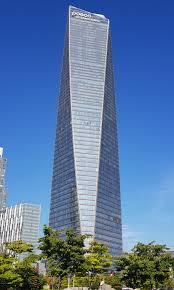
POSCO International HQ
The Fault Line: Geography ≠ Control
But location is not sovereignty. Laos and Malaysia remain deeply intertwined with Chinese feedstock, processing know-how, and commercial networks. Even ex-China refining can sit inside China’s broader system.
Diversification, yes. Detachment, no.
Signals vs Story
Credible: scarcity of heavy rare earths; processing as the bottleneck; POSCO’s aggressive positioning.
Speculative: near-term independence; scalable magnet production outside China; clean supply chain separation.
Why ItMatters: Processing Is Power
Heavy rare earth separation remains the hardest industrial hurdle. Until that shifts, magnet dominance—and EV leverage—stays constrained. POSCO is building something meaningful. But in rare earths, supply chains don’t break—they reroute.
On the Rare Earth Move
POSCO is executing a multi-pronged rare earth strategy rather than a single bet, building positions across the full supply chain. In the U.S., it has partnered with ReElement Technologies (since 2025) through MOUs, joint development, and offtake agreements to support rare earth refining, recycling, and magnet production, targeting more than 3,000 tons of supply by 2030. In Southeast Asia, POSCO is expanding refining capacity through a $30 million joint venture in Malaysia and participation in a Laos project, aiming to scale output from roughly 4,500 tons annually to over 10,000 tons, with a focus on securing heavy rare earths like dysprosium and terbium.
Domestically, as cited in The Korea Times (opens in a new tab), it has invested approximately $5–8 million via a corporate venture vehicle into a Korean refining company targeting high-purity oxides and metals, while also establishing a broader ~$16 million CVC fund to gain exposure across upstream and midstream critical mineral assets. Underpinning these moves is a longer-term strategy to integrate mining, refining, magnet production, and recycling—an attempt to replicate China’s vertically integrated model.
From a Rare Earth Exchanges™ perspective, POSCO is assembling a diversified portfolio spanning refining (the core bottleneck), magnets (the highest-value segment), recycling (future feedstock), and geographic diversification across the U.S. and Southeast Asia—though most initiatives remain early-stage and still partially reliant on China-linked inputs and ecosystems.
The Company
POSCO HOLDINGS Inc. (PXX) is a South Korea–based industrial group whose roots trace to the 1968 founding of POSCO, formerly Pohang Iron and Steel Company. In 2022, the group adopted a holding-company structure, with POSCO HOLDINGS positioned above a broader portfolio spanning steel, battery materials, infrastructure, trading, and other future-materials businesses. The group describes its core growth pillars as steel, rechargeable battery materials, infrastructure, and new businesses, while major affiliates include POSCO, POSCO International, and other operating subsidiaries across energy, logistics, construction, and materials.
POSCO remains one of the world’s major steel producers and a key supplier to automotive, shipbuilding, construction, energy, and manufacturing markets. The broader group has been pushing beyond steel into eco-friendly future materials, particularly battery inputs and related industrial value chains, reflecting a deliberate diversification strategy rather than a pure steel story. That matters in the rare earth and critical minerals context: POSCO’s institutional scale, trading reach, and industrial customer base give it unusual capacity to bridge upstream materials investment with downstream manufacturing demand.
For Rare Earth Exchanges™ readers, the key point is simple: POSCO is not just a steelmaker. It is a large, strategically diversified industrial platform with the balance sheet, global sourcing reach, and downstream industrial logic to matter in critical minerals, magnet materials, battery supply chains, and the broader contest to build ex-China processing capacity.
PXX currently carries a market capitalization of approximately $17.4 billion and an enterprise value of about $26.1 billion, reflecting a modest valuation profile relative to its global industrial footprint. The company trades at a relatively high trailing P/E of 41x, though this appears driven more by compressed earnings than strong price expansion, as evidenced by thin profitability—net margins under 1% and slightly negative operating margins. Revenue remains substantial at roughly 69 trillion KRW ($50B+ equivalent), but is contracting modestly year-over-year (-5.4%), signaling cyclical pressure in core steel markets. Balance sheet metrics show moderate leverage, with $29.8 trillion in debt and a debt-to-equity ratio near 48%, offset by strong liquidity (current ratio ~1.9 and significant cash reserves). Cash flow generation remains positive at the operating level (4.6 trillion KRW), though free cash flow is negative, suggesting heavy reinvestment—likely tied to its push into battery materials and critical minerals. Valuation multiples such as price-to-book (0.46x) and price-to-sales (0.39x) indicate that the market is discounting the execution of future growth. Overall, POSCO presents as a large, capital-intensive industrial transitioning toward higher-value materials, but currently operating under margin pressure with elevated reinvestment demands


0 Comments
No replies yet
Loading new replies...
Moderator
Join the full discussion at the Rare Earth Exchanges Forum →