
Highlights
- The March 2026 attacks on Persian Gulf desalination plants exposed a universal vulnerability: criticality stems not from resource scarcity but from concentrated, fragile processing infrastructure that transforms raw materials into usable products.
- From water desalination to neon purification, helium liquefaction, and rare earth refining, the pattern repeats—abundant natural resources become critical bottlenecks when the few specialized facilities that process them are disrupted or destroyed.
- Policy must shift focus from resource extraction to processing resilience through diversified capacity, strategic reserves sized to multi-year processing lead times, and coordinated international defense of transformation infrastructure.
How the 2026 Gulf Water Crisis Reveals a Universal Vulnerability from Desalination to Rare Earths
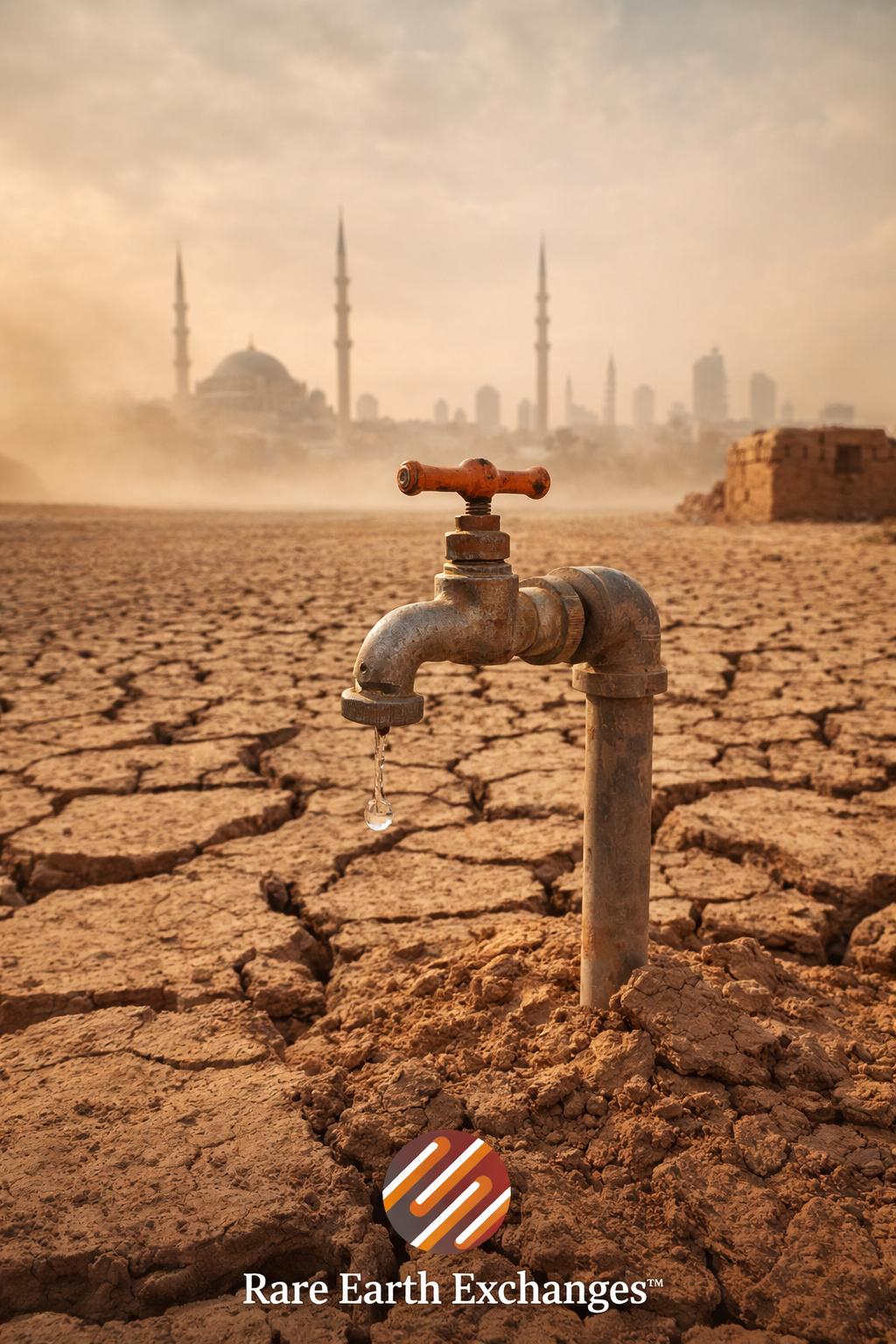
Water is often perceived as the ultimate abundant resource, so fundamental that its availability is taken for granted. Yet the March 2026 attacks on desalination plants in the Persian Gulf reveal a stark truth: any material, no matter how plentiful in nature, can become critically scarce when the infrastructure that delivers it is disrupted. Even with an almost inexhaustible natural source, the transformation, purification, and distribution steps can themselves become the real bottleneck, just as refining and separation, rather than geological occurrence, are the true point of criticality for rare earth elements.
The core lesson is that criticality is not an intrinsic property of a material, but a function of processing concentration, infrastructure fragility, and the absence of timely alternatives. This article traces that pattern across water, neon, helium, and phosphorus to show why policy attention must shift from where critical materials are found to where and how they are processed.
The Processing Bottleneck
In every case of critical material vulnerability, the pattern is the same. The raw material exists in abundance. What is scarce, concentrated, and fragile is the transformation step: desalination, gas purification, rare earth separation, and helium liquefaction. Policy attention fixates on where materials come from. The real vulnerability lies in where and how they are processed.
Consider: the Persian Gulf contains effectively unlimited seawater, yet Gulf states depend on a small number of coastal desalination plants to turn it into drinking water. According to the Atlantic Council, over 90% of the Gulf’s desalinated water comes from just 56 plants. Neon is present in the atmosphere everywhere on Earth, yet until 2022, almost all semiconductor-grade neon imported by the United States was purified at a handful of facilities in Ukraine. Helium is the second most abundant element in the universe, yet commercially usable helium depends on a small number of extraction and liquefaction plants co-located with specific natural gas fields. Rare earth elements are geologically widespread, yet China controls the vast majority of global refining and separation capacity, regardless of where the ores are mined.
In each case, the processing step, not the underlying resource, is the chokepoint. And it is the processing step that adversaries, accidents, or market failures can disrupt most effectively.
The Gulf Water Crisis: Processing as the Point of Failure
The Persian Gulf hosts some of the world’s largest desalination capacities, enabled by advanced technology and massive investment. For decades, desalination has provided nearly all drinking water in Kuwait, Qatar, and Bahrain, and the majority in Saudi Arabia and the UAE. On any given day, the region’s desalination plants produce tens of millions of cubic metres of freshwater, appearing as reliable as tap water in any developed nation.
This apparent abundance, however, rests on a precarious foundation. Desalination plants are concentrated along exposed coastlines and depend on uninterrupted electricity, chemical inputs, and skilled operators. Their output is consumed almost immediately; in most Gulf states, strategic storage covers only days rather than weeks.
On 7 March 2026, Iran accused the United States of attacking a desalination plant on Qeshm Island in the Strait of Hormuz, disrupting water supply to approximately 30 villages. The following day, an Iranian drone struck a desalination plant in Bahrain. Bahrain’s Interior Ministry condemned the attack as indiscriminate targeting of civilian infrastructure; Iran’s Foreign Minister Abbas Araghchi framed it as retaliation, stating that “the US set this precedent, not Iran.” The US military did not acknowledge the Qeshm strike.
While Bahrain’s Electricity and Water Authority confirmed that services were not immediately disrupted, the attack exposed a vulnerability that had been neglected for decades. Kuwait subsequently reported drone debris causing a fire at the Doha West Power and Water Distillation Station, and strikes landed dangerously close to Dubai’s Jebel Ali complex, which hosts 43 desalination units producing over 600 million cubic metres of water per year.
The escalation deepened on 22 March, when Iranian parliament speaker Mohammad Bagher Qalibaf warned that if Iran’s power plants and infrastructure were targeted, vital infrastructure across the region — explicitly including desalination facilities — would be considered legitimate targets and “irreversibly destroyed.” Iran’s unified military command separately stated that desalination plants across the Middle East would be struck in any infrastructure war.
In a matter of days, water, the most elemental resource, became a weapon of strategic coercion. The shock was geopolitical, not geological: a reminder that criticality is manufactured by human decisions, not imposed by natural limits. And the point of vulnerability was not the sea (which remained where it always was) but the processing infrastructure that transforms seawater into something people can drink.
Beyond Rare Earths: The Processing Pattern Repeated
Rare earth elements have rightly drawn policy attention because of their concentrated processing in China and their indispensability in high-tech manufacturing. But the Gulf water crisis exposes a broader truth: critical materials include substances that are neither “rare” nor “earths.” Neon, helium, phosphorus, and water share common vulnerabilities above all, dependence on a small number of specialised processing stages that can be far more fragile than the underlying resource base.
Neon: Purification as the Sole Bottleneck
The 2022 neon crisis linked to the Ukraine war is perhaps the purest illustration of the processing bottleneck. Neon is present throughout the atmosphere. It is also generated as a byproduct of steel production, particularly in older Soviet-era steel mills that were equipped with gas-collection technology. Russia produced much of the crude neon gas; Ukraine purified it. Two Ukrainian companies, Cryoin and Ingas, located in or near the Black Sea port city of Odesa, supplied the vast majority of semiconductor-grade purified neon imported by the United States, approximately 90%, according to the US International Trade Commission.
When both facilities ceased production in March 2022, the disruption sent shockwaves through global electronics manufacturing. The raw material had not disappeared; neon remained in the atmosphere and continued to be captured at steel mills elsewhere. What vanished overnight was the purification capacity. Qualification of a new neon source takes 3 to 18 months, ensuring that no rapid substitute is available. The pattern is identical to water in the Gulf: a mundane, reliably available substance became a bottleneck because processing was concentrated, redundancy was minimal, and alternatives required years to develop.
Helium: Extraction and Liquefaction as Chokepoints
Helium is the second most abundant element in the universe, but commercially scarce because of the limited number of facilities that can extract, separate, and liquefy it from natural gas. The US Federal Helium Reserve, once the world’s strategic buffer, has been drawn down through sales rather than preserved. New helium extraction capacity requires drilling, separation facilities, and long-term offtake agreements; a multi-year proposition. As with desalinated water and purified neon, the bottleneck is not the resource itself but the small number of processing facilities that stand between a raw input and a usable product.
Phosphorus: Processing Concentration in a Different Guise
Phosphorus offers a further parallel. Essential for agriculture and with no synthetic substitute, phosphorus is mined in a handful of countries, notably Morocco (which holds roughly 70% of global reserves), China, and the United States. But phosphate rock is not directly usable as fertiliser; it must be chemically processed into fertiliser-grade products such as diammonium phosphate (DAP) or monoammonium phosphate (MAP). This processing capacity is concentrated in different countries from the mines, creating an additional layer of vulnerability. A geopolitical shock to these processing chains would not trigger famine immediately, but within a single growing season, the absence of phosphate fertilisers could cascade into global food shortages.
The Temporal Mismatch: When Crisis Arrives Before Alternatives
One of the most sobering lessons from both the Gulf water crisis and the rare earth debate is that alternative processing capacity takes years to materialise. In the Gulf, even if every state began building new desalination plants immediately, construction, commissioning, and integration into distribution systems would take three to five years. Strategic water storage, aquifer recharge, and regional water grids require sustained investment and political coordination that cannot be improvised during a crisis.
Similarly, developing a rare-earth refinery outside China typically takes 7 to 10 years from exploration to commercial-scale separation. Qualifying a new neon purification source takes up to 18 months. Helium extraction demands drilling, separation facilities, and long-term offtake agreements; there are no quick substitutes.
This temporal mismatch is a defining feature of critical material risk. The moment of crisis arrives long before alternative processing lines can be established. In the Gulf, the window between a coordinated attack on desalination infrastructure and large-scale displacement is measured in days, while the window to build resilient water processing systems is measured in years. The same asymmetry applies to every material discussed here.
Rethinking Risk Assessment: Processing as Supply Chain
The water attacks underscore that critical material risk assessments must move beyond traditional supply–demand models. Three dimensions require urgent attention.
Processing Infrastructure as the Primary Risk Surface
Water’s criticality in the Gulf is driven not by the resource itself but by the processing infrastructure that delivers it. Desalination plants, pipelines, and storage facilities form a concentrated and exposed network. A comprehensive critical materials risk assessment must therefore map not only extraction sites but also chokepoints in processing, refining, and distribution. For rare earths, this means evaluating separation and refining facilities, not just mines. For neon, it means tracking purification capacity. For helium, it means monitoring liquefaction plants. In every case, the processing step is where concentration is highest and where disruption has the most immediate impact.
Geopolitical Threat Modelling
The March 2026 attacks were deliberate military acts, not natural disasters or technical accidents. Yet most critical material risk assessments still focus on export restrictions, labour disputes or unplanned outages. The Gulf case shows that adversarial targeting of processing infrastructure must be treated as a primary scenario. For materials like neon, semiconductors, or rare earths, the question is not only “What if a producer cuts supply?” but “What if an adversary destroys a key processing facility?”
Strategic Reserves Sized for Processing Lead Times
Because rapid substitutes for processing capacity are lacking, strategic reserves must be dimensioned to bridge the full period needed to bring new processing capacity online — not merely to smooth short-term supply fluctuations. Gulf states kept water storage measured in days; they now recognise the need for months of supply. The United States maintains only minimal strategic stockpiles of rare earths, and its Federal Helium Reserve has been drawn down rather than preserved. A credible strategy requires reserves sized to the actual lead time of alternative processing development.
Strategies for Processing Resilience
The water crisis provides a template for how governments and industries can prepare for processing-related shocks across the critical materials landscape.
Diversification of processing capacity. Gulf states are exploring nuclear desalination and atmospheric water generation to reduce reliance on vulnerable coastal plants. Rare earth consumers must similarly support multiple refining and separation projects across jurisdictions. The lesson from neon is instructive: after 2022, Japan, South Korea, and several US firms invested in domestic purification capacity, reducing dependence on Ukrainian facilities. This diversification must be proactive, not reactive.
Strategic reserves matched to processing lead times. Reserves must cover the full lead time required to develop alternative processing capacity. For water in the Gulf, this implies months of storage; for rare earths, stockpiles that can sustain three to five years of essential industrial demand while new separation facilities come online; for neon, reserves sufficient to bridge the 3–18 month qualification period for new purification sources.
Accelerated permitting for processing infrastructure. Gulf states are considering pre-approved “shovel-ready” desalination projects that can be fast-tracked in emergencies. Critical material strategies should likewise include pre-permitted processing sites, expedited environmental reviews, and government-backed offtake agreements to enable rapid capacity expansion when threats emerge.
International coordination on processing security. Water in the Gulf is a regional common good, and no single state can secure its processing infrastructure alone. The same logic applies to global critical material chains. Alliances such as the Minerals Security Partnership must evolve from dialogue platforms into mechanisms for coordinated investment in diversified processing capacity, mutual defence of processing infrastructure, and joint strategic reserves.
The Next Bottleneck May Already Exist
The attacks on Persian Gulf desalination infrastructure in March 2026 shattered the illusion that water, a substance as common as the sea, cannot become a critical material overnight. But the deeper lesson is not about water alone. It is about processing. In every case examined here, water, neon, helium, phosphorus, and rare earths, the raw material exists in sufficient or even abundant quantities. What is scarce, concentrated, and fragile is the transformation step that turns a natural input into a usable product.
Risk assessments can no longer treat processing infrastructure as a secondary concern while focusing narrowly on resource extraction. The next critical material shock may come from an unexpected direction, such as a purification plant in a war zone, a liquefaction facility hit by sanctions, a refinery concentrated in a single jurisdiction, but its impact will be amplified by a failure to recognise that the processing step, not the periodic table, is where criticality is made.
The question for policymakers, supply chain leaders, and strategists is no longer just “Where do our critical materials come from?” It is: “Where are they processed and what happens when that processing stops?”


0 Comments
No replies yet
Loading new replies...
Moderator
Join the full discussion at the Rare Earth Exchanges Forum →