
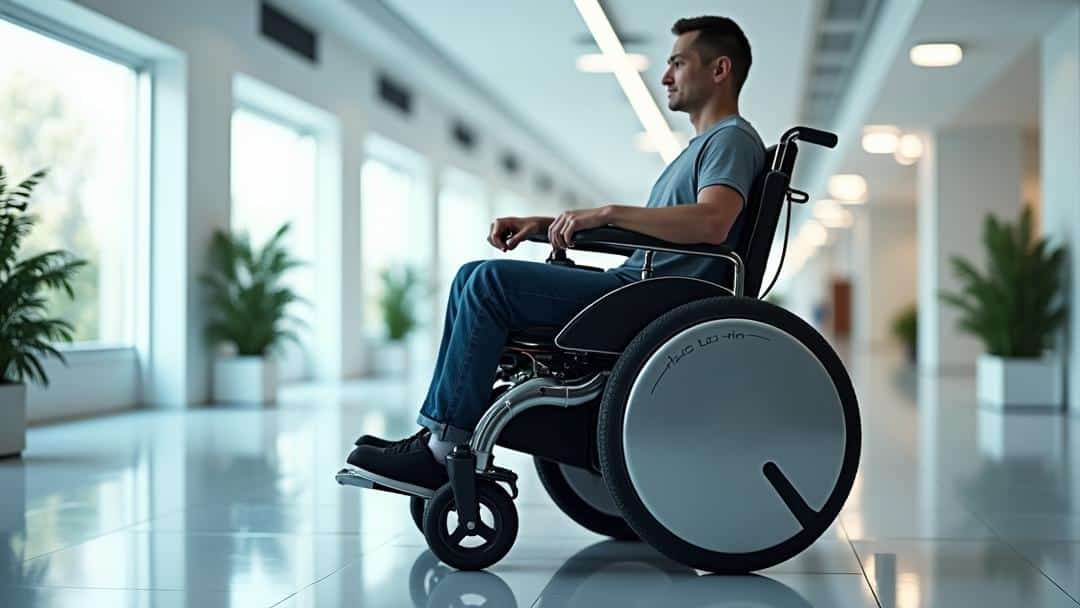
Before electrification, wheelchair users relied on manual chairs or scooters that demanded upper-body strength and limited speed, slope handling, and endurance—especially indoors or on uneven terrain. Research (opens in a new tab) shows most manual wheelchair users move in short bursts averaging only about 28 feet (8.6 meters) at a time before stopping, reflecting the intense effort required for even short distances. Over a three-year period, more than 60% of active manual wheelchair users (opens in a new tab) reported falls related to instability, sometimes resulting in fractures or serious injury.
The arrival of compact, torque-dense motors, intelligent controls, and safer power systems transformed mobility, extending range and comfort.
Table of Contents
How Did Rare Earths Revolutionize Personal Mobility?
Electric wheelchairs use small, powerful motors that deliver high torque and responsive control while conserving battery life—capabilities made possible by advanced materials science. According to the World Health Organization, over 2.5 billion people worldwide need assistive mobility devices, (opens in a new tab) making these innovations critical for independence, safety, and accessibility.
The shift to powered mobility—driven by rare earth–based motors and lightweight batteries—marked a turning point. Users gained the ability to travel several miles on a single charge, climb inclines that were once impassable, and navigate tight indoor spaces with fingertip precision. What was once an exhausting physical task became smooth, controlled, and safe. Beyond mechanical upgrades, this shift restored independence, expanded access to work and education, and allowed many to participate more fully in community life.
Which Rare Earth Elements Power Electric Wheelchairs?
Rare earth elements quietly enable the shift from manual to powered mobility:
- Neodymium (Nd) and Praseodymium (Pr) create high-strength magnets for drive motors and actuators, providing compact power and smooth torque. Sintered NdFeB magnets deliver some of the highest energy densities of any permanent magnet material, allowing smaller, lighter motors without sacrificing performance.
- Dysprosium (Dy) and Terbium (Tb) enhance magnetic stability at higher temperatures, ensuring consistent operation during extended use—a critical advantage for users who rely on dependable mobility across different environments.
- Cerium (Ce) and Lanthanum (La) enhance battery chemistry and alloy stability under load, extending component life.
- Phosphors containing REEs illuminate LED displays and indicators in control panels.
Without these materials, the leap from manual wheelchairs to efficient electric independence would not have been possible.
How Rare Earths Create Mobility Solutions
Electric wheelchair motors operate through a finely tuned interaction between permanent magnets and electrical coils. When current flows through the stator coils, it generates a magnetic field that pushes against the rare earth–enabled magnet rotor. This produces rotational force, or torque, which drives the wheels.
Because NdFeB magnets are so strong and stable, engineers can design motors that:
- Deliver high torque at low speeds for controlled starts and climbs
- Operate efficiently in compact housings, preserving battery life
- Maintain consistent performance across temperature ranges
- Reduce overall system weight without sacrificing strength
This precision makes rare earth magnets indispensable to the smooth acceleration, quiet operation, and fine motion control users now expect from modern electric wheelchairs.
The Complex Journey from Mine to Mobility Device
Creating a rare earth-enabled electric wheelchair involves an intricate global supply chain. Mining operations extract rare earth-bearing ores like bastnäsite and monazite. These ores undergo complex separation processes to isolate specific rare earth elements with high purity.
Specialized manufacturers then transform these raw materials into precision magnets and components. Powder metallurgy techniques align magnetic grains to maximize performance. Each component undergoes rigorous testing to meet medical device standards for reliability and safety.
Economic and Social Impact
The powered wheelchair market represents a significant and growing sector. Global market estimates suggest the industry was valued at approximately $3.1 billion in 2022 (opens in a new tab), with expectations of continued growth driven by aging populations and improved assistive technology access.
Beyond economics, electric wheelchairs powered by rare earth technologies represent profound human impact. They enable:
- Greater personal independence
- Improved workplace participation
- Reduced caregiver burden
- Enhanced quality of life
Technological Pioneers
The development of rare earth-enabled mobility technologies traces back to breakthrough materials science. Neodymium-iron-boron (NdFeB) magnets emerged in the early 1980s, independently developed by researchers at Sumitomo Special Metals and General Motors.
These innovations transformed how engineers could design motors, creating possibilities for smaller, more efficient mobility solutions that were previously unimaginable.
Current and Future Perspectives
Rare earth technologies continue to evolve toward greater efficiency and sustainability. Manufacturers are reducing dependence on heavy elements like dysprosium and terbium, improving magnet microstructures, and expanding recycling programs to reclaim valuable materials from end-of-life devices. Policy efforts to diversify rare earth processing outside current supply hubs are also helping stabilize access to these critical inputs.
Ultimately, electric wheelchairs as we know them would not exist without rare earth elements. They make compact motors powerful, extend battery life, and ensure long-term reliability—translating directly into independence, mobility, and confidence for millions of users. Continued improvements in recycling and materials design will keep that freedom accessible while reducing environmental and supply risks.
For investors and policymakers, this underscores why stable rare earth supply chains matter far beyond electric vehicles and defense: they sustain quality-of-life technologies that depend on long-term material security. Projects capable of producing and refining NdPr efficiently (and recycling it responsibly) support not just industry growth, but human mobility itself.
FAQs
Do all electric wheelchairs use rare earth magnets?
Many powered wheelchairs use permanent magnet motors for torque density and efficiency, and NdFeB is a common choice in compact, high-performance designs. Some cost-sensitive or lower-torque applications may use ferrite magnets, trading size and weight for lower material cost. Actuators and non-contact joysticks can also incorporate small REE magnets. The exact bill of materials varies by model and intended duty cycle.
Why would a designer choose SmCo instead of NdFeB in a wheelchair component?
SmCo maintains coercivity and magnetic properties better at higher temperatures and in corrosive environments, reducing demagnetization risk in tough duty cycles. While SmCo is typically more expensive and slightly lower in maximum energy product than top NdFeB grades, it can simplify thermal design and improve long-term stability. This trade can be favorable in compact actuators with poor heat dissipation. Design teams balance magnet cost, volume, and thermal margins.
Where do rare earths show up beyond the motors?
REEs also appear in the LEDs that provide headlights, indicators, and display backlighting via YAG:Ce and related phosphors. Small permanent magnets paired with Hall-effect sensors enable precise, wear-free joystick and position sensing. In some legacy systems, REEs appear in glass polishing or specialized coatings for optics. Battery chemistries themselves do not inherently require REEs, though adjacent components may.
Are supply risks for rare earths likely to affect wheelchair availability?
Midstream steps—separation, alloying, and sintered magnet production—are geographically concentrated, making prices and lead times sensitive to policy and trade shifts. Mobility devices are a relatively small consumer of magnets compared with EVs and industrial drives, but they compete for the same materials. Manufacturers hedge by qualifying multiple magnet suppliers, reducing heavy REE content, and exploring recycled feedstocks. Policy moves to onshore processing may improve resilience over time.
How are manufacturers reducing reliance on heavy rare earths like Dy and Tb?
Techniques such as grain-boundary diffusion place Dy/Tb precisely at magnet grain edges, preserving coercivity with much less heavy REE overall. Improved alloy chemistry and microstructure control raise intrinsic coercivity in base NdFeB, cutting additive needs. Some applications also redesign motors to use ferrites where torque density permits. These strategies lower cost and exposure to constrained heavy-REE supply.
