
Here's an unordered list in HTML based on the provided content:
Highlights
- Trump's second-term energy policy cuts green tech subsidies while investing heavily in nuclear power and critical mineral resources.
- The global energy landscape is rapidly shifting towards renewables, with Europe and China leading green technology investments.
- The 21st-century energy race will be defined by control of rare earth minerals and advanced energy technologies, not just oil and gas.
How about the “art of the contrarian gamble? President Donald Trump has never been shy about big bets. His second-term energy doctrine — enshrined in the One Big Beautiful Bill — may be his boldest yet. While Europe and China sprint toward renewables, Trump is marching in the opposite direction: away from subsidies for solar, wind, and electric vehicles, and toward what he calls “real energy independence.”
The new law fast-tracks the rollback of federal tax credits for renewables by 2027 and sunsets the $7,500 EV credit by 2026. Critics call it an assault on decarbonization. Trump calls it a reality check. His wager: that fossil fuels, nuclear power, and critical minerals — not subsidized green tech — will anchor America’s future.
Is it the right bet?
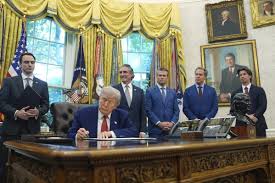
This isn’t just an oilman’s nostalgia. The same legislation channels billions toward advanced nuclear reactors, small modular reactor (SMR) projects, and uranium enrichment capacity — all reclassified as “strategic clean assets.” And while climate hawks accuse him of undermining renewables, Trump’s Pentagon quietly secured a 15% stake in MP Materials, the nation’s only active rare earth mine. It’s a hedge on the metals behind green tech: lithium, nickel, neodymium, and dysprosium — the sinews of electric motors and missiles alike.
His energy logic is simple, even elegant: favor what America already dominates — oil, gas, and uranium — and seize the upstream mineral base for the technologies it doesn’t.
The World Turns Green — Without Him
Beyond U.S. shores, the energy transition is accelerating, not retreating. Europe invested €110 billion in renewables in 2023, ten times more than in fossil fuels, as it scrambles to replace Russian gas. China commands 60% of global EV sales and builds more solar panels in a quarter than the U.S. installs in a year. Even Turkey, squeezed by high natural gas prices, is turning to both renewables and Russia-backed nuclear power.
The rest of the world isn’t debating whether the future is green — it’s just deciding who will own it.
Nuclear: The Middle Path or Mirage?
Here, Trump may have found a rare sweet spot. Nuclear power, long a politically contentious issue, is back in vogue. It offers what solar and wind cannot: round-the-clock, baseload power without carbon emissions. From Britain’s Rolls-Royce SMRs to Poland’s Westinghouse projects, nations are rediscovering atoms as the backbone of reliable grids.
If the U.S. can finally commercialize small modular reactors — cheaper, safer, and scalable — Trump’s bet could look prophetic. But the nuclear renaissance is slow. America’s only new reactors, at Plant Vogtle in Georgia, took 14 years and $35 billion to complete. For all the promise of new designs, costs, and bureaucracy remain formidable obstacles.
In betting on nuclear, Trump isn’t wrong — just early, perhaps by a decade.
The New Oil Is Invisible
Where his instincts may prove most prescient is in the geopolitics of materials. The 21st-century energy race won’t just be fought over barrels and pipelines, but over supply chains for rare earths and battery metals. China refines more than 90% of the world’s rare earths; the U.S. produces less than 2%. By locking in mineral equity and defense-backed stockpiles, Trump is arming America for a world where magnets, not molecules, power economies.
Betting Against the Tide
So was it madness to cut green incentives — or genius to resist the herd? If renewables stumble, if storage proves costly, or if global supply chains fracture, Trump will look like the man who saw the bust coming. Yet if the transition holds its pace — if solar keeps falling in price and EVs keep rising in sales — America could find itself lagging in the technologies that define the next century.
For now, Trump’s America is betting on the atom, the barrel, and the mine — while much of the world bets on the sun and the wind and the technologies to store the juice better. One side will look visionary; the other, stubbornly wrong. The stakes are nothing less than who controls the energy architecture of the 21st century.
©!-- /wp:paragraph -->


0 Comments
Discuss this article