
Highlights
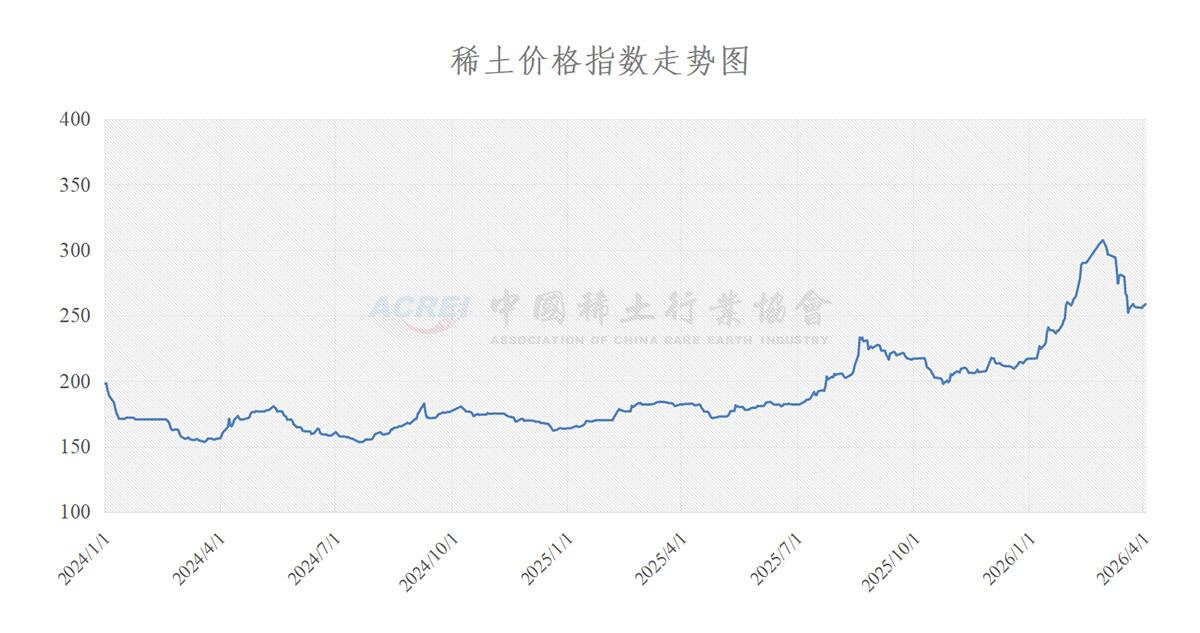
- China's domestic rare earth price index rose to 258.7 on April 2, 2026, continuing a volatile uptrend that saw the index climb from mid-100s in 2024 to above 300 in early 2026, with magnet materials like PrNd oxide up 12.5% month-over-month.
- Light rare earth magnet inputs are driving price increases, with neodymium and praseodymium materials rising over 12% in January 2026, reflecting strong demand for EV, wind turbine, and defense applications.
- China's price index reflects a managed, state-controlled system shaped by quotas and export controls rather than free market dynamics, while ex-China price discovery remains fragmented and strategically vulnerable without full supply chain control.
China’s domestic rare earth price index rose to 258.7 on April 2, 2026, up from 255.7 on March 30, reinforcing the sharp move higher seen since late 2025. The index uses 2010 as the base year (100) and is calculated from the average of daily transaction data reported by domestic Chinese rare earth enterprises. That makes it useful as a directional barometer of China’s internal market—but not a transparent global benchmark.
A Rising Tape, With Real Volatility
The January 2026 report shows the index averaged 235.3 for the month, with a high of 260.2 on January 30 and a low of 217.0 on January 4, a swing of about 18.4%. The chart history supplied by the association shows the index rising from the mid-100s in 2024 to above 300 briefly in early 2026 before pulling back into the mid-250s by early April. This is not a flat market. It is a volatile uptrend inside a controlled domestic system.
Magnet Inputs Are Doing the Heavy Lifting
The strongest January moves were in light rare earth magnet inputs. PrNd oxide averaged 661.83 yuan/kg, up 12.5% month over month; PrNd metal averaged 801.71 yuan/kg, up 12.2%; neodymium oxide averaged 672.50 yuan/kg, up 12.7%; and neodymium metal averaged 819.86 yuan/kg, up 12.0%. These are the materials that matter most for NdFeB magnets used in EVs, wind turbines, robotics, and defense systems.
Heavy Rare Earths Are Firmer—But More Selectively
Heavy rare earth pricing was firmer, though not uniformly explosive. Dysprosium oxide rose 3.2%, dysprosium-iron rose 4.3%, terbium oxide rose 0.2%, terbium metal fell 0.6%, holmium oxide rose 5.2%, and yttrium oxide jumped 21.4%. That profile suggests selective tightness rather than a broad-based panic bid.
Why This “Market” Is Distorted
China’s index is built from domestic enterprise transaction reports and published by a state-linked industry body. It sits inside a system shaped by production quotas, export controls, state-backed consolidation, administrative guidance, and opaque reporting not to mention a communist ideology.
So yes, it reflects real transactions—but not a fully free or fully transparent market-clearing process. It is best understood as a managed-pricing signal from the world’s dominant rare-earth supply chain. Yes, it must be taken very seriously.
Ex-China Pricing Is Emerging—But It Is Not Yet Sovereign
The West is beginning to generate ex-China price discovery, especially for separated oxides, metals, alloys, and magnet-ready materials outside China. But there can be no truly independent market without control of the underlying supply chain. A real market requires not just upstream ore or concentrate, but reliable separation, refining, metal-making, alloying, and magnet production. Without that full stack, ex-China prices are still largely derivative—reacting to China’s system rather than replacing it.
Bottom Line
China is not merely reporting prices. It is still shaping the commercial reference frame. Until the West controls meaningful volumes of both feedstock and refined product, price discovery outside China will remain partial, fragmented, and strategically vulnerable.
Disclaimer: This report is based on information published by the China Rare Earth Industry Association, a state-linked entity. The data reflects domestic Chinese market conditions and should be independently verified before being used for investment or strategic decision-making.


0 Comments
No replies yet
Loading new replies...
Moderator
Join the full discussion at the Rare Earth Exchanges Forum →