
Highlights
- China's October export controls on rare earths dominate 70% of global supply and 90% of processing.
- The controls have created a standoff threatening U.S. electric vehicle, semiconductor, and defense production ahead of the Trump-Xi Kuala Lumpur summit.
- Both superpowers are engaged in dueling narratives:
- Washington frames China's rare earth policies as economic coercion and supply chain power grabs.
- Beijing claims it's merely mirroring U.S. export restrictions in self-defense.
- The crisis accelerates global efforts to diversify critical mineral sources.
- There are surging investments in non-Chinese rare earth projects.
- There is an urgent need for a transparent, resilient supply chain that no single nation can dominate.
Ensure key terms like rare earth supply chain, US–China trade war, and export controls feature prominently for discoverability.
The upcoming meeting between U.S. President Donald Trump and China’s President Xi Jinping is shaping up as a geopolitical chess match with a periodic twist. At the center of this high-stakes dialogue are not just tariffs and soybeans, but the obscure, rare-earth elements quietly critical to electric vehicles, smartphones, jet engines, and missiles. As both sides posture ahead of their Kuala Lumpur talks, rare earths – the magnets of modern technology – have become a powerful bargaining chip and a potential Achilles’ heel for both superpowers.
Table of Contents
A Magnetized Standoff with Real-World Shockwaves
This isn’t the first time rare earths have been wielded as leverage. When trade tensions flared in April, Beijing cut off rare earth magnet supplies to U.S. buyers, a move that “threatened to halt U.S. production of electric vehicles, semiconductors and weapons systems”. Washington quickly felt the shock: for decades, China has built a near-monopoly in these critical minerals, supplying roughly 70% of the world’s rare earths and dominating ~90% of processing capacity. In response, U.S. tariffs on Chinese goods skyrocketed to triple digits before a 90-day truce restored the flow of magnets in May. That fragile peace unraveled when the U.S. expanded export blacklists in late September, and China struck back on October 10 with sweeping new export controls on rare earths, requiring licenses for any product using Chinese rare earth materials or technology.
ASEAN Malaysia 2025
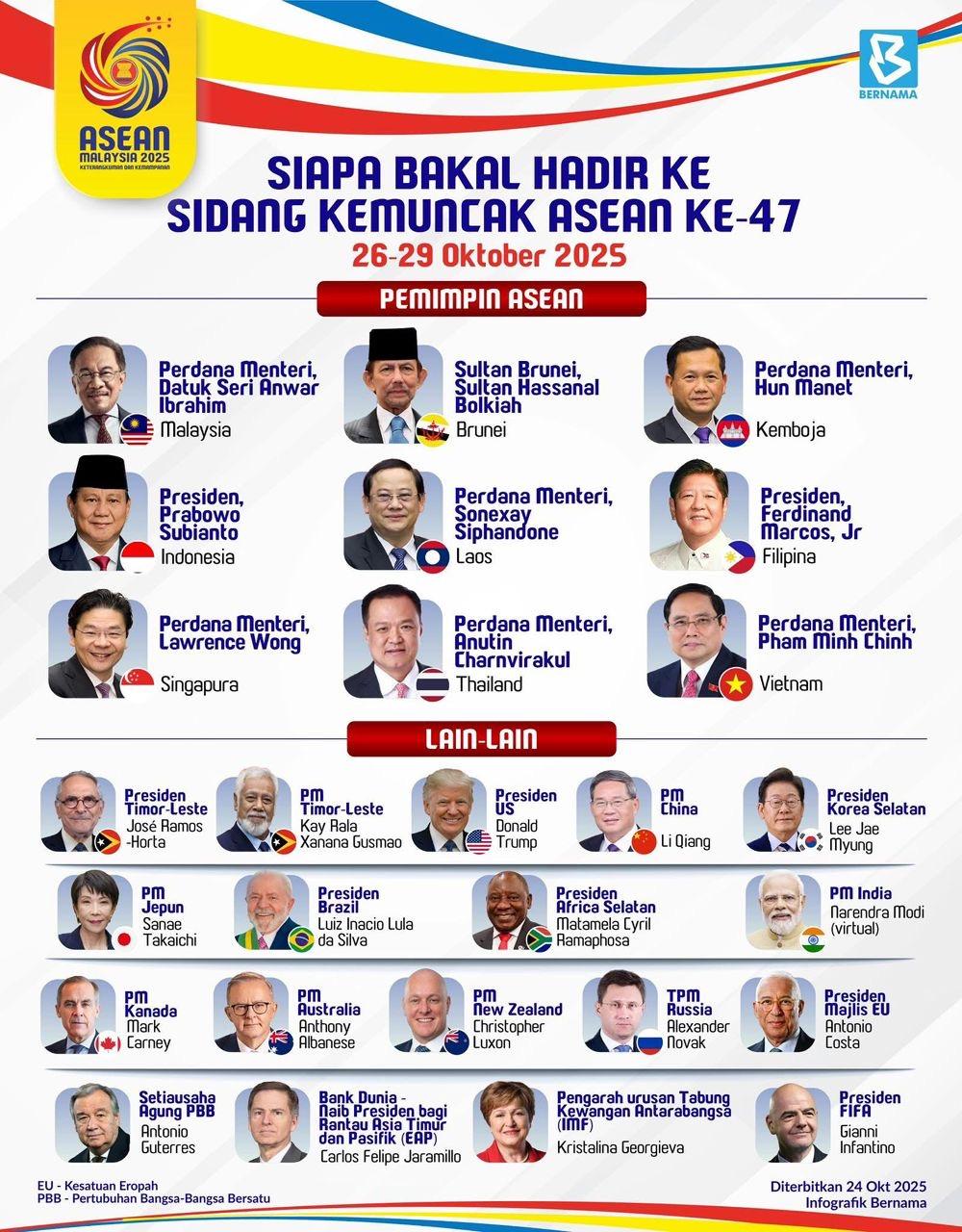
American officials blasted Beijing’s move as a “global supply chain power grab” even as the U.S. mulled retaliatory curbs on a dizzying array of tech exports from laptops to jet engines. The result is a magnetized standoff: unless negotiators broker a last-minute fix, Trump has warned 100% tariffs will hit on November 1, imperiling next week’s Trump–Xi summit and sending investors scrambling for cover.
Behind the saber-rattling lies a stark reality: rare earths are the linchpin of 21st-century industry and defense. They “underpin advanced weapons systems, EVs, and the energy transition”, as one geopolitical expert noted in Newsweek (opens in a new tab). Decades of offshoring have left Western supply chains fragile and overly reliant on Chinese materials, a fact laid bare when magnet shipments paused and “manufacturers [faced] serious supply risks,” hitting everything from car factories to missile programs. In short, China’s rare earth “stranglehold” is not tabloid hyperbole but a daily concern for companies and militaries worldwide. Little wonder the rare earth supply chain now commands as much attention as steel or soy at the negotiating table.
Brinkmanship and Bargaining: High Hopes vs. Hard Reality
With the Kuala Lumpur talks underway (see event above), the question is whether brinkmanship will give way to a bargain. Optimists like Georgetown’s Dennis Wilder believe cooler heads will prevail: “Ultimately, I’m optimistic... there will be tactical decisions to extend the pause,” he said this week, predicting Trump will hold off on 100% tariffs and Beijing will soften its rare earth stance to keep next week’s summit alive. Such an eleventh-hour reprieve would echo prior truces that dialed back tariffs and got Chinese magnets flowing again. Indeed, Trump himself struck a confident tone before departing for Asia: “I think we’ll have a good meeting,” he told reporters at Reuters (opens in a new tab), hinting at interim deals on farm purchases and tech blacklists to calm the waters.
But seasoned analysts caution that hope is not a strategy. Rare earth elements remain one of Beijing’s strongest cards – a “well-known Achilles Heel” of U.S. industry and “one of the most potent leverages Beijing has”. “I’m not sure the Chinese can agree to reverse those controls – it’s the primary leverage they have,” observed Josh Lipsky (opens in a new tab) of the Atlantic Council. In other words, expecting China to concede its rare earth advantage may be wishful thinking unless the U.S. offers something big in return.
Moreover, Washington is hardly in a conciliatory mood; even as talks proceed, the Trump administration launched a new probe into China’s failure to meet past trade commitments, laying legal groundwork for yet more tariffs. Both sides, it seems, are keeping their powder dry. The risk is that each misreads the other’s brinkmanship as bluffing – and the whole trade détente collapses in a spiral of escalation. “We won’t know if Beijing’s counter-move induced a spiral until Trump and Xi meet,” noted one China expert, warning that without a deal, “everyone will need to prepare for things to get much nastier”reuters.com (opens in a new tab).
Dueling Narratives: Power Plays or Normal Practices?
Beyond the hard economics, a narrative tug-of-war is underway over who is the aggressor. U.S. officials paint China’s rare earth policy as economic blackmail, a techno-nationalist gambit so extreme it’s like taking a “bazooka” to the industrial base of the free world newsweek.com (opens in a new tab). Washington’s top trade envoy decried the export licenses as “an exercise in economic coercion,” granting Beijing “control over basically the entire global economy, ”newsweek.com (opens in a new tab). Such language frames China as a rogue actor weaponizing its mineral dominance to upend the status quo. And it’s not just rhetoric: U.S. allies in Europe and Asia share the alarm. Officials from Tokyo to Brussels are rushing to secure alternative supplies, wary of being caught flat-footed by what one U.S. negotiator called China’s supply-chain “power grab.
Beijing, for its part, tells a very different story as global media such as Reuters (opens in a new tab) may capture. Chinese officials bristle at the “weaponization” narrative and insist they are merely responding in kind to Washington’s own export bans. The Commerce Ministry spokeswoman He Yongqian accused the U.S. of “seriously distort[ing] and exaggerat[ing]” China’s measures and “deliberately stirring up unnecessary... panic”. She stressed that legitimate civilian orders will still be approved, implying that China’s aim is narrowly focused on keeping rare earths out of foreign weapons, not strangling global industry. In Beijing’s telling, their new rules simply mirror long-standing U.S. export controls – “consistent with international practice” and justified by national security concerns.
Reuters reported that Chinese state media even published side-by-side lists to argue that Washington restricts far more items than China. This narrative casts China not as a bully but as a reluctant combatant adopting America’s own playbook to “hit back with the enemy’s methods”. The truth, of course, likely lies somewhere in between. Of course, there is bias depending on one’s worldview, paradigm, and national presence.
China’s rules may have precedent, but their timing and breadth send an unmistakable message of leverage. And while U.S. officials may emphasize worst-case scenarios, even Chinese experts quietly acknowledge that such moves carry long-term risks if they drive customers to find other sources.
So is the rare earth furor a genuine security policy or high-stakes theater? Likely a bit of both. Bias seeps in on all sides. American leaders invoke freedom and global norms, yet were content to rely on cheap Chinese minerals for years until geopolitical winds shifted. Chinese leaders claim reluctant defense, yet they timed their rare earth “bazooka” precisely when it would hurt Trump’s political base and tech ambitions. Each side cherry-picks history to justify present actions – a reminder that in trade wars, perception is a weapon of its own.
The Rare Earth Reckoning – What It Means for Investors
Strip away the rhetoric, and what remains is a clarifying moment for the rare earth element supply chain. This saga has laid bare the peril of having one country hold all the magnetic keys to modern life. Every twist – tariffs, blacklists, export licenses – reinforces the REEx core thesis: transparency, diversification, and resilience in critical minerals are no longer academic ideals but urgent imperatives. If there’s a silver lining to the current standoff, it’s that markets and governments worldwide have been jolted into action. “Each time China tightens the spigot, it accelerates the political will and capital investment to erode its dominance,” observed one strategist, noting a global race is on to develop new mines, refining capacity, and recycling innovations outside China (opens in a new tab).
The past week alone saw American and Australian rare earth stocks surge on expectations of a coming supply chain overhaul. Of course, no media chronicles this unfolding historical dynamic as much. Even JPMorgan’s CEO Jamie Dimon weighed in, calling the West’s dependence on foreign critical minerals a “painfully clear” vulnerability and pledging billions to fix it. REEx reported that the investment bank announced a $1.5 trillion infrastructure fund.
In the immediate term, investors and industries are hanging on every word from Kuala Lumpur. Will we see a truce that averts doomsday tariffs and eases the rare earth chokehold, or a collapse that forces companies to enact costly contingency plans? The rare earth drama adds a volatile new layer to an already fraught U.S.–China relationship. But it also offers a moment of clarity. As REEx has argued since our launch at the start of 2025, the path to real security lies not in trade war one-upmanship but in building a more transparent, diversified supply chain that no single nation can so easily dominate.
Until that day comes, expect these tiny elements with strange names (dysprosium, neodymium, praseodymium) to loom large in headlines and boardrooms alike. In a sense, the true meeting happening this week is between geopolitical reality and economic necessity – and rare earths are seated at the head of the table.
© 2025 Rare Earth Exchanges™ – Accelerating Transparency, Accuracy, and Insight Across the Rare Earth & Critical Minerals Supply Chain.


0 Comments
Discuss this article