
Highlights
- China is leveraging technical standards to reinforce its rare earth industry dominance, using standard-setting as a strategic tool to influence global procurement, quality definitions, and competitive advantages beyond just mining and refining.
- Nearly 90 experts advanced standards for critical applications, including NdFeB magnet coatings used in EVs, wind turbines, and defense systems, with specifications that could raise barriers for foreign competitors while accelerating Chinese market adoption.
- By controlling the technical rulebook across the full rare earth lifecycle—from materials to recycling—China is compelling foreign firms to operate within Chinese-defined frameworks, creating a subtle linkage between standards and export control.
China is moving to strengthen not just its dominance in rare earth supply, but its influence over how the industry is defined, measured, and governed. At a March 24–27 standards meeting in Jinjiang, Fujian Province, nearly 90 experts gathered under the auspices of the National Rare Earth Standardization Technical Committee and affiliated state-linked research bodies to advance a new round of rare earth standards spanning materials, magnet manufacturing, and industrial processing.
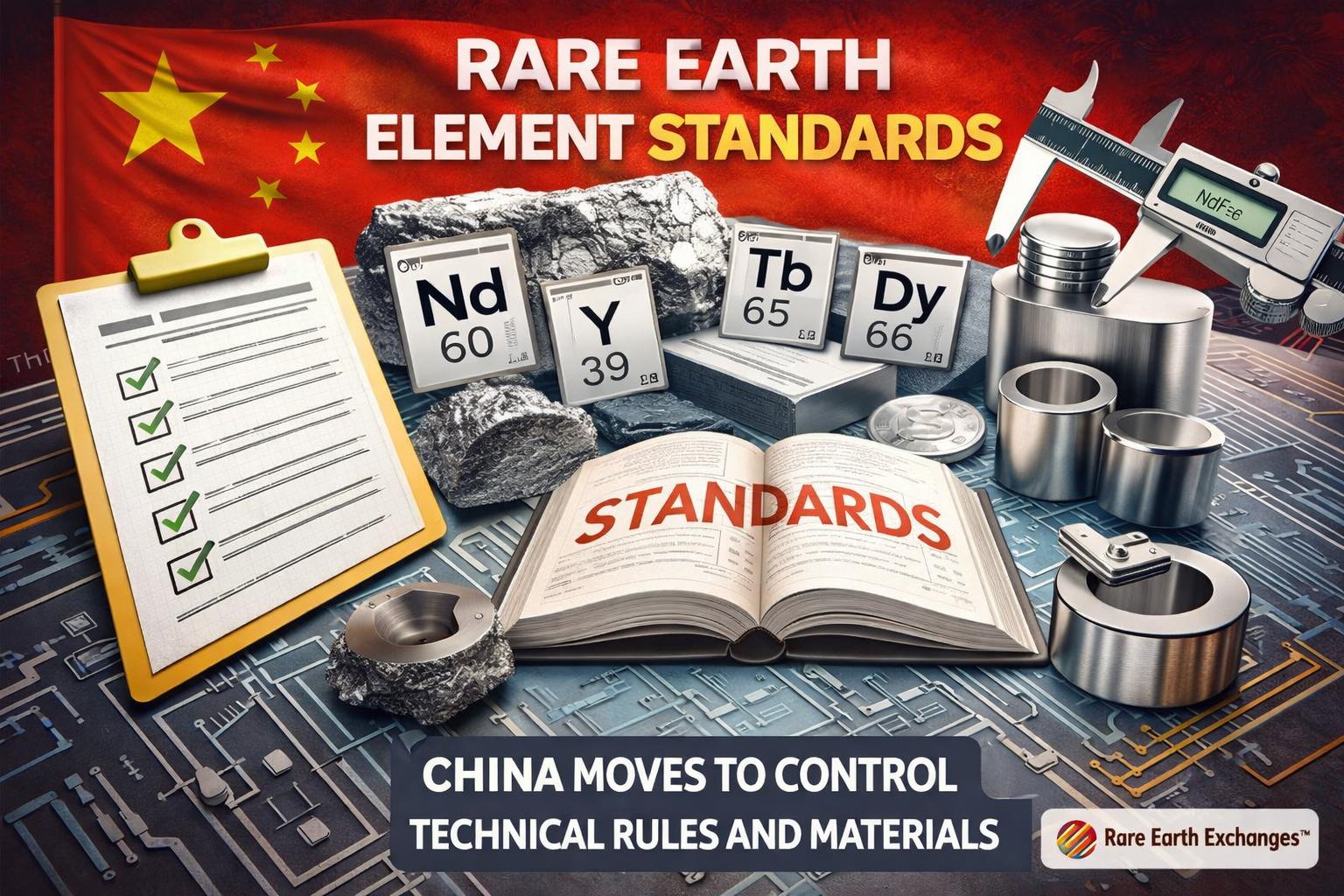
That may sound dry. It is not. In strategic sectors, technical standards are rarely neutral. They shape qualification rules, product specifications, manufacturing tolerances, and, over time, competitive advantage.
From Mines to Magnets—And Now to the Rulebook
The clearest message from the meeting was political as much as technical: rare earth standards should serve national strategy. Officials said standardization must reinforce China’s “full industry chain” advantage and support high-quality industrial development. In plain English, Beijing is working to ensure that its lead in rare earth mining, refining, magnet production, and downstream applications is reinforced by control over the technical rulebook itself.
This matters. A country that helps write the standards can influence what counts as quality, what qualifies for procurement, and what becomes normal in global trade.
The Details Worth Watching
The meeting reviewed the direction of China’s rare earth standardization work, formally evaluated the first batch of 2026 proposed projects, assigned work on six national standards, and pre-reviewed five additional national or industry standards.
Among the items discussed were standards for adhesive-layer electrical testing in joined rare-earth permanent magnets, yttrium-magnesium alloys, and laser processing specifications for sintered rare-earth permanent magnet materials.
One issue drew particular attention: surface coatings for sintered NdFeB magnets. That is not trivial. NdFeB magnets sit inside EV drivetrains, wind turbines, robotics, and defense systems. Their coatings affect corrosion resistance, durability, manufacturability, and end-use reliability. Rare Earth Exchanges™ has reported rapid development in alloy electroplating, electroplating-plus-chemical plating composite methods, and physical vapor deposition. China now wants tighter specifications around performance indicators such as coating surface tension.
Why Western Readers Should Pause
No single scientific breakthrough was announced. Rare Earth Exchanges suggests that the deeper development is institutional. China is moving to compress the distance between industrial policy, technical committees, and commercial production.
That has at least three implications for the West. First, standard-setting can harden China’s advantage without a headline export ban. Second, more detailed specifications can quietly raise the bar for foreign competitors. Third, these standards may help Chinese producers move faster from process innovation to scaled market adoption.
The Quiet Contest
The rare earth contest is no longer just about who owns deposits or builds separation plants. It is also about who defines the technical grammar of the sector. China is not merely producing critical materials. It is steadily positioning itself to decide how those materials are tested, processed, and judged.
Did You Know?
China’s National Rare Earth Standardization Technical Committee is accelerating a coordinated push to shape global rare-earth standards to reinforce its industrial dominance. Through the approval of dozens of new and pending standards spanning 2025–2026, the effort targets high-value segments such as NdFeB permanent magnets, hydrogen storage materials, polishing powders, and increasingly, recycling and secondary resource utilization—effectively covering the full lifecycle of rare earth materials. The strategic intent is not just technical harmonization, but influence: by aligning global specifications, testing protocols, and quality benchmarks with Chinese frameworks, Beijing can embed its industrial norms into international supply chains.
This creates a subtle but powerful linkage between standard-setting and export control, particularly in sectors tied to advanced manufacturing and defense. Annual convenings of large expert groups further institutionalize this process, prioritizing reliability, testing rigor, and scalability. The broader implication is a “quiet” strategy—one that compels foreign firms to operate within Chinese-defined technical boundaries, thereby reinforcing the country’s already dominant position in rare earth processing and refining.
Source disclaimer: This news item is based on a few sources, including reporting published through Chinese industry and state-linked channels and members of the REEx network in mainland China, on condition of anonymity. Our information may be directionally informative, but key details should be independently verified as always.


0 Comments
No replies yet
Loading new replies...
Moderator
Join the full discussion at the Rare Earth Exchanges Forum →