
Highlights
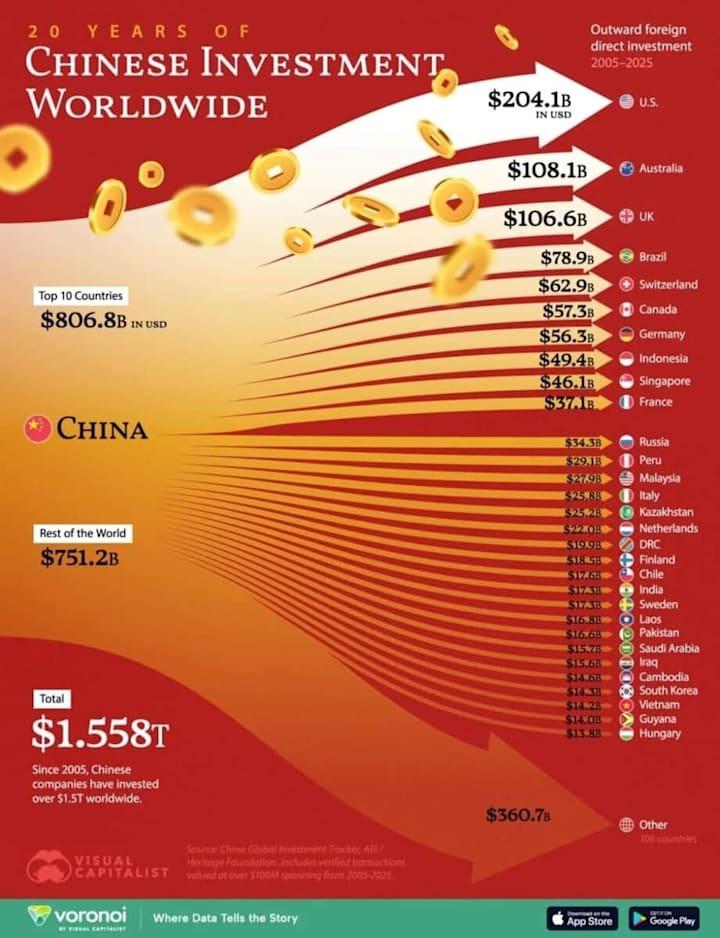
- China strategically invested $1.558 trillion in FDI over two decades, with $806.8B flowing to the top 10 countries to secure resources, technology access, and infrastructure positioning across the entire supply chain stack.
- Chinese capital mapped three strategic pillars: resource security through Australia/Brazil/Canada; technology and financial access via the US/UK/Germany/Switzerland; and geopolitical positioning through Belt and Road infrastructure investments.
- Supply chains have transformed from efficiency tools into weapons of statecraft, with China controlling 85–90% of rare earth processing while Western nations respond through friend-shoring, CFIUS screening, and domestic industrial policy.
In 2025, Rare Earth Exchanges (REEx) declared the arrival of Great Powers Era 2.0—a world where economic power is exercised through control of supply chains. One key question now: did China anticipate this shift?
*shared by Economic Planning Council via LinkedIn
The data suggests it did—and at scale.
Over the past two decades, China deployed $1.558 trillion in outbound foreign direct investment (FDI) (Visual Capitalist; China Global Investment Tracker, AEI/Heritage Foundation). Of that, $806.8B flowed into the top 10 countries, while another $751.2B spread across the rest of the world, with over 100 additional countries capturing $360.7B. This is not random dispersion—it is structured global positioning.
Where the Capital Went—and Why
The largest destinations—U.S. ($204B), Australia ($108B), UK ($106B), Brazil ($79B), Switzerland ($63B), Canada ($57B), Germany ($56B)—map precisely onto three strategic pillars:
- Resource Security
Australia, Brazil, and Canada anchor long-term access to iron ore, energy, and agricultural systems—inputs that sustain China’s industrial base. - Technology & Financial System Access
The U.S., UK, Germany, and Switzerland provide advanced manufacturing, capital markets, and intellectual property—fuel for moving up the value chain. - Infrastructure & Geopolitical Positioning
Secondary flows into Indonesia ($49B), Kazakhstan ($25B), DRC ($20B), Southeast Asia, and broader Global South corridors align with Belt and Road logistics, processing zones, and industrial expansion.
Capital as Pre-Positioning
This was not passive globalization—it was pre-positioning across the full supply chain stack:
- Upstream → mining and raw materials
- Midstream → refining, separation, logistics (China’s strongest leverage point today)
- Downstream (selective) → technology ecosystems and demand centers
In the Great Powers Era 2.0, this architecture resembles strategic terrain acquisition.
The Inflection Point: Supply Chains as Weapons
That system is now activated:
- The U.S. weaponizes semiconductors and tariffs
- China controls ~85–90% of rare earth processing and magnet supply chains, plus several critical mineral supply chains
- Trade chokepoints (Venezuela, Hormuz, Red Sea) become economic pressure valves and sites for potential militarization
Our premise: Supply chains are no longer efficiency tools—they are instruments of statecraft. Perhaps they always were, but the globalization period after World War 2 prioritized trade liberalization over all other considerations.
The Next Phase: Fragmentation
Western response is reshaping flows:
- CFIUS and EU screening regimes are tightening
- Capital is becoming politically filtered, not purely economic
- Acceleration of friend-shoring and domestic industrial policy
China will adapt:
- More indirect deal structures and proxies
- Deeper push into Global South resource and infrastructure nodes
- Intensified competition for critical minerals and midstream control
- Given unfolding disruptions, tighter ties with former allies, exemplified by the $1 trillion deal with Canada recently, deeper ties into Europe, connectivity with Russia, etc.
Why It Matters
For investors and policymakers, the signal is unmistakable:
Follow the Chinese capital → identify supply chain chokepoints → anticipate future leverage. China did not just invest. It mapped the terrain of the next global contest—and embedded itself within it.
Source: Visual Capitalist (China Global Investment Tracker, AEI/Heritage Foundation)


0 Comments
No replies yet
Loading new replies...
Moderator
Join the full discussion at the Rare Earth Exchanges Forum →