
Highlights
- Digital twins in rare earth supply chains enable faster scenario planning and process optimization, but cannot substitute for building real separation, metalmaking, and magnet capacity—especially given China's 89-92% control of midstream and downstream stages.
- The technology stack spans process twins (chemistry modeling), plant twins (operations), supply chain twins (network resilience), and organizational twins (governance), with vendors fragmenting across layers from Azure Digital Twins to AspenTech to OLI Systems' REE-specific thermodynamics.
- Credible proof points include Aclara Resources' AI-enabled solvent extraction twin with Argonne National Laboratory and USA Rare Earth's DOE-backed heavy REE separation models, but industrial-scale validation, data-sharing governance, and cybersecurity remain critical gaps.
Do digital twins suddenly matter in rare earth supply chains? Rare Earth Exchanges™ coined 2025 as entry into “Great Powers Era 2.0” — shorthand for a world where supply chain control is no longer a corporate optimization problem but a state-level instrument. The rare earth element (REE) and permanent magnet stack, in addition to the far bigger problem of critical minerals, represent a prime case because disruption transmits “quietly” into motors, actuators, sensors, and power systems long before it shows up in headline inflation.
The strategic tension is rooted in industrial concentration. A U.S. Department of Energy deep-dive on sintered NdFeB magnets describes how concentration rises with each downstream stage — from mining into separation, metal refining, and magnet manufacturing — and places China at roughly ~89% of global separation capacity, ~90% of refining, and ~92% of sintered NdFeB magnet manufacturing in the report’s 2020 framing. This degree of concentration is why multiple outside analyses routinely treat rare earths as a “chokepoint” commodity rather than a normal mined material.
In that environment, digital twins are increasingly pursued as a way to (a) anticipate failure modes, (b) compress learning curves in complex chemistry, and (c) stress-test policy and investment choices before physical assets exist. But they are not a substitute for real separation, metalmaking, and magnet capacity. The DOE report is explicit that U.S. capacity constraints, especially midstream, remain a core structural weakness.
What a rare earth supply chain digital twin actually is
A digital twin is best understood as a continuously updated model used for forecasting, simulation, optimization, and decision support — not a static “dashboard.” ISO has also formalized digital-twin thinking in manufacturing through standards such as ISO 23247-1 (opens in a new tab), which defines framework-level principles, terminology, and requirements for manufacturing digital twins.
For rare earths and critical minerals, the “twin” is rarely one model. It is a stack:
- Process twins (chemistry and unit operations): solvent extraction, precipitation, calcination, impurity control, reagent recycle, and mass/energy balances.
- Plant/asset twins (operations): equipment health, uptime, maintenance, operator training, and control strategy testing.
- Supply chain twins (network behavior): multi-tier flows, lead times, inventory buffers, logistics shocks, export controls, and qualification bottlenecks (especially for alloys and magnets).
- Organization/mission twins (governance): how decisions propagate across procurement, engineering, finance, and policy — what Gartner formalizes as a “digital twin of an organization (DTO).”
Two recurring implementation realities show up across standards and security guidance. First, integration and synchronization are the hard part — digital twins are “powered by integration” and “built on data,” and their value depends on whether the representation remains aligned with operational reality. Second, trust and cybersecurity are not optional: model integrity, data provenance, and the possibility of tampering or “counterfeiting” are explicit concerns in NIST’s security-and-trust guidance for digital twins.
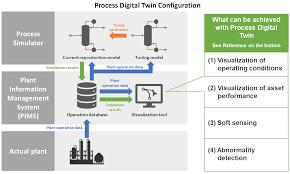
Technology and vendor landscape for digital twins
The market fragments into layers; no single vendor covers the entire mine-to-magnet stack end-to-end in practice (even if marketing implies otherwise). The most defensible way to “survey the landscape” is to map technologies to the layer they actually serve.
Industrial graph + real-time twin platforms. Microsoft positions Azure Digital Twins as a PaaS for building “twin graphs” (knowledge-graph-like models) of environments such as factories and energy networks. Amazon Web Services positions AWS IoT TwinMaker as an “operational digital twin” service explicitly built around a knowledge graph plus connectors to disparate data sources.
Engineering-grade plant and process twins (the ‘process industries’ incumbents). AspenTech (opens in a new tab) describes digital twin technology as manipulable simulation models kept current with operating data, while noting that an “ideal” perfect simulation is bounded by computing power and by limits in domain understanding — an important reality check for rare earth separation chemistry.
Siemens (opens in a new tab) frames digital twins as design/simulate/optimize representations that extend from products into production systems and plants. AVEVA (opens in a new tab) positions its industrial digital twin approach as connecting engineering, operations, and real-time data via a common platform. Honeywell markets “Process Digital Twin (opens in a new tab)” for online process models used for what-if analysis and plant optimization. Emerson separately markets digital twin solutions tied to dynamic simulation/operator training use cases.
Simulation-first digital twin vendors (multi-physics, infrastructure, mining). ANSYS (opens in a new tab) positions Twin Builder as a simulation-based (often hybrid physics + data) digital twin tool. Dassault Systèmes brands “virtual twin experiences (opens in a new tab)” as its digital-twin construct built on 3DEXPERIENCE. Bentley Systems provides the iTwin platform (opens in a new tab) for infrastructure digital twin development, emphasizing data integration and lifecycle use. Hexagon positions digital twin solutions for industrial facilities and has a dedicated mining digital-twin narrative.
IIoT + operations platforms adjacent to twins. PTC positions ThingWorx (opens in a new tab) as an Industrial IoT platform that commonly underpins connected-asset use cases (often a prerequisite layer for operational twins).
Supply chain digital twins (network design, planning, stress testing). Coupa markets supply chain design “powered by LLamasoft (opens in a new tab)” as end-to-end network modeling with a “digital twin” and optimization. o9 Solutions (opens in a new tab) explicitly markets its platform as an always-on digital representation built on an enterprise knowledge graph — effectively a planning-centric “twin.” Academic supply-chain literature increasingly treats digital twins as resilience instruments (stress testing, deep-tier visibility, scenario-based planning), including documented large-scale deployment approaches.
Chemistry and thermodynamics engines (the rare-earth-specific bottleneck accelerators). OLI Systems (opens in a new tab) is an example of a vendor building thermodynamic modeling capabilities explicitly for REE solvent extraction — the kind of foundational “physics layer” that higher-level twins depend on.
How about a Gartner-style hype-cycle view of rare-earth digital twins
This section applies Gartner’s® hype-cycle methodology (opens in a new tab) (not Gartner’s private vendor ratings). Gartner’s published methodology defines five phases — from Innovation Trigger through Plateau of Productivity. The positioning below is an evidence-based approximation for April 2026, using public indications of maturity, repeatability, and adoption.
Mapping Digital Twins onto the Rare Earth Reality Curve
| Hype-Cycle Phase (REEx Lens) | What’s Actually Happening (2026 Reality) | What’s Still Missing (The Constraint Layer) |
|---|---|---|
| Innovation Trigger | AI-enabled digital twins for heavy rare earth solvent extraction (e.g., Aclara Resources + Argonne National Laboratory). Early pilots driven by HPC + chemistry models. | Multi-year validation of stable plant operations: solvent degradation, impurity control, uptime consistency, and real-world yield predictability. |
| Peak of Inflated Expectations | “Mine-to-magnet command center” narratives—full supply chain visibility, real-time control across tiers, AI-driven optimization across nations. | Data-sharing reality: no standardized governance, weak cross-border trust, liability concerns, and fragmented ownership across Tier 1–3 suppliers. |
| Trough of Disillusionment | Programs stall: incomplete sensor data, weak instrumentation, poor data rights, and models that cannot be validated at industrial scale. | Sustainable operating models: who owns the twin, updates it, audits it, and uses it for decisions—not just demos. |
| Slope of Enlightenment | Supply chain twins used for scenario planning: export controls, logistics shocks, defense readiness modeling, OEM sourcing strategies. | Integration gap: linking process reality (chemistry, yields) with network models (procurement, policy) in a trusted way. |
| Plateau of Productivity | Mature in oil/gas and chemicals: operator training, plant simulation, predictive maintenance (vendors like AspenTech, Siemens). | Translation problem: rare earth separation remains harder than hydrocarbons—no proven repeatable playbook at scale outside China. |
A key nuance from NIST: digital twin technology is “emerging” in standards and practice, even though its underlying components (modeling/simulation, IoT, VR/AR) include mature elements. That mix is why hype-cycle dynamics are pronounced.
Rare-earth specific experimentation and proof points
The rare-earth landscape shows three credible “digital twin frontiers,” each operating at a different fidelity layer.
First, the highest-stakes industrial frontier is midstream separation. As reported by Rare Earth Exchanges, Aclara Resources states it is building an AI-enabled digital twin of its heavy rare earth solvent extraction process in collaboration with Argonne National Laboratory, combining Argonne’s SolventX platform with Aclara's pilot-scale data to simulate and optimize operating conditions. This is notable because solvent extraction cascades are exactly where ex-China projects tend to fail: not at the concept stage, but at scale-up, stability, and repeatability.
Second, USA Rare Earth appears to be pursuing similar “process-intelligence” leverage. A U.S. government LOI announcement notes that the National Energy Technology Laboratory signed an LOI to collaborate with multiple parties on heavy REE separation technologies, leveraging digital twin technology, tied to the Wheat Ridge lab and Round Top deposit work. The company’s SEC filings similarly reference DOE-backed digital twin development for advancing separation technology.
Third, the research frontier indicates that rare-earth producers — especially in China’s ecosystem — have been exploring plant-level digital twins for rare-earth extraction for years. A peer-reviewed Scientific Reports paper describes a digital twin system for the rare earth extraction process (REEP), noting that cascade extraction tanks are commonly used in Chinese facilities and presenting a DT architecture with soft measurement, process simulation, control optimization, and virtual inspection — including a reported reduction in inspection and detection time in the described system.
A separate but strategically relevant thread extends to materials-level digital twins. Researchers have published tomography-based digital twins of Nd-Fe-B permanent magnets aimed at assisting magnet optimization — a reminder that “digital twin” competition is also about compressing materials learning curves, not only building factories.
What this means for investors and policymakers in critical minerals
Digital twins are best understood as a force multiplier on scarce physical capacity — not a replacement for it. The DOE magnet supply chain assessment underscores that the decisive constraint remains industrial concentration and limited non-China capacity in midstream and downstream stages.
For investors, the most decision-useful filter is whether a “digital twin” claim is backed by the prerequisites that make it real:
- Data defensibility: pilot-scale or operating plant data streams, instrumentation, and validated sensors/soft sensors (not just lab beakers).
- Model defensibility: thermodynamics/chemistry engines plus empirical calibration; vendors like OLI illustrate why chemistry-grade modeling is a distinct layer.
- Operational defensibility: explicit plans for cybersecurity, integrity, and trust — NIST highlights propagation of errors, counterfeiting/tampering risk, and the difficulty of certifying a twin’s correctness.
For policymakers, the opportunity is faster iteration: using “model-and-stress-test” programs to prioritize funding toward chokepoints (heavy REE separation, metal/alloy conversion, magnet qualification) before capital is sunk. But policy also has to solve what software cannot: permitting timelines, workforce, and the build-out of real plants.
The bottom line is dual: those who model faster will often learn faster, but those who build and operate reliably will still control the supply chain.


0 Comments
No replies yet
Loading new replies...
Moderator
Join the full discussion at the Rare Earth Exchanges Forum →