
Highlights
- A “Doctor Innovation Station” in Baotou embedded PhD researchers directly into NdFeB magnet production, achieving +10% magnetic energy gains, +8% coercivity improvement, and yield rates above 95%—cutting costs by $200K annually.
- The company-led R&D model demonstrates China’s structural advantage: tight coupling of research and manufacturing enables rapid iteration, process optimization at scale, and quality improvements supporting high-value applications in EVs and defense.
- This localized success signals a scalable approach to industrial policy—not through breakthrough inventions, but through thousands of coordinated, incremental manufacturing improvements that compound across China’s rare earth production ecosystem.
A company-led R&D platform in Baotou—China’s rare earth hub—is reporting measurable gains in NdFeB magnet performance and manufacturing efficiency. The model—embedding PhD researchers directly inside factories—offers a glimpse of how China is tightening the link between research and production, with potential implications for cost, quality, and scale in the global magnet market.
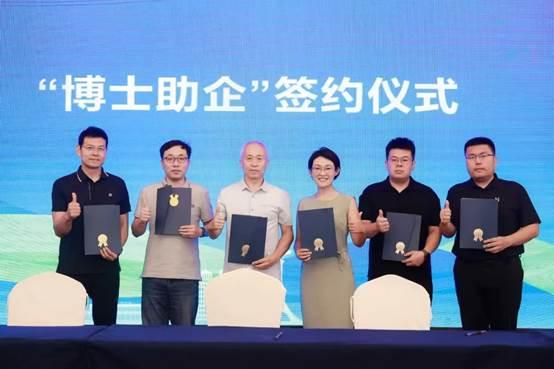
Doctoral Talent Supporting Enterprises Signing Ceremony
What’s Going On?
A “Doctor Innovation Station” established at Inner Mongolia Qianshan Heavy Industry Co., Ltd. brings together company engineers and PhD researchers (including a doctoral candidate from Inner Mongolia University of Science and Technology serving as a deputy GM) to solve practical production problems in NdFeB (neodymium-iron-boron) magnets.
The team focused on two persistent bottlenecks:
- Improving magnetic performance
- Increasing pressing/forming yield rates
Through iterative adjustments—from rare earth element ratios to sintering process parameters—the team reports:
- +10% increase in magnetic energy product
- +8% improvement in coercivity
- Yield rate improvement from 88% to >95%
From Lab to Line: Real Industrial Impact
Unlike academic research, the stated goal was direct translation to production. The results:
- Annual cost reduction of
1.5 million RMB ($200K) - ~20% increase in production efficiency
- Shift toward higher-value products (high-end NdFeB share rising from 15% to 30%)
The company also strengthened supply relationships with major industrial customers, including Baogang Group.
Why This Matters: China’s Quiet Manufacturing Edge
This is not a breakthrough in basic science. It is arguably more important: process optimization at scale.
For Western audiences, the takeaway is structural:
- Embedded R&D: Researchers working inside factories accelerate iteration cycles
- Incremental Gains, Big Impact: Small efficiency improvements compound across massive production volumes
- Cluster Effects: Other local firms are now seeking similar collaboration, spreading capability across the region
China’s advantage may not come from one big invention—but from thousands of small, coordinated improvements.
Implications for the U.S. and Allies
- Cost Competitiveness: Higher yields and lower waste reduce per-unit magnet costs
- Quality Climb: Improved magnetic properties support higher-performance applications (EVs, defense, wind turbines)
- Ecosystem Strength: Integration of universities, firms, and regional clusters deepens industrial capability
This is how industrial policy shows up on the factory floor—not as headlines, but as margin expansion and quality gains.
Breakthrough or Signal?
The reported gains are meaningful but localized. There is no indication yet of:
- Replication at the national scale
- Independent validation of performance metrics
- Detailed process disclosure
Still, the model itself—tight coupling of research and production—is likely scalable.
The Bigger Picture: Engineering the Advantage
China continues to refine its rare earth dominance not just upstream, but inside the production process itself. That is harder to replicate than mine—and potentially more durable.
Disclaimer: This report is based on content published by Baotou News. As a state-linked source, the claims and performance metrics should be independently verified.


0 Comments
No replies yet
Loading new replies...
Moderator
Join the full discussion at the Rare Earth Exchanges Forum →