
Highlights
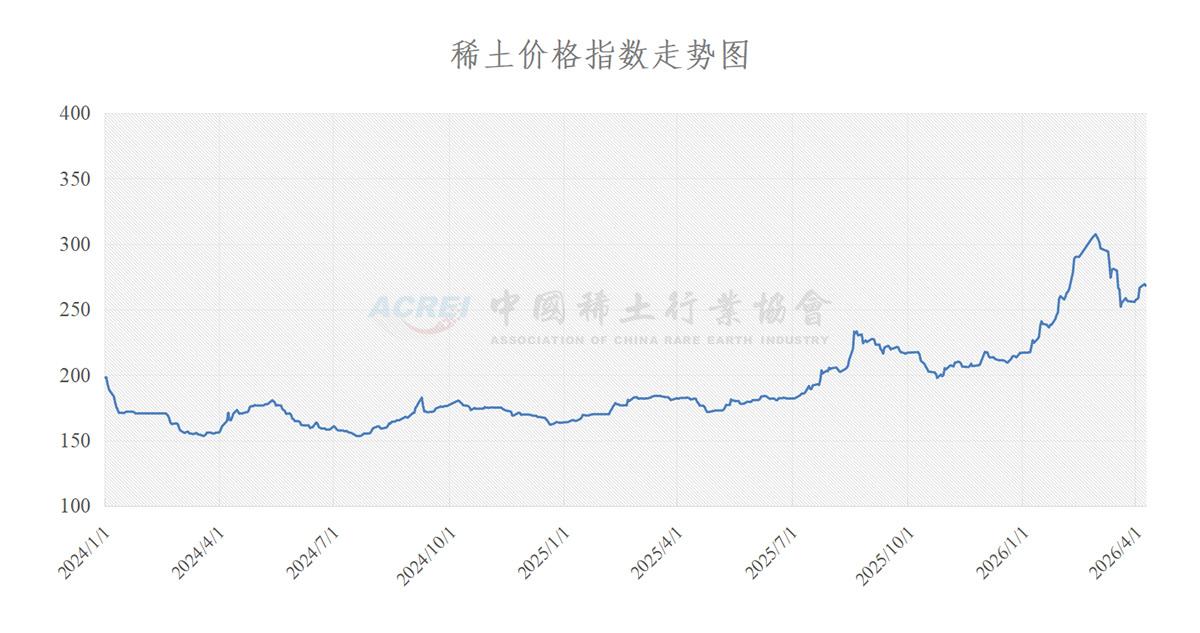
- China's rare earth price index stabilized at 268.2 on April 8, 2026—down from a 300+ peak but rebounding from mid-250s, signaling controlled market reset with early upward pressure rather than collapse.
- Magnet feedstock materials (NdPr oxide/metal, dysprosium) declined selectively while heavy rare earths like terbium remain flat and historically elevated, reflecting recalibration in EV/motor demand not broad market weakness.
- The index reinforces China's continued market control and structural price elevation, with Western supply chains still dependent on Chinese price discovery despite short-term volatility.
Index at 268.2 as magnet materials soften—but market shows signs of renewed lift
China’s rare earth price index stood at 268.2 on April 8, 2026, according to the China Rare Earth Industry Association—still dramatically above the 2010 baseline of 100. The chart tells a more nuanced story than a simple pullback: after peaking just above ~300 in early 2026, prices declined into the mid-250s before rebounding modestly back toward 268, signaling stabilization with a slight upward bias.
For U.S. and European observers, the takeaway: despite short-term volatility, China’s rare earth market remains structurally elevated—and actively managed.
What the Index Really Tracks
The index is derived from daily transaction data across Chinese rare earth enterprises, benchmarked to a 2010 base year of 100. It reflects domestic Chinese market activity, not a global spot price. In practical terms, this is the closest thing to a reference price inside the world’s dominant rare earth ecosystem—but it is not a neutral or transparent benchmark in the Western sense at all.
Under the Hood: Selective Softness, Broad Stability
The underlying product data reveals a market that is not falling—but recalibrating:
- NdPr oxide: ↓ down
- NdPr metal/alloy: ↓ down
- Dysprosium oxide: ↓ down
- Gadolinium oxide: ↓ down
- Terbium oxide: → flat
- Holmium oxide: → flat
Most light rare earths (lanthanum, cerium) and several mid/heavy elements remain flat, reinforcing the view that this is selective pressure in magnet feedstocks, not a broad-based decline.
Key nuance: Even at current levels, many heavy rare earths remain historically elevated, particularly terbium.
Chart Reality: Not Falling—Resetting, Then Firming
The price trajectory now reads as a three-stage cycle:
- Stable base through 2024–early 2025 (~150–180)
- Sharp climb through 2025 into early 2026 (>300 peak)
- Pullback → stabilization → early rebound (~268)
This is not a collapse. It is a controlled reset with early signs of upward pressure returning.
Why This Matters for the West
China is not simply participating in the market—it is shaping it, given the bulk of output processed there.
- NdPr softness may reflect downstream demand calibration (EVs, motors)
- Heavy rare earths remain structurally tight, reinforcing defense and high-performance material risk
- The rebound suggests price floors may be actively defended or naturally tighten
For Western supply chains, this reinforces a persistent reality: price discovery still runs through China.
Bottom Line
No headline breakthrough—but a powerful signal.
China’s rare earth market is:
- Elevated
- Selectively softening
- Stabilizing with upward pressure
- Firmly under centralized influence
Disclaimer: This report is based on pricing data published by the China Rare Earth Industry Association, an entity operating within China’s state-influenced industrial system. These prices reflect domestic transactions and do not arise from fully free-market dynamics, but rather from a market shaped by state coordination, industrial policy, and managed supply conditions. All figures should be independently verified before use in investment, procurement, or policy decisions.


0 Comments
No replies yet
Loading new replies...
Moderator
Join the full discussion at the Rare Earth Exchanges Forum →