
Highlights
- Kazakhstan offers Europe a critical minerals partnership combining its resource base (lithium, nickel, copper) with EU technology.
- Kazakhstan warns Brussels must act quickly or lose out to China and the U.S.
- Europe's friendshoring strategy extends to Kazakhstan and Uzbekistan as domestic mineral autonomy is impossible.
- Clean energy and defense needs require strategic partnerships beyond Canada and Australia.
- The Kazakhstan-EU Gateway signals Europe's next upstream projects will include:
- Joint venture refining plants
- Lithium processing hubs
- ESG-compliant supply chains outside Chinese dominance
Europe rarely receives such a blunt warning: “Kazakhstan is ready to do business with the European Union (EU). But if the EU is too slow, it will miss the bus.” That line—offered by Professor Peter Tom Jones, Director of the KU Leuven SIM2 Institute—hung over yesterday’s Kazakhstan–EU Gateway launch in Brussels like an industrial policy flare. It signaled urgency, opportunity, and a quiet frustration increasingly felt across Europe’s critical-minerals community.
Table of Contents
Rare Earth Exchanges tracks experts, such as Professor Jones, key influencers in this evolving, nascent ex-China rare earth and critical mineral supply chain.
The Friendshoring Imperative
Europe cannot become autonomous in critical raw materials. That is not pessimism—it is physics, geology, and time. The EU’s clean-energy, digital-technology, and defense requirements cannot be met solely from domestic deposits, even under the most optimistic CRM Act scenarios.
Kazakhstan–EU Gateway’s new cooperation platform
Thus, “friendshoring” has become more than a buzzword. It is the architecture of Europe’s survival strategy: MoUs with Canada, Australia, Chile, Argentina, Ukraine—and now, pointedly, Uzbekistan and Kazakhstan. Europe is extending its diplomatic radius because supply chains have become fault lines in a disorderly world where, as Tom Jones notes, a “resource Marxist” sits across the Atlantic shaping U.S. industrial policy through export controls, subsidies, and de-risking rhetoric.
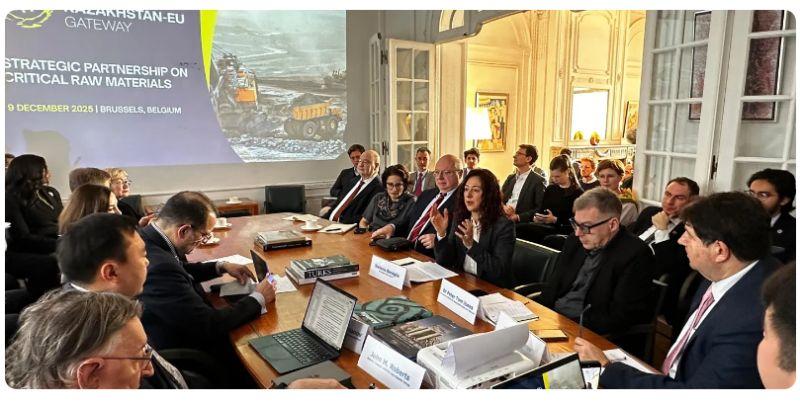
Kazakhstan’s Moment—and Europe’s Opening
Kazakhstan carries real industrial weight: substantial lithium, nickel, copper, and rare-earth endowments; a rising appetite for joint ventures; and a Eurasian logistics position that can feed both European gigafactories and defense supply chains.
Professor Jones’s message was straightforward: Europe excels at innovation—advanced battery chemistries, low-impact mining, precision refining, and recycling—but falters at deployment. Kazakhstan, on the other hand, has the scale, political will, and resource base to move quickly.
The proposition is asymmetrically perfect:
Europe brings technology. Kazakhstan brings throughput. Together, they build resilience.
It is a partnership model that avoids replicating China’s dominant extract-to-refine architecture while preventing Europe from sliding into a patchwork of new dependencies.
Why This Matters to Rare Earth and Battery Investors
The Kazakhstan–EU Gateway is not diplomatic theater. It is an early indicator of where Europe’s next wave of upstream and midstream projects may be anchored: pilot refining plants, JV hydromet facilities, lithium processing hubs, and traceability-driven ESG frameworks.
If Brussels moves slowly, China—or increasingly, the U.S.—will not. And in a world where gigafactories are being built faster than the mines that feed them, timing is no longer strategic. It is existential.
Professor Jones shared the fullreport. (opens in a new tab)
© 2025 Rare Earth Exchanges™ – Accelerating Transparency, Accuracy, and Insight Across the Rare Earth & Critical Minerals Supply Chain


0 Comments
Discuss this article