
Highlights
- China's rare earth price index at 267.0 signals stability through active economic management, not true market equilibrium, with NdPr around $111-113/kg and heavy rare earths structurally tight.
- A parallel ex-China pricing regime is forming with U.S. DoD-backed floors around $110/kg for NdPr, supported by strategic supply chain policies rather than spot market forces.
- The global rare earth market is bifurcating into two systems: China's controlled, policy-smoothed pricing versus ex-China's higher-cost, government-supported, supply-security driven model.
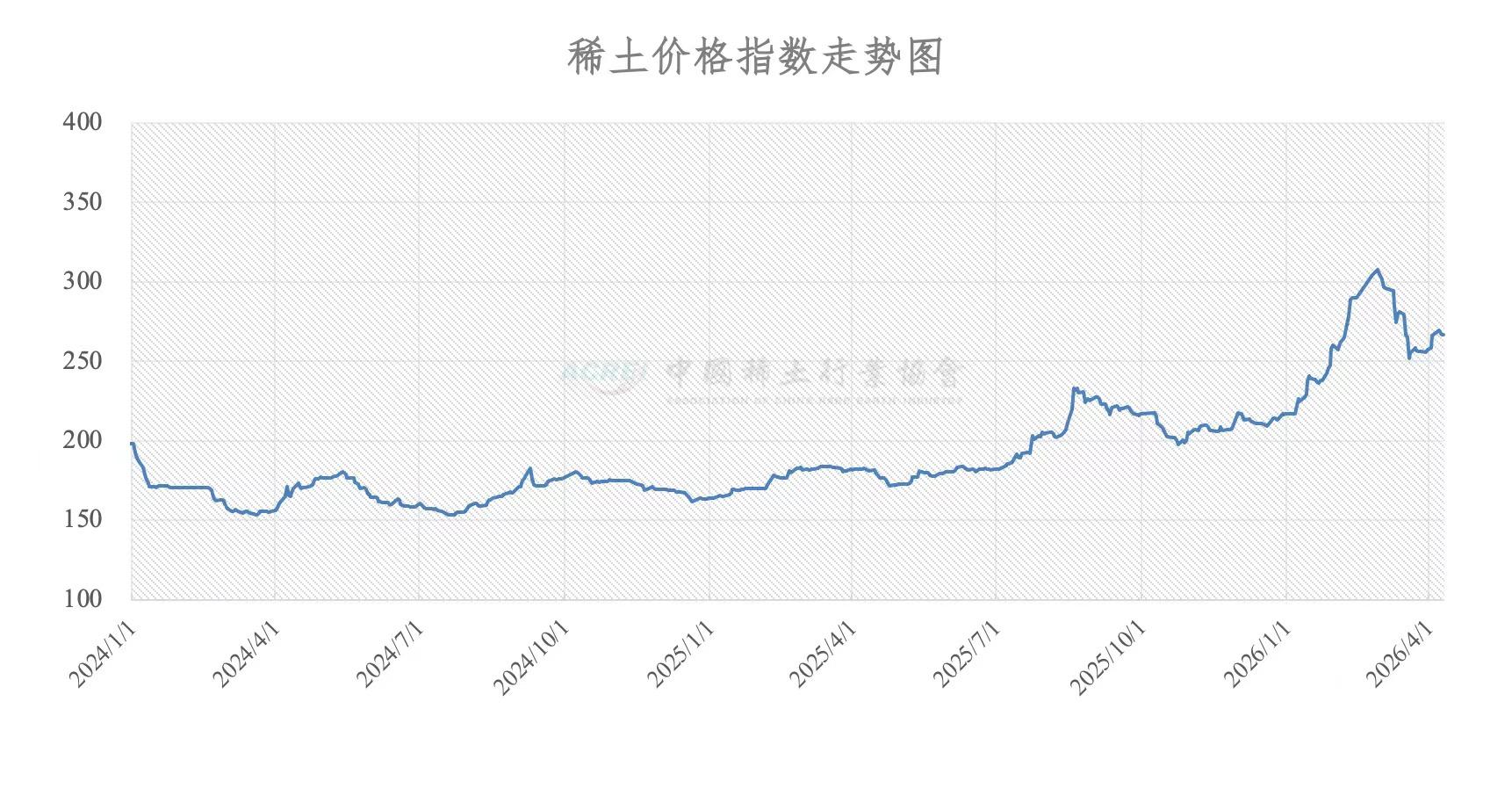
China’s rare earth price index printed 267.0 on April 10, 2026, signaling stability. But this is not a market-clearing price—it is a managed indicator inside a state-influenced system. More importantly, a second market is beginning to form: an “ex-China” pricing regime, increasingly shaped by government floors and strategic supply chain policies.
Rare Earth Price Index Trend Chart
The Headline Number—And What It Really Means
According to the China Rare Earth Industry Association, the rare earth price index reached 267.0, using 2010 as a base of 100.
How It’s Calculated
- Based on average daily domestic transactions
- Aggregated across Chinese enterprises
- Processed through a proprietary index model
This is not Brent crude or LME copper.
It is a constructed signal reflecting China’s internal market conditions.
What the Underlying Prices Show
From disclosed product ranges:
- NdPr oxide: 797–817 RMB/kg ($111–113/kg)
- NdPr metal: 990–1,010 RMB/kg ($138–140/kg)
- Dysprosium oxide: 2,225–2,425 RMB/kg ($309–337/kg)
Key signals:
- Heavy rare earths remain structurally tight (much higher ex-China)
- NdPr continues as the volume and margin driver
- Prices are stable—but far from cheap
Stability by Design, Not by Market
China’s pricing system:
- Smooths volatility
- Anchors expectations
- Aligns with industrial policy
This is not passive reporting.
It is active economic management.
The result: a system that appears stable even when global fundamentals are not.
The Real Shift: A Two-Tier Market Emerges
What’s changing—and what matters most—is happening outside China.
A parallel “ex-China” market is forming, with distinct pricing dynamics:
- In the U.S., Department of Defense-backed arrangements—most notably involving MP Materials—are effectively supporting NdPr price floors around ~$110/kg
- Australia and allied jurisdictions are exploring similar mechanisms to de-risk project economics
- Long-term offtakes and subsidies are beginning to replace spot pricing with policy-driven pricing
Translation:
The world is moving toward two price systems:
- China market → controlled, opaque, policy-smoothed
- Ex-China market → higher-cost, policy-supported, supply-security driven
Why Investors Should Pay Attention
This bifurcation has real consequences:
- Ex-China supply will likely come at a premium to Chinese prices
- Government-backed floors may distort capital allocation—but enable production
- True price discovery becomes fragmented across jurisdictions
Most importantly:
The “global price” for rare earths may no longer exist.
The Bottom Line
China’s index at 267.0 signals calm.
But calm is not equilibrium.
It is control—inside one system.
Outside that system, a new market is forming—
more expensive, less efficient, but strategically necessary.
For investors, the playbook is changing:
Don’t ask “what is the price?”
Ask “which market are you in?”
Disclaimer: This data originates from the China Rare Earth Industry Association, a state-linked industry body. Reported prices reflect domestic Chinese conditions and internal methodologies shaped by state influence and are not indicative of free-market global price discovery. Independent verification is recommended.


0 Comments
No replies yet
Loading new replies...
Moderator
Join the full discussion at the Rare Earth Exchanges Forum →