
Highlights
- Supply chain professionals are evolving from transactional procurement roles to strategic operators controlling interfaces across five tiers—from raw resource extraction to final system assembly.
- Risk mitigation has shifted from managing supplier failure to preventing interface failures between tiers, where disruptions originate upstream and cascade downstream.
- Success in defense and aerospace now depends on controlling the seams between supply chain tiers, not just owning top-tier suppliers or superior engineering.
So why is controlling the supply chain interface now the decisive advantage? For decades, supply chain functions in defense and aerospace were viewed as transactional—focused on procurement, cost control, and vendor management. That era is over. A new model is emerging across the industry, one that transforms supply chain professionals into central operators of program execution, risk control, and strategic advantage.
But as Rare Earth Exchanges™ (REEx) has consistently highlighted, this transformation only makes sense when viewed through the lens of the five-tier supply chain—from raw materials to finished systems. The modern supply chain professional is not just managing suppliers; they are increasingly responsible for controlling the interfaces between tiers, where the real risk—and leverage—resides. Advanced technology including digital twins and other AI-powered capabilities become ever more prevalent.
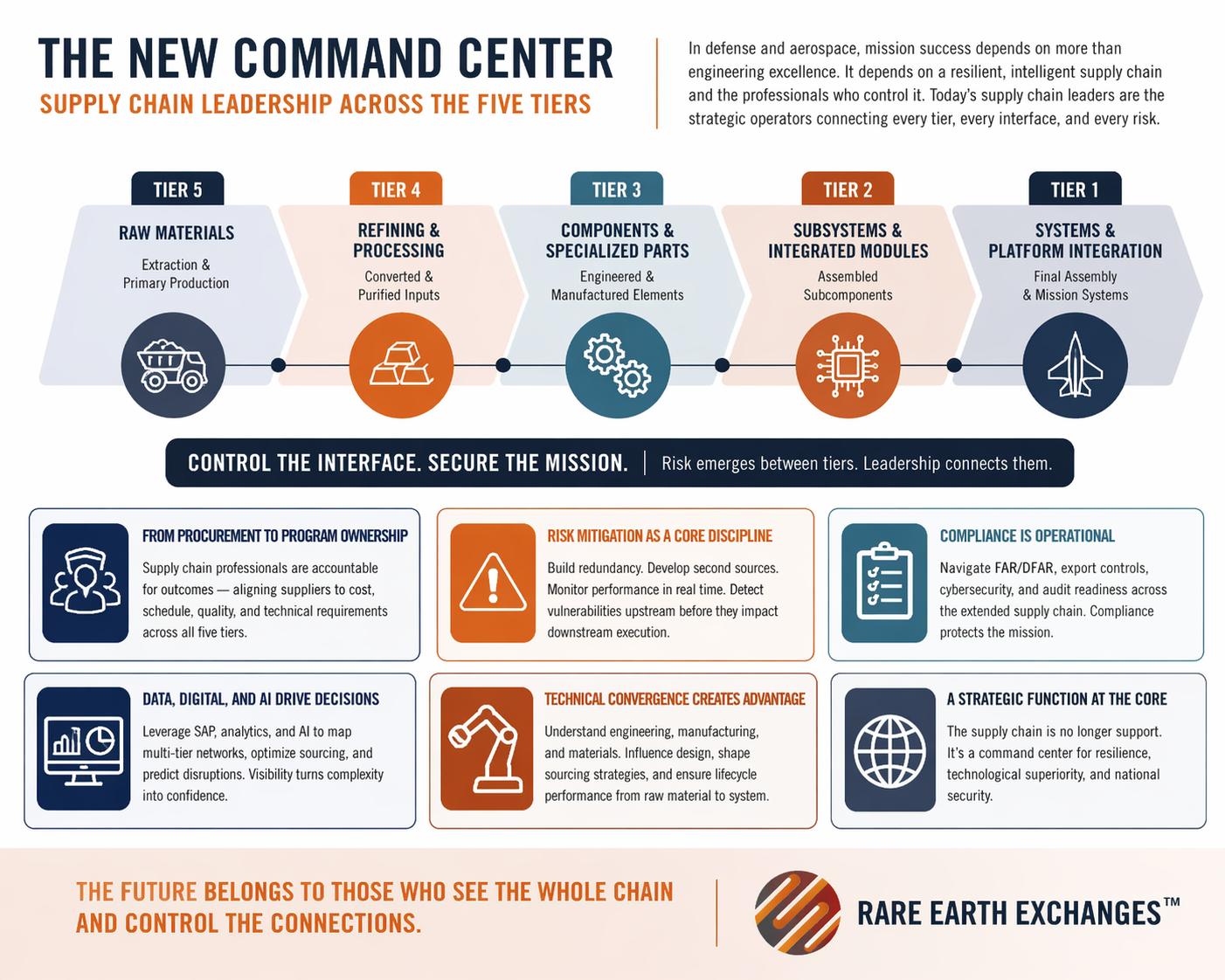
From Procurement to Program Ownership—Across All Five Tiers
Today’s supply chain roles span a wide spectrum—from subcontract administrators and materials analysts to procurement engineers, compliance leaders, and AI developers. What unites them is a shift toward end-to-end accountability.
But “end-to-end” now means something far more complex:
- Tier 1: Prime integrators and final system assembly
- Tier 2: Subsystems and components
Tier 3: Specialized parts and materials processing* Tier 4: Refined inputs (metals, chemicals, engineered materials)
- Tier 5: Raw resource extraction
REEx has repeatedly underscored a critical truth:
Most organizations control Tier 1 and partially Tier 2—but are blind to Tiers 3–5. The new supply chain professional is being asked to close that gap—ensuring not just supplier performance, but tier-to-tier continuity.
Risk Mitigation: From Supplier Risk to Systemic Risk
A defining feature of the modern defense supply chain is its relentless focus on risk. But the nature of that risk has evolved.
Historically:
- Risk = supplier failure
Today:
- Risk = interface failure between tiers
This is where REEx’s framework becomes essential. Disruptions rarely originate at Tier 1—they emerge upstream:
- A Tier 4 processing bottleneck
- A Tier 5 geopolitical shock
- A Tier 3 single-point-of-failure component
Modern supply chain teams are now tasked with:
- Building second-source pathways across tiers, not just vendors
- Monitoring multi-tier dependencies in real time
- Escalating issues before they cascade downstream
In effect, they are becoming system integrators of risk and risk-based continuous assessment, not just managers of suppliers.
Controlling the Interface: Where Value and Vulnerability Converge
REEx has emphasized that the most important control point in modern supply chains is not ownership—it is interface control.
Why? Because:
- Materials change form and value at each tier
- Specifications tighten as you move downstream
- Substitution becomes harder at each transition
The supply chain professional’s role is shifting toward:
- Ensuring spec alignment between tiers
- Managing handoff risk (quality, timing, compliance)
- Maintaining visibility into upstream transformations
This is especially critical in sectors dependent on:
- Rare earth elements and critical minerals
- Advanced alloys
- Semiconductor inputs
- Energy transition materials
In these domains, losing control of the interface = losing control of the supply chain.
Compliance: The Hidden Thread Binding the Tiers
Regulatory complexity has elevated compliance into a cross-tier discipline.
Supply chain professionals must now ensure:
- FAR/DFAR compliance at Tier 1 and Tier 2
- Export controls and ITAR sensitivity across tiers
- Cybersecurity and documentation integrity throughout
The challenge:
Compliance requirements do not stop at your supplier—they propagate upstream.
This forces supply chain teams to act as:
- Auditors of extended networks
- Enforcers of standards beyond direct contracts
The Digital Layer: Mapping the Invisible Supply Chain
The rise of digital tools and AI is not just about efficiency—it is about visibility into previously opaque tiers.
Modern capabilities include:
- Multi-tier supply chain mapping
- Predictive risk modeling
- Supplier performance analytics
- AI-driven scenario planning
This aligns directly with REEx’s warning:
The greatest risk in modern supply chains is not what you see—it is what you don’t.
Digital supply chain professionals are now expected to illuminate Tiers 3–5, turning hidden dependencies into actionable intelligence.
Technical Convergence: Designing for Supply Chain Reality
The convergence of engineering and supply chain is no longer optional—it is inevitable.
Why?
Because:
- Design decisions determine Tier 3–5 dependencies
- Material selection locks in geopolitical exposure
- Manufacturing complexity dictates supplier concentration
Modern supply chain professionals must:
- Influence design for manufacturability and sourcing
- Align engineering with supply chain constraints
- Anticipate lifecycle risks from material to system
This is where REEx’s thesis becomes operational:
Deposits are not supply chains. Processing is power. Interfaces are control.
The Strategic Shift: From Cost Center to Control Tower
The overarching pattern is clear: the supply chain is no longer a support function. It has become a strategic command center. This is especially so if one buys into the REEx Great Powers Era 2.0 premise. And the daily news seems to be pointing to our accuracy.
And for this strategic command center, more specifically, it is becoming a:
- Multi-tier risk orchestrator
- Interface control authority
- Geopolitical exposure manager
- Digital intelligence hub
In an era defined by:
- Fragmented globalization
- Resource nationalism
- Technological competition
The supply chain professional is emerging as a frontline actor in national capability and industrial resilience.
Final Take: The REEx Reality
For defense contractors and aerospace firms, the implication is profound:
Success will not be determined by:
- Who has the best Tier 1 supplier
- Or even the best engineering
Rather, it will be determined by: Who understands—and controls—the interfaces across all five tiers. Because in today’s environment:
- Supply chains don’t fail at the top
- They fracture at the seams
And those seams—the interfaces—are now the domain of the modern supply chain professional.


0 Comments
No replies yet
Loading new replies...
Moderator
Join the full discussion at the Rare Earth Exchanges Forum →