
Highlights
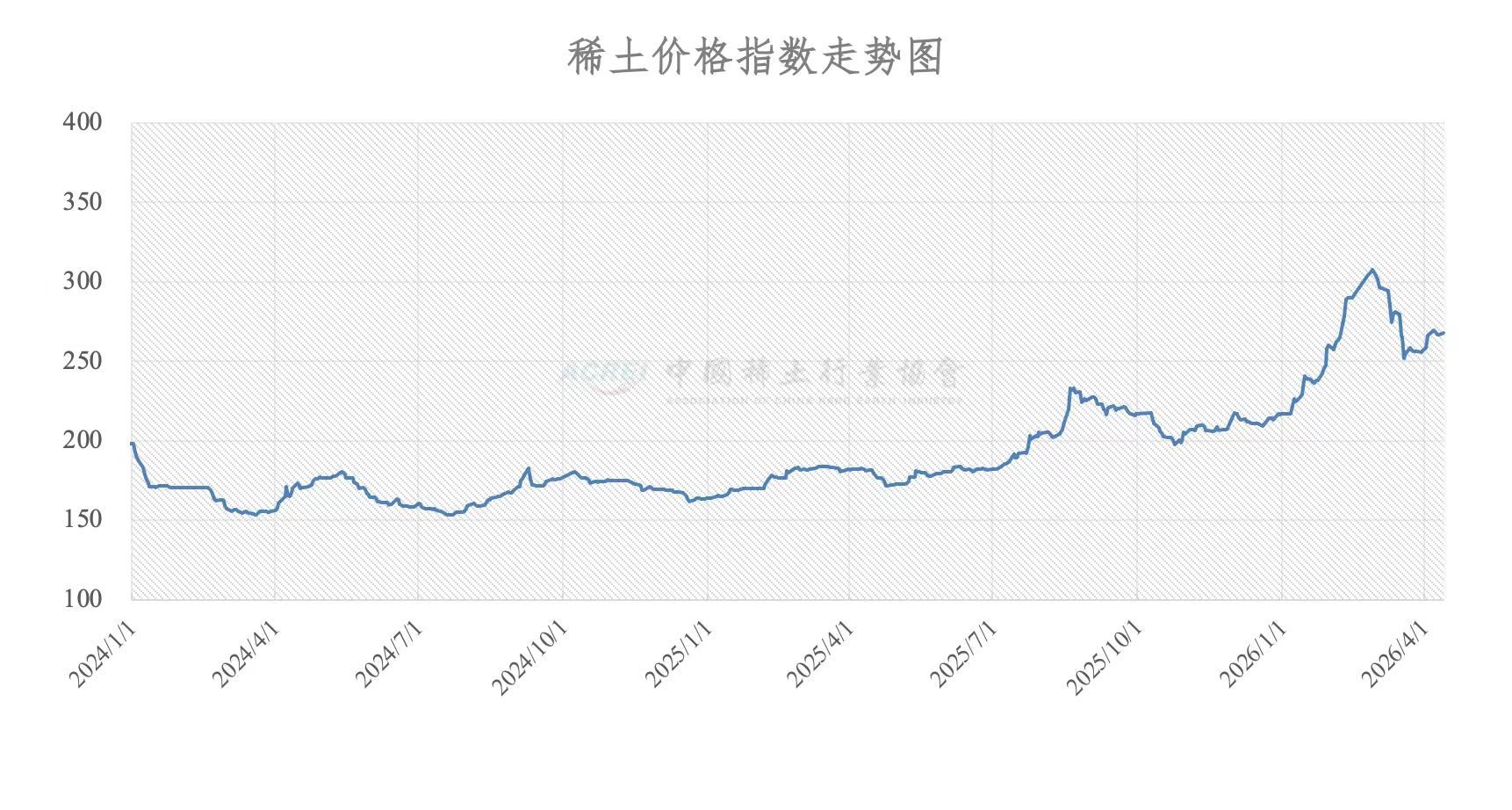
- China's rare earth price index sits at 271.8—nearly triple its 2010 baseline—but this isn't a true market signal; it reflects state quotas, export controls, and policy objectives rather than transparent supply and demand.
- Western nations are building parallel supply chains yet remain structurally dependent on China's pricing system, creating a paradox where independence efforts still rely on the very market they're trying to escape.
- True price discovery requires scaled independent processing, standardized specifications, and transparent trading venues—until then, investors face a fragmented system where no single price reflects actual market reality.
The latest update from the China Rare Earth Industry Association places the country’s rare earth price index at 271.8, nearly three times its 2010 base level. On its face, the signal is clear: prices remain elevated, particularly for magnet-critical materials such as neodymium, praseodymium, dysprosium, and terbium. But for investors and policymakers, the more important question is not where prices sit. It is what those prices actually represent.
A Benchmark Without a True Market
China’s pricing system is often treated as the global benchmark for rare earths. Yet it does not function like a conventional commodity market. There is no true open exchange (although one is touted), no continuous order book, and no transparent clearing mechanism. Also, no futures exchange. Instead, prices are derived from reported transactions among domestic firms—firms that operate within a tightly managed industrial system.
That system is shaped by:
- State production quotas
- Export controls and licensing
- Strategic stockpiling and coordinated releases
- Consolidation into large, state-aligned enterprises
The result is a pricing environment that reflects policy objectives as much as supply and demand.
China’s index, therefore, is best understood not as a free-market signal, but as a state-influenced reference point—one that still anchors global expectations because of China’s overwhelming dominance in processing and magnet production.
The Structural Trap for the West
Western governments are attempting to build a parallel rare earth supply chain, supported by subsidies, stockpiles, and long-term offtake agreements. Yet price discovery remains stubbornly tethered to China.
The reason is simple: China still processes the vast majority of the world’s rare earth materials. Even when ores are mined elsewhere, they frequently pass through Chinese separation or magnet manufacturing before reaching end markets.
This creates a structural paradox. The West seeks independence, but its pricing logic still depends on the very system it is trying to escape.
The Mirage of Western Price Indices
In response, a number of firms and data providers have begun publishing “ex-China” rare earth price benchmarks. These efforts are important—but they remain incomplete.
Unlike China’s system, Western markets suffer from the opposite problem: too little visibility.
- Transactions are bilateral and confidential
- Contracts are often long-term and bespoke
- Pricing may reflect strategic considerations, not just market forces
As a result, Western indices are typically:
- Survey-based
- Intermittent
- Dependent on limited disclosed data
They provide guidance, but not true price discovery.
What Real Pricing Looks Like Today
In practice, rare earth pricing now operates in layers:
- China sets the baseline, albeit within a managed, distorted system
- Western supply commands a premium, particularly for secure, traceable material
- Strategic buyers accept “ex-China” pricing, especially in defense and critical infrastructure
This is not a unified market. It is a hybrid system, shaped simultaneously by state control in China and strategic intervention in the West. Remember, it’s the government in the West setting the $110 per kg baseline—at least in a couple of contracts.
The Market That Has Yet to Form
The emergence of a genuine ex-China pricing regime will require more than policy support. It will demand:
- Scaled, independent processing capacity
- Standardized product specifications
- Transparent transaction reporting
- Ultimately, a credible trading venue
- An honest media
Until then, the world remains in an uncomfortable transition.
China’s prices dominate global perception—but they do not reflect a free market. Western prices are emerging—but they are not yet fully formed.
The consequence is a system in which no single price can be taken at face value.
For investors, that is not just a complication. It is the defining feature of the rare earth market today. What impacts does this have on the investor community and investment decision-making?


0 Comments
No replies yet
Loading new replies...
Moderator
Join the full discussion at the Rare Earth Exchanges Forum →