
Highlights
- China's rare earth price index rose to 283.2 on April 21, 2026—nearly 2.8 times the 2010 baseline—driven by sharp increases in magnet-linked materials like PrNd oxide, terbium, and neodymium, while commodity light rare earths remained flat.
- The market shows clear bifurcation: strategic magnet materials critical for EVs, advanced motors, and defense are tightening and gaining strength, while lower-value light rare earths like cerium and lanthanum stay subdued, signaling concentrated demand in high-performance applications.
- China maintains dominant pricing power over rare earths through state influence and opaque domestic markets, while ex-China pricing offers no transparent alternative—remaining fragmented, thinly traded, and shaped by bilateral contracts under Chinese supply dominance.
China’s rare earth price index rose to 283.2 on April 21, 2026, according to data published by the China Association of Rare Earth Industry. With 2010 set as the base year at 100, the index now stands at nearly 2.8 times that baseline.
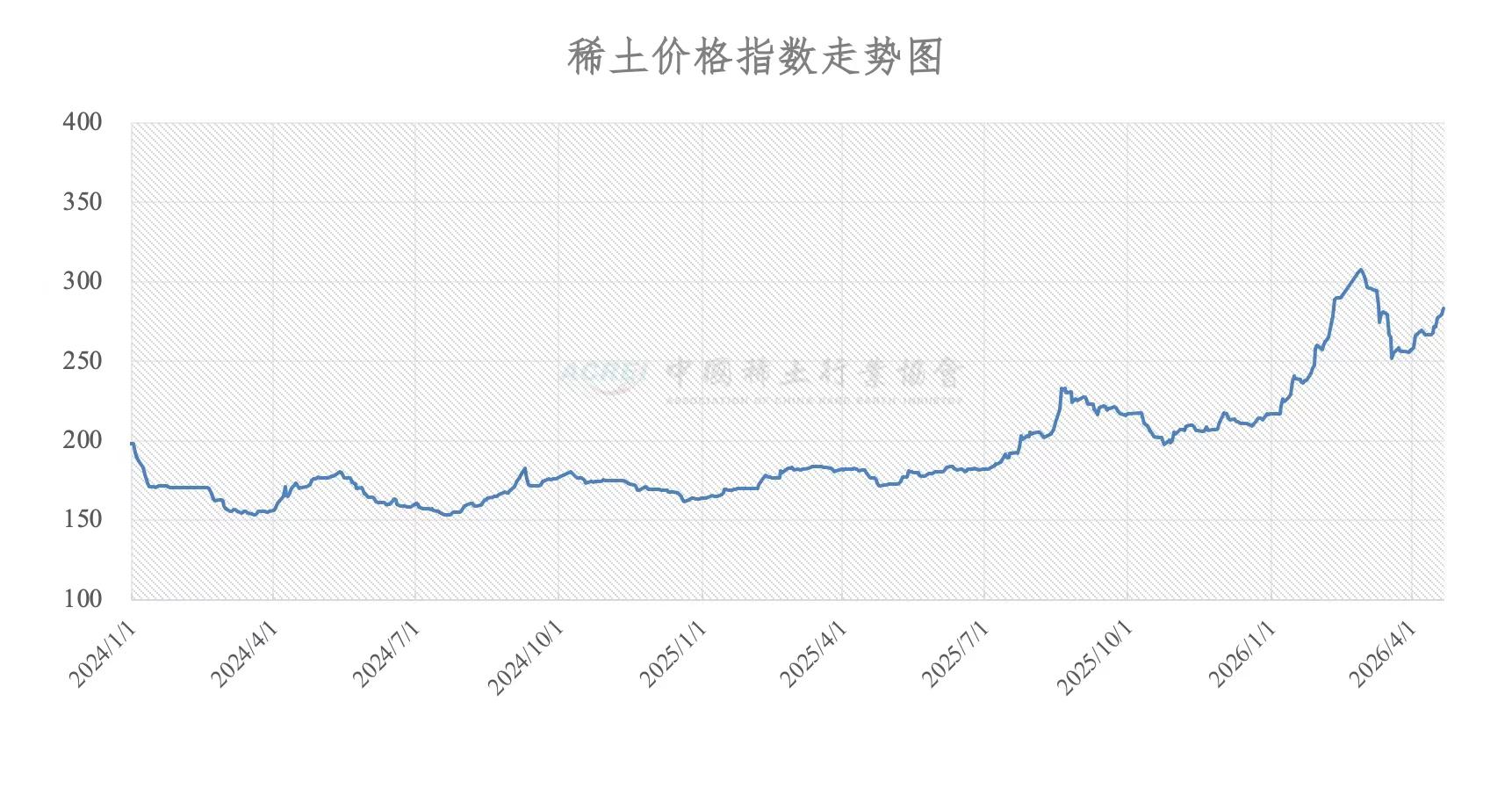
The chart shows a market that was relatively range-bound through much of 2024 and early 2025, then turned sharply higher in the second half of 2025, with volatility increasing into early 2026. The broad direction is clear: strategic rare earth prices inside China have strengthened materially.
But this should be read with caution. This is not a transparent market-clearing benchmark in the Western sense. The index is calculated from daily transaction averages reported by domestic rare earth enterprises in China, which means it reflects a market shaped by state ownership, industrial policy, licensing controls, and administrative influence.
Magnet Materials Lead the Move
The strongest signals are again coming from magnet-linked materials.
On April 21, the published domestic reference ranges included:
- PrNd oxide at ¥805.3–825.3/kg, or about $111.85–$114.63/kg at roughly 7.2 RMB/USD, and marked up.
- PrNd metal came in at ¥980.2–1000.2/kg, or about $136.14–$138.92/kg, also up.
Dysprosium oxide was listed at ¥1350–1390/kg, or about $187.50–$193.06/kg, and was flat. Terbium oxide stood at ¥854.4–874.4/kg, or about $118.67–$121.44/kg, and was up. Neodymium oxide itself was lower than PrNd oxide, at ¥539.0–559.0/kg, or about $74.86–$77.64/kg, also up.
Meanwhile, lower-value light rare earths remained comparatively subdued. Cerium oxide was flat at ¥4.0–6.0/kg and lanthanum oxide was flat at ¥13.4–15.4/kg, reinforcing the divide between commodity-like light rare earths and strategically important magnet materials.
A Bifurcated Market Is Taking Shape
The table points to a split market. The materials tied most directly to permanent magnets, electrified mobility, advanced motors, and defense applications are firm or rising. Much of the lower-value light rare earth complex is flat.
That pattern matters. It suggests that the strongest pricing momentum remains concentrated in the parts of the rare earth chain that matter most for high-performance magnets and strategic manufacturing, rather than indicating a broad-based industrial upswing across the entire complex.
Holmium also showed strength, with holmium oxide and holmium metal both showing higher levels, while dysprosium remained stable at elevated levels. In practical terms, the heavy rare earth segment remains tight, even as day-to-day price movements are uneven.
What It Means for the West
There is no technical breakthrough in this update. The significance is structural.
China continues to dominate the reference-pricing environment for rare earths, especially for those linked to magnets. That gives Western buyers little real price discovery.
And the so-called ex-China price is not a true, transparent benchmark either. Those markets are often thinly traded, opaque, negotiated through bilateral contracts, and shaped by volume, end-use restrictions, delivery terms, and geopolitical risk premiums. Plus, the terms of these agreements are highly confidential in most cases. Although some agencies pay for access to snippets of deidentified numbers.
So while the domestic Chinese index is not a free-market price, ex-China pricing is not a clean alternative. It is often better understood as fragmented negotiated pricing under Chinese supply dominance.
Bottom Line
China’s April 21 data show a rare earth market that is still tightening where it matters most: PrNd, terbium, dysprosium, and related magnet materials. Light rare earths remain weak by comparison.
The takeaway is not simply that prices are up. It is that strategic pricing power remains centered in China, and the materials gaining strength are those most critical to electric vehicles, advanced motors, and defense supply chains.
Disclaimer: This report is based on pricing data published by the China Association of Rare Earth Industry, drawing on domestic enterprise transaction data. The information originates from a Chinese industry body operating within a state-influenced industrial system and should be independently verified. These prices should not be interpreted as equivalent to transparent global market prices.


0 Comments
No replies yet
Loading new replies...
Moderator
Join the full discussion at the Rare Earth Exchanges Forum →