
Highlights
- China dominates not just rare earth mining but the critical reagent supply chains—ammonium sulfate, magnesium sulfate, and aluminum sulfate systems—that make extraction economically viable.
- Western attempts to substitute seawater or low-grade brines fail in practice, causing lower recovery rates, system fouling, higher energy costs, and degraded economics.
- Washington funds mining and magnets but ignores the middle: the U.S. must classify reagents as strategic materials, build domestic production, and stockpile critical leaching chemicals.
The West has spent the last few years obsessing over rare earth mining. It is chasing deposits, funding projects, and talking about “mine-to-magnet independence.” But yet another real bottleneck has quietly shifted—and it’s not in the ground. It’s in chemistry.
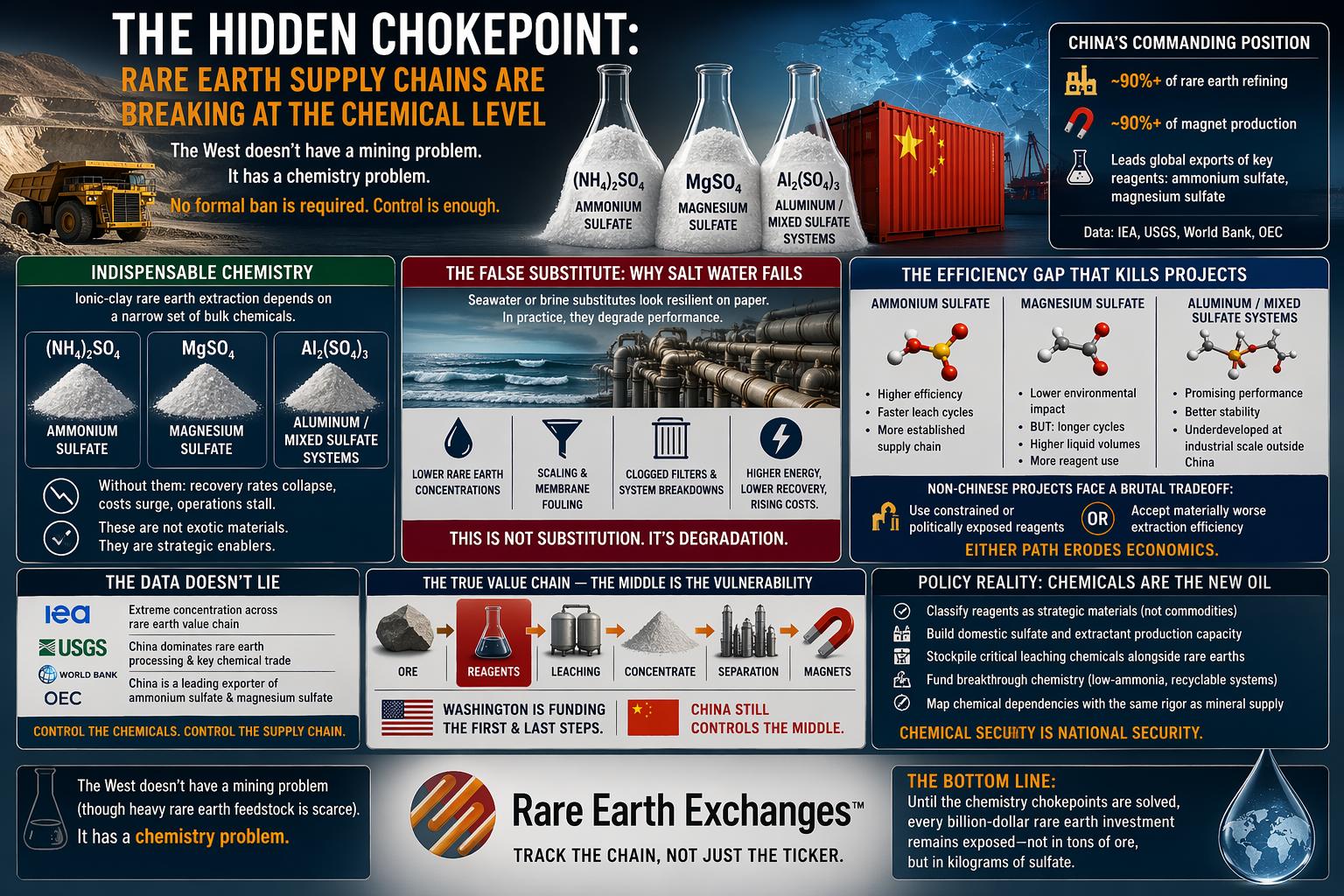
At the center of modern ionic-clay rare earth extraction is a narrow set of reagents: ammonium sulfate, magnesium sulfate, and increasingly aluminum- or mixed-sulfate systems. These are not exotic materials. They are bulk chemicals. But in rare earth processing, they are indispensable. Without them, recovery rates collapse, costs surge, and operations stall.
Here’s the uncomfortable reality: China dominates not just rare earth refining (90%+) and magnet production (90%+), but also sits in a commanding position across key upstream reagent supply chains. Data from the International Energy Agency and U.S. Geological Survey show that concentration across the value chain remains extreme. Trade data from the World Bank and OEC confirm China as a leading exporter of ammonium sulfate and magnesium sulfate—chemicals now emerging as strategic inputs.
No formal ban is required. Control is enough.
The False Substitute: Why Salt Water Fails
In response, some Western operators are experimenting with seawater or low-grade brine substitutes. On paper, this looks like resilience. In practice, it’s a step backward. Research shows seawater-based leaching produces significantly lower rare earth concentrations unless supplemented with traditional reagents. Worse, salt-heavy systems introduce scaling, membrane fouling, and filtration breakdowns—well-documented challenges in desalination literature. The result: clogged systems, higher energy use, lower recovery, and rising operating costs.
This is not substitution. It’s degradation.
The Efficiency Gap That Kills Projects
Magnesium sulfate offers environmental advantages over ammonium sulfate, but at a cost: longer leach cycles, higher liquid volumes, and increased reagent consumption. Aluminum sulfate and mixed systems show promise—higher efficiency, better stability—but remain underdeveloped at industrial scale outside China.
This leaves non-Chinese projects trapped in a brutal tradeoff:
- Use constrained or politically exposed reagents
- Or accept materially worse extraction efficiency
Either path erodes economics.
A Strategic Blind Spot in Washington
Rare Earth Exchanges™ continues to chronicle the reality that U.S. still lacks commercial-scale heavy rare earth separation. But even that framing is incomplete. The real vulnerability starts earlier.
The system looks like this in at least some value chains:
- Ore → Reagents → Leaching → Concentrate → Separation → Magnets
Washington is funding the first and last steps. China still controls the middle.
Policy Reality: Chemicals Are the New Oil
If the U.S. wants a viable rare earth supply chain, it must pivot immediately:
- Classify reagents as strategic materials (not commodities)
- Build domestic sulfate and extractant production capacity
- Stockpile critical leaching chemicals alongside rare earths
- Fund breakthrough chemistry (low-ammonia, recyclable systems)
- Map chemical dependencies with the same rigor as mineral supply
There are a number of other moves Washington DC needs to make but we’ll save for a different day.
And here’s the bottom line:
The West, first and foremost, doesn’t have a mining problem, although appropriate feedstock, especially of the heavy rare earth sort, is scarce now. And the West has a major chemistry problem. And until that is solved, every billion-dollar rare earth investment remains exposed to at least one single (and perhaps a few), quiet chokepoint—one measured not in tons of ore, but in kilograms of sulfate.


0 Comments
No replies yet
Loading new replies...
Moderator
Join the full discussion at the Rare Earth Exchanges Forum →