
Highlights
- China's rare earth price index reached 284.9 on April 22, 2026, showing selective increases in strategic heavy rare earths (dysprosium, terbium) while most materials, including NdPr magnet feedstock, remain flat—signaling targeted supply pressure rather than broad market tightening.
- Neither the Chinese domestic nor the ex-China rare earth markets reflect free-market pricing; China's state-influenced system uses production quotas and internal transaction data, while ex-China deals are bilateral, opaque, and can cost multiple times higher than reported benchmarks.
- Heavy rare earth price sensitivity creates strategic risk for U.S. defense systems, EVs, and wind turbines that depend on dysprosium and terbium for high-performance magnets, even as base magnet material NdPr remains stable.
A benchmark moves higher—but what does it really mean? China’s rare earth price index reached 284.9 on April 22, 2026, according to the China Association of Rare Earth Industry (CARI). The index—benchmarked to 2010 levels (base = 100)—is calculated using aggregated domestic transaction data reported by Chinese rare earth enterprises, averaged into a composite pricing model.
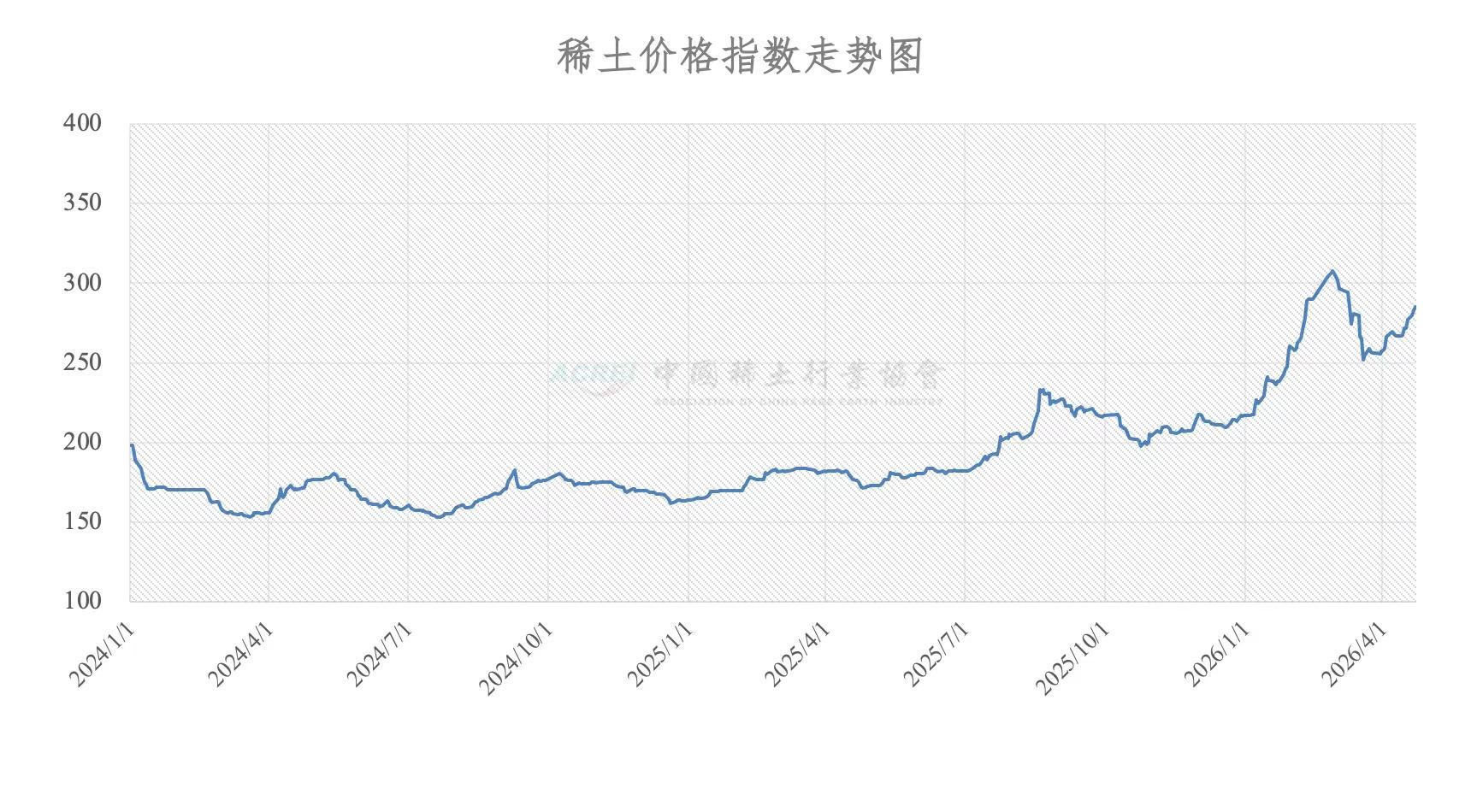
No Market Pricing?
Neither China’s domestic rare earth prices nor ex-China prices reflect a true “free market.” Inside China, pricing is shaped by a state-influenced system that includes production quotas, environmental controls, export licensing, consolidation into large state-backed groups, and the use of internal transaction data rather than open exchange-based discovery.
These mechanisms can stabilize or steer prices in ways that reflect industrial policy as much as supply–demand fundamentals. Outside China, the situation is not meaningfully more transparent.
The global (ex-China) market is thinly traded, highly fragmented, and largely bilateral, with most material still flowing through Chinese-controlled or influenced processing capacity. Prices are often set through confidential, bespoke contracts rather than liquid spot markets, and can include embedded premiums tied to security of supply, qualification status, and geopolitical risk.
The result is a bifurcated system where China sets the center of gravity, and ex-China pricing reflects scarcity, opacity, and strategic hedging—not classical free-market equilibrium.
What’s Relevant?
For a U.S. business audience, the key point is this: the index reflects China’s internal pricing environment, not a transparent global benchmark. Still, it remains one of the few consistent directional indicators of pricing pressure inside the world’s dominant rare earth system.
Under the Surface: Mostly Stable Prices, Select Strength in Key Materials
The accompanying price table shows that most rare earth products are unchanged (“flat”) on the day, including major light rare earths:
- Cerium oxide: ¥4.0–6.0/kg (~$0.55–$0.85/kg)
- Lanthanum oxide: ¥4.0–6.0/kg (~$0.55–$0.85/kg)
However, several mid- to heavy rare earths show upward movement, including:
- Dysprosium oxide: ¥1360–1400/kg ($189–$194/kg) ↑
- Terbium oxide: ¥6095–6155/kg ($847–$855/kg) ↑
- Gadolinium oxide: ¥860–880/kg (~$119–$122/kg) ↑
- Holmium oxide: ¥539–560/kg (~$75–$78/kg) ↑
In contrast, key magnet material neodymium-praseodymium (NdPr oxide) remains stable at:
- NdPr oxide: ¥810–830/kg (~$112–$115/kg) — flat
Important nuance: This is not a broad-based rally. The data reflects selective price increases in specific heavy rare earths, while most of the complex—including NdPr—remains stable.
No Breakthroughs—But a Familiar Structural Pattern
There are no policy announcements or structural changes in this release. However, the data reinforces several realities:
- The index is based on internally reported enterprise transactions, not open global price discovery
- Pricing signals are directional but not fully transparent
- Heavy rare earths (Dy, Tb) continue to show episodic upward pressure, consistent with tight supply dynamics
A more precise framing: the market operates within a state-influenced industrial system, which can shape supply, liquidity, and pricing behavior.
Why This Matters for the U.S. and Europe
Even modest increases in heavy rare earth prices can have outsized downstream implications:
- Defense systems depend on Dy/Tb for high-temperature magnet performance
- EVs and wind turbines rely on NdFeB magnets doped with heavy rare earths
- Procurement risk rises when pricing is opaque, and supply is concentrated
Notably, while NdPr remains stable, the real constraint is not base magnet material—it is access to heavy rare earth inputs. And remember, in bespoke ex-China deals, pricing can be multiple times higher, according to Rare Earth Exchanges™ sources.
Bottom Line: Incremental Data, Structural Insight
This update is not dramatic—but it is revealing. Most prices are flat, but select increases in high-value heavy rare earths highlight where strategic pressure persists.
Takeaway: The market, at least as it is known in China, is not broadly tightening—but the most critical materials remain sensitive, thinly supplied, and strategically exposed.
Disclaimer: This information is based on data published by the China Association of Rare Earth Industry, a state-affiliated organization. Prices are collected from domestic enterprises and are intended for industry reference only. USD conversions are approximate based on prevailing exchange rates and should be independently verified.


0 Comments
No replies yet
Loading new replies...
Moderator
Join the full discussion at the Rare Earth Exchanges Forum →