
Highlights
- Baogang Group exported a 300,000 m³/hour sintered plate dust collector to Vietnam, marking China's first environmental technology export there with chip-embedded filter elements for digitized tracking and maintenance.
- The Vietnam deal strategically positions China near Southeast Asia's ionic clay belt, a critical source of heavy rare earths like dysprosium and terbium used in EVs and defense systems.
- Beyond mining rights, China is embedding its industrial standards, technology infrastructure, and service models across Southeast Asian supply chains through scaled Belt and Road deployments.
Baogang Group has exported its environmental technology to Vietnam for the first time, shipping a large-scale industrial dust removal system for steel production. On the surface, it’s a routine equipment sale. In reality, it’s a signal: China is extending its industrial ecosystem—technology, standards, and services—into Southeast Asia.
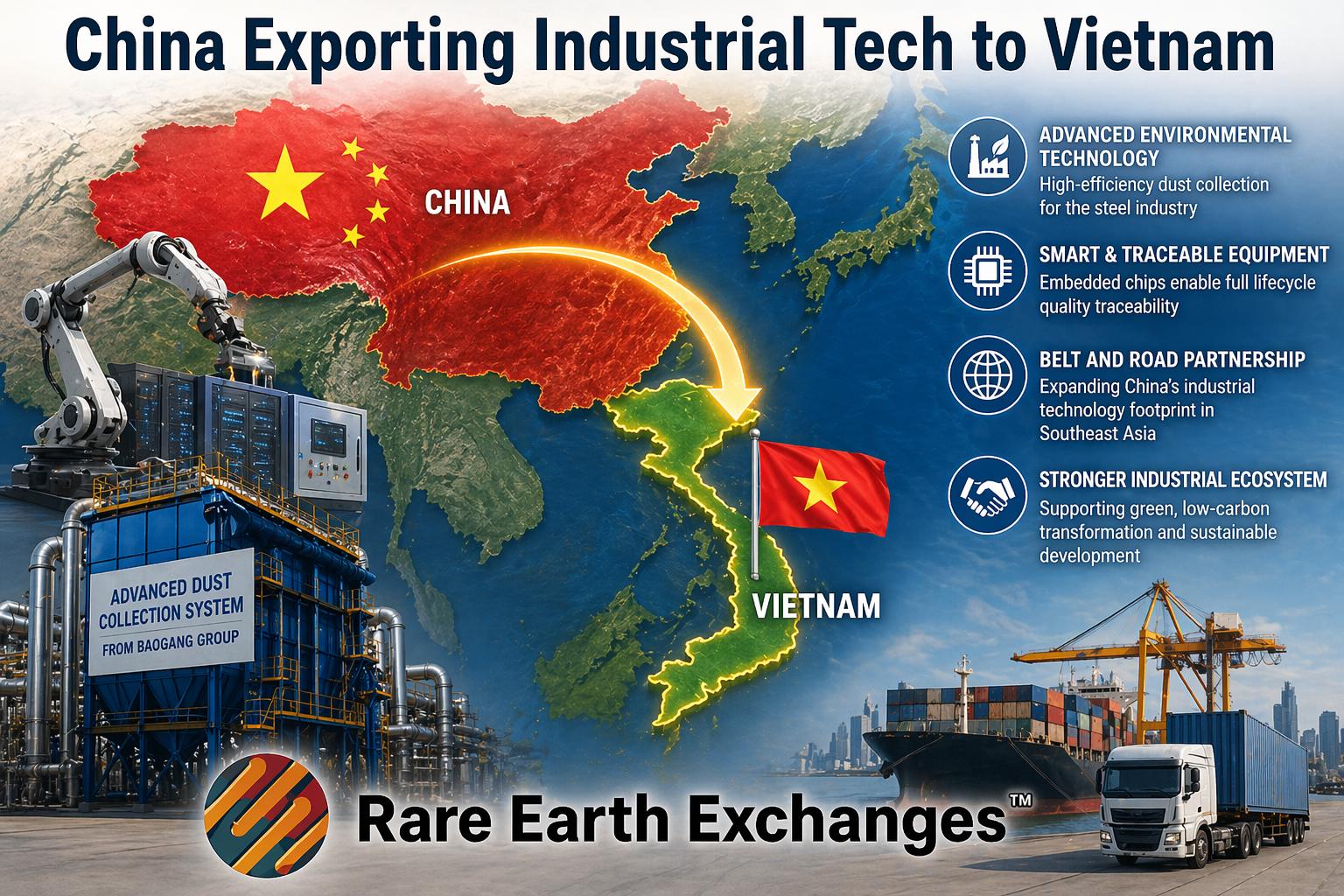
The product, a 300,000 m³/hour sintered plate dust collector, is designed for high-intensity steel environments where dust is dense, humid, and difficult to capture. According to Baogang, the system solves persistent operational challenges tied to high dust concentration, dispersion, and moisture—a niche but critical function in modern steelmaking.
Smart Hardware, Chinese Standards
The more interesting detail is technological. Baogang embedded chips into 960 filter elements, allowing users to scan components and track lifecycle data in real time. That enables traceability, maintenance optimization, and quality control—a step toward digitized industrial systems.
Baogang has also helped define industry standards for this equipment in China and deployed over 230 installations domestically, suggesting this is not experimental technology—it’s scaled and codified.
Why Vietnam Matters
Vietnam is not just another export destination. It sits within the broader Southeast Asian ionic clay belt, one of the world’s few alternative sources of heavy rare-earth elements (HREEs), such as dysprosium and terbium—materials essential for advanced magnets used in EVs, wind turbines, and defense systems.
China’s move here is subtle but strategic. By exporting industrial equipment and environmental systems, Baogang is:
- Building technical and commercial footholds near critical mineral resources
- Embedding Chinese standards and service models into emerging supply chains
- Strengthening influence across rare earth-adjacent industrial ecosystems
For the West, the takeaway is this: supply chain competition is not just about mining rights—it’s about who provides the technology, infrastructure, and operational backbone.
Belt and Road, Industrial Edition
Baogang’s expansion follows earlier entries into South Korea, India, and Serbia, and aligns with China’s broader Belt and Road strategy. The company explicitly frames this as part of a push to deliver “green, intelligent, low-carbon” industrial solutions globally.
No breakthrough technology is claimed. But that misses the point. The breakthrough is deployment at scale, across borders, with integrated systems.
Bottom Line
Baogang’s Vietnam deal is not just an export—it’s a foothold in a strategically critical region tied to heavy rare earth supply. As China exports not just materials but industrial capabilities, the competitive landscape shifts further downstream. The West may be looking for mines. China is already building an operating system around them.
Disclaimer: This news item is based on Baogang Daily, a publication affiliated with a Chinese state-owned enterprise. The information should be independently verified, and readers should consider potential bias, selective disclosure, and strategic framing.


0 Comments
No replies yet
Loading new replies...
Moderator
Join the full discussion at the Rare Earth Exchanges Forum →