
Highlights
- China is executing a coordinated vertical integration strategy in rare earths—moving beyond extraction to dominate downstream applications in medicine, quantum computing, defense systems, and advanced electronics through breakthrough materials science.
- Recent Chinese research breakthroughs span precision rare earth extraction membranes, biomedical nanoparticles for disease treatment, magneto-optical crystals for communications, and quantum memory materials—positioning China to control emerging technology standards.
- Western policy focused on upstream mining misses the strategic reality: China is consolidating intellectual property and application ownership across future industries, creating compounding advantages in AI hardware, quantum systems, and next-generation infrastructure.
What if it looks like lab work, but actually represents a quest for strategic power? A cluster of newly surfaced studies highlighted by the Shanghai Rare Earth Association (opens in a new tab) reveals something far more consequential than incremental scientific progress. Taken together, they point to a deliberate and coordinated push by China to dominate not just the supply of rare earth elements, but also the technologies those elements enable—from medicine and quantum computing to advanced communications and defense systems.
This is not a resource policy. It is a systems strategy.
Put plainly: China is no longer just extracting the periodic table—it is designing the future built on top of it. And American, and for that matter, European policy makers still mostly are blind to what’s unfolding.
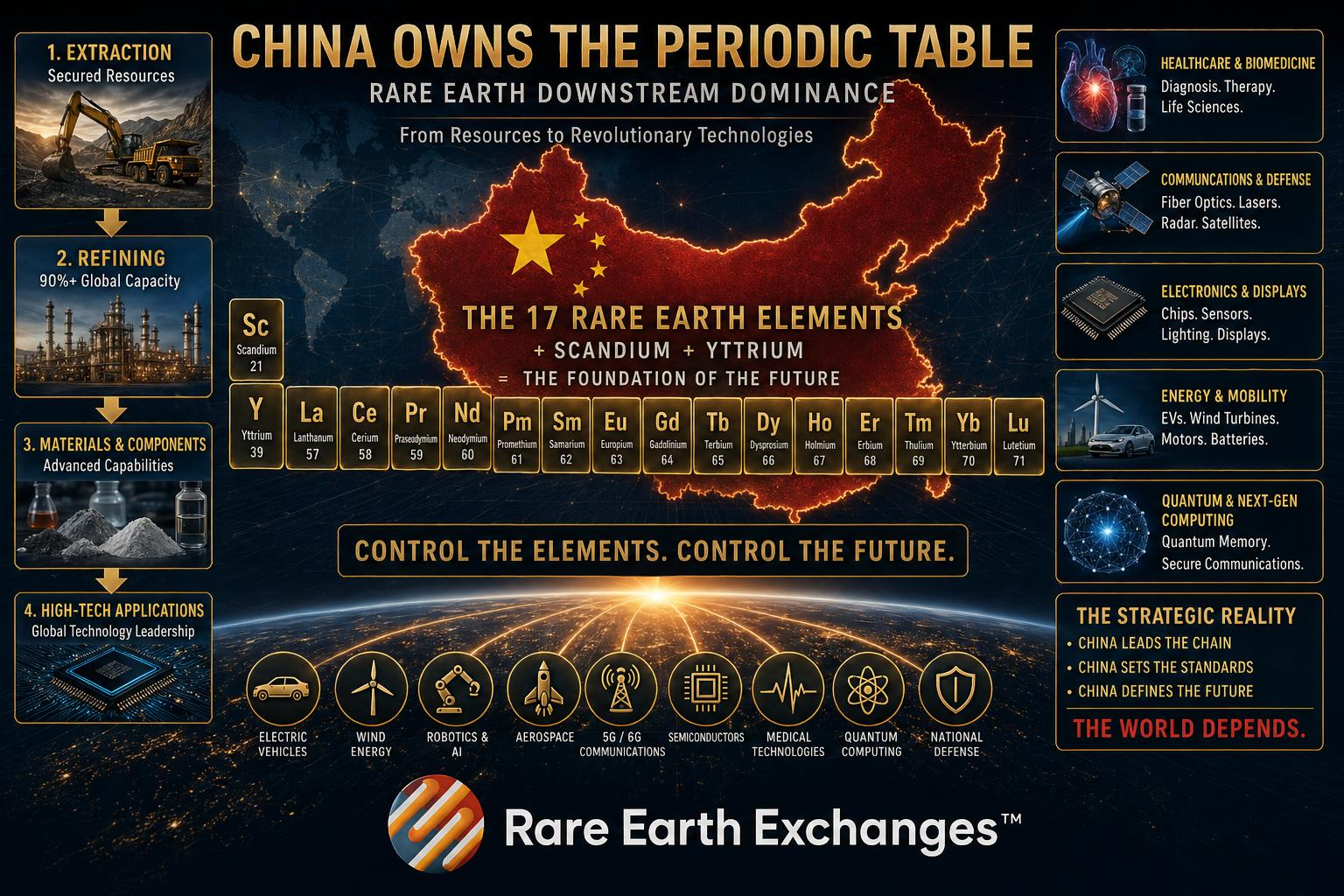
From Dirt to Devices: Vertical Integration in Motion
Smarter Extraction Means Structural Advantage
One study describes a honeycomb-inspired membrane capable of selectively capturing rare-earth ions, such as samarium and terbium, from mixed solutions. Stripped of technical language, the breakthrough functions like a precision filter—pulling valuable elements from complex waste streams with high efficiency, low cost, and repeatable usability.
Why it matters:
China’s dominance in refining—already near-total globally—does not stand still. Innovations like this extend the lead by lowering costs, improving yields, and unlocking recovery from previously uneconomic sources.
Rare Earths Move Into the Human Body
Another line of research explores rare-earth nanoparticles capable of both diagnosing and treating atherosclerosis.
These particles can illuminate diseased tissue, deliver targeted therapy, and reduce inflammation at the molecular level.
Why it matters:
Rare earths are crossing a threshold—from industrial inputs to biomedical infrastructure. That shift opens entirely new markets where early standard-setting confers long-term control.
Rewiring Communications and Defense Systems
Chinese researchers are also advancing magneto-optical crystals that improve the performance of fiber optics, lasers, and sensing systems.
The implications are straightforward:
- More stable high-speed communications
- Enhanced sensing capabilities
- Greater resilience across extreme conditions
Why it matters:
These materials sit at the core of telecommunications, aerospace systems, and defense architectures—domains where performance advantages compound into strategic leverage.
Owning the Building Blocks of Electronics
Breakthroughs in neodymium- and europium-based thin films signal progress in next-generation electronic and optical components.
These materials enable:
- High-efficiency light emission
- Atomic-scale engineering precision
- New classes of sensors and display technologies
Why it matters:
Control shifts downstream—from raw materials to the functional components embedded in advanced systems.
Positioning for the Quantum Frontier
Perhaps most telling is work on rare-earth-based materials designed for quantum memory.
These materials can store and retrieve quantum information with high fidelity—an essential capability for quantum computing and secure communications.
Why it matters:
This is not about catching up. It is about shaping the architecture of the next computing paradigm.
The Pattern: From Extraction to Application Dominance
Across these developments, the trajectory is unmistakable:
- Extraction innovation → lower-cost, scalable supply
- Material science → performance breakthroughs in critical systems
- Application engineering → product development → ownership of emerging industries
- Mass monetization → capital accumulation → competition to USD as standard of trade
This is vertical integration—not at the firm level, but at the national strategy level.
What the West Still Misunderstands
In the United States and Europe, the conversation remains anchored in:
- Permitting reform
- Mine development timelines and pricing floors
- Short-term supply vulnerabilities
These are necessary—but insufficient.
China’s focus is elsewhere: Owning the intellectual property, materials science, and applications that define future industries. That is a structurally superior position—one that compounds over time.
REEx Bottom Line
This is not a collection of isolated scientific advances. It is a coherent geoeconomic strategy unfolding in real time. The world’s second-largest economy, rapidly approaching America’s, seeks to monopolize the periodic table to propel its advancement over the next decades.
If Western policy continues to concentrate upstream—on extraction alone—while China consolidates downstream innovation, the outcome is not ambiguous:
- Dependence will persist
- Pricing power will remain concentrated
- And the defining technologies of the next industrial era—from AI hardware to quantum systems—will be shaped elsewhere
The lesson is simple, but increasingly urgent for investors in the REEx community: track the chain, not just the ticker.


0 Comments
No replies yet
Loading new replies...
Moderator
Join the full discussion at the Rare Earth Exchanges Forum →