
Electric vehicle motors revolutionized transportation by replacing complex internal combustion engines with efficient, low-maintenance electric drivetrains. These motors deliver instant torque, smooth acceleration, and high efficiency across broad speed ranges while using far fewer moving parts. At the heart of many high-performance EV motors are rare earth elements (REEs), particularly in permanent magnets that enable compact, powerful designs. This comprehensive guide explores how REEs transform raw materials into advanced motor technologies, examining the supply chain, environmental impacts, and engineering innovations shaping the future of electric mobility.
Table of Contents
How did electric vehicle motors change mobility—and why do rare earths matter?
Before electric vehicles became mainstream, passenger cars relied almost entirely on internal combustion engines. These engines only reached peak efficiency within narrow speed ranges, required complex transmissions with multiple gears, and needed frequent maintenance like oil changes, spark plug replacements, and emissions system repairs. The mechanical complexity meant hundreds of moving parts that could wear out or fail.
Electric vehicle motors transformed this reality by delivering instant torque from zero speed, providing smooth and silent acceleration, and achieving drivetrain efficiency above 90% across most driving speeds. Unlike combustion engines that must idle and rev up to produce power, electric motors can start and stop instantly without wasting energy. The motor itself contains far fewer wear components—essentially just bearings and cooling systems need occasional attention.
Rare earth elements matter because many of today's most efficient EV motors depend on powerful permanent magnets made with these materials. Neodymium-iron-boron (NdFeB) magnets provide the highest energy density available, allowing automakers to build compact, lightweight motors that still deliver impressive power. These rare earth magnets maintain their strength even at the high temperatures generated during aggressive driving or sustained highway cruising.
Beyond the magnets in the main motor, rare earths show up in position sensors that help control the motor precisely, in specialized alloys that handle heat, and sometimes in the electronics that manage power flow. Understanding where these materials come from and how they enable modern electric mobility helps explain both the promise and challenges of the EV transition.
Rare Earth Role in Electric Vehicle Motors
Which Elements Are Used and Why
Neodymium (Nd) and praseodymium (Pr) form the foundation of NdFeB permanent magnets used in many high-performance traction motors. These elements create magnets with exceptional magnetic energy density, meaning automakers can build smaller, lighter motors that still produce substantial torque. A typical EV motor magnet contains about 30% rare earth elements by weight, with neodymium making up the largest share.
Dysprosium (Dy) and terbium (Tb) serve as crucial additives that improve high-temperature performance. Adding just 2-8% of these heavy rare earths dramatically improves a magnet's ability to resist demagnetization when hot. This matters during real-world driving conditions like climbing long mountain grades, towing heavy loads, or repeated hard acceleration that can push motor temperatures above 150°C.
Samarium (Sm) appears in specialized samarium-cobalt magnets that excel in extreme temperature environments. While more expensive than NdFeB magnets, SmCo magnets maintain their properties from -270°C to over 350°C and resist corrosion better. Some aerospace and military electric motor applications use these, though cost keeps them out of most consumer EVs.
Cerium (Ce) and lanthanum (La) occasionally appear in research for lower-cost magnet alternatives, but they cannot match the performance of neodymium-based magnets. Scientists continue exploring ways to substitute abundant cerium for some neodymium content, which could help manage costs if successful.
How It Works
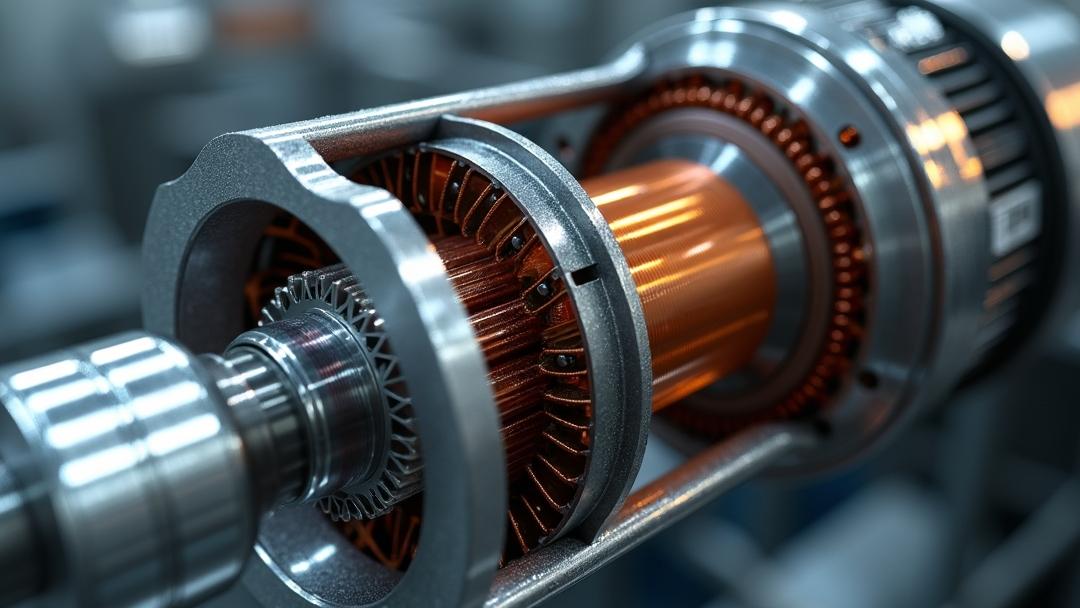
The traction motor's rotor contains powerful NdFeB permanent magnets that create a strong, constant magnetic field. When the motor controller sends electric current through copper windings in the surrounding stator, it creates a second magnetic field. The interaction between these two fields produces rotational force—torque—that turns the wheels.
Higher coercivity from dysprosium or terbium additions means the rotor magnets maintain their field strength even when the motor heats up during hard driving. Without these additions, magnets could partially demagnetize at high temperatures, permanently reducing motor power. Think of it like a rubber band that loses elasticity when overheated—except with magnets, that loss would be permanent without proper material selection.
Small rare earth magnets in resolver sensors track the exact position of the rotor thousands of times per second. This precise feedback allows the motor controller to adjust current flow for optimal efficiency and smooth operation. Better position sensing means less vibration, quieter operation, and more miles from each kilowatt-hour of battery energy.
The motor controller must manage heat carefully because both magnets and copper windings share the same cooling system. Motors designed for sustained high power often use more dysprosium to handle temperature extremes, while city-focused vehicles might use less to reduce costs. This balance between thermal capability, efficiency, and material cost drives many engineering decisions in modern EV motor design.
Journey from Mine to Product
Supply Chain Steps
The path from underground ore to finished motor involves complex chemistry and specialized manufacturing. Mining operations extract rare earth ores that contain multiple elements mixed together—separating them requires sophisticated chemical processing that can involve hundreds of extraction steps.
After mining, the ore gets crushed and chemically treated to create a mixed rare earth concentrate. This concentrate then goes through solvent extraction, where specific chemicals selectively bind to individual rare earth elements. The separation process is capital-intensive and technically demanding, requiring precise pH control and multiple stages to achieve the purity needed for magnets.
Once separated into individual oxides like neodymium oxide or dysprosium oxide, these materials get converted to metals through electrolysis or metallothermic reduction. Magnet manufacturers then combine these metals with iron and boron in precise ratios, melting them together to form an alloy. The alloy gets pulverized into fine powder, pressed into shape under strong magnetic fields to align the particles, then sintered at high temperature to create solid magnets.
Finished magnets receive protective coatings to prevent corrosion, get magnetized to their full strength, then undergo precise machining to meet exact dimensional requirements. Motor manufacturers install these magnets into rotor assemblies using special adhesives or mechanical retention systems designed to withstand centrifugal forces at high RPM. The complete motor assembly includes the magnet-laden rotor, copper stator windings, cooling channels, bearings, position sensors, and housing.
Typical Chokepoints
Separation capacity represents the tightest bottleneck in the rare earth supply chain. Building new separation facilities requires hundreds of millions in investment, specialized expertise, and years of construction. Environmental regulations add complexity since the process generates chemical waste that needs careful management.
Heavy rare earths like dysprosium and terbium face particularly tight supply because they occur in much lower concentrations than light rare earths. Most heavy rare earth production comes from ion-adsorption clays found primarily in southern China and Myanmar. Political instability, export restrictions, or environmental crackdowns in these regions can quickly disrupt global supply.
Magnet manufacturing capacity is geographically concentrated, with most sintered NdFeB magnet production occurring in China. Even when rare earth oxides are available, turning them into finished magnets requires specialized equipment for powder processing, pressing, sintering, and coating. New magnet factories take years to build and require technical knowledge that isn't widely distributed globally.
Statistics & Societal Impact
Quantitative Snapshot
Global electric vehicle sales reached 14.2 million units in 2023, with each vehicle typically containing one or two traction motors depending on whether it uses front-wheel, rear-wheel, or all-wheel drive. This translates to roughly 20 million traction motors produced annually, though the exact number varies with drivetrain configurations.
A typical 100-150 kW permanent magnet traction motor contains 1-2 kg of rare earth magnets. High-performance vehicles with dual motors or more powerful single motors may use 3-4 kg total. With millions of EVs produced yearly, this adds up to thousands of tons of rare earth demand from the automotive sector alone.
Neodymium-praseodymium oxide prices fluctuated between $50-150 per kilogram over the past five years, with dysprosium oxide ranging from $200-400 per kilogram. These price swings directly impact motor costs, pushing automakers to optimize magnet usage and explore alternative designs when prices spike.
Modern permanent magnet motors achieve peak efficiencies of 94-97%, compared to 85-91% for induction motors in typical automotive applications. This efficiency advantage translates to extended driving range—a 5% efficiency improvement might add 15-20 miles of range to a typical EV.
Downstream Effects
Higher motor efficiency directly reduces electricity consumption per mile driven. For an average American driving 12,000 miles annually, a 5% motor efficiency improvement could save 150-200 kWh per year—enough electricity to power a typical refrigerator for two months. These savings multiply across millions of vehicles, reducing grid demand and carbon emissions.
Compact high-power-density motors enabled by rare earth magnets create new vehicle design possibilities. Smaller motors leave more room for batteries, cargo, or passenger space. Some EVs now feature front trunk storage ("frunk") specifically because electric motors take up less space than combustion engines. The weight savings from smaller motors also improves handling and efficiency.
Better thermal management from properly formulated magnets ensures consistent performance during demanding use cases. Delivery trucks making hundreds of stops, ride-share vehicles operating continuously, or pickup trucks towing trailers all generate significant heat. Motors that maintain efficiency and power under these conditions reduce operating costs and prevent unexpected performance degradation that could strand commercial vehicles.
Innovators & History
Key Breakthroughs
The invention of neodymium-iron-boron magnets in 1984 by teams at General Motors and Sumitomo revolutionized permanent magnet motors. These magnets offered twice the energy density of previous samarium-cobalt magnets at lower cost, though they initially suffered from poor temperature stability that limited their use.
Subsequent development of dysprosium additions and grain boundary diffusion techniques solved the temperature problem. Scientists discovered that adding small amounts of heavy rare earths specifically at grain boundaries could improve coercivity without diluting the entire magnet. This breakthrough in the 1990s and 2000s made NdFeB magnets practical for automotive traction applications.
The evolution from insulated-gate bipolar transistors (IGBTs) to silicon carbide power electronics improved motor control precision and efficiency. These advances in power electronics allowed engineers to extract maximum performance from permanent magnet motors through sophisticated field-weakening and current control strategies.
Interior permanent magnet (IPM) motor designs gained prominence in the 2000s (opens in a new tab) as automakers sought to combine high torque density with extended high-speed operation. By embedding magnets within the rotor rather than mounting them on the surface, IPM designs achieved both reluctance and magnetic torque, improving efficiency across wider speed ranges.
From Lab to Product
Academic research on rare earth magnets transitioned to mass production through incremental improvements in manufacturing consistency. Early NdFeB magnets varied significantly in properties, making them unsuitable for automotive use where thousands of identical motors must perform predictably.
Japanese companies like Shin-Etsu Chemical and TDK developed quality control methods that reduced variation in magnetic properties to acceptable levels for automotive applications. Chinese manufacturers later scaled up production dramatically, driving down costs through vertical integration from mining through magnet production.
Motor control algorithms evolved from simple six-step commutation to sophisticated field-oriented control that maximizes efficiency while minimizing torque ripple. These control strategies, refined through millions of test miles, now run on automotive-grade microprocessors that can withstand temperature extremes and vibration while processing position feedback thousands of times per second.
Why It Matters Now
Current Drivers
Electric vehicle adoption continues to climb globally, with electric car sales rising more than 20% in 2025 to 21 million units, equal to one in four cars sold worldwide, according to the IEA’s Global Energy Review 2026 (opens in a new tab). Government mandates in Europe, China, and parts of the United States are pushing automakers to electrify their fleets rapidly. Each new EV model requires decisions about motor technology that balance performance, cost, and supply chain risk.
Automakers are pushing for higher integration with combined motor-inverter-gearbox units called e-axles. These integrated units require even more compact motors to fit packaging constraints, increasing the value of high-energy-density rare earth magnets. The latest e-axles combine what used to be three separate components into units barely larger than a traditional differential.
Fleet operators increasingly focus on total cost of ownership rather than just purchase price. Electric motors' high efficiency, minimal maintenance needs, and consistent performance make them attractive for commercial applications. Delivery companies, transit agencies, and ride-sharing services are electrifying rapidly, creating demand for motors optimized for continuous operation rather than peak performance.
Security & Policy Context
Rare earth processing concentration in China—handling over 85% of global capacity—creates strategic vulnerabilities for countries pushing vehicle electrification. This geographic concentration extends beyond raw materials to include magnet production, where China controls an even higher percentage of global capacity.
Governments are investing billions to develop domestic rare earth supply chains. The United States, European Union, and Australia are funding new separation facilities, magnet manufacturing plants, and recycling infrastructure. These investments aim to create alternative supply chains by 2030, though building this capacity takes significant time and expertise.
Export restrictions and trade policies add uncertainty to rare earth markets. China has previously restricted rare earth exports during political tensions, causing price spikes and supply concerns. These events push automakers to maintain strategic inventories, develop alternative motor designs, and establish diverse supplier relationships to manage risk.
Future Outlook
Materials & Design Trends
Grain boundary diffusion technology is reducing dysprosium requirements by concentrating heavy rare earths exactly where they provide the most benefit. Instead of mixing dysprosium throughout the entire magnet, manufacturers apply it specifically to grain boundaries where it prevents demagnetization. This technique can reduce heavy rare earth usage by 50-70% while maintaining temperature performance.
Magnet recycling is transitioning from research to commercial scale, with companies developing processes to recover rare earths from production scrap and end-of-life motors. Current recycling focuses on clean production scrap, but technologies for processing mixed waste streams and oxidized magnets are advancing rapidly.
Motor design diversity will likely increase rather than converge on a single solution. Permanent magnet motors will remain dominant for passenger vehicles prioritizing efficiency and packaging. Induction motors may gain share in commercial vehicles where durability and rare earth independence matter more than peak efficiency. Switched reluctance and axial flux designs could find niches in specific applications.
5-10 Year Scenario
Neodymium and praseodymium demand will likely double by 2030 as EV sales grow and wind turbines also require large amounts of permanent magnets. Meeting this demand requires both new mining projects and expanded separation capacity, with lead times of 5-10 years for major projects.
Supply chain diversification will advance but remain incomplete. New separation facilities in the United States and Australia will provide alternative sources, but China will likely maintain cost advantages through scale and technical expertise. Automakers will need to balance supply security against cost pressures.
The most realistic outlook involves parallel development of multiple solutions. High-performance vehicles will continue using the best available permanent magnet motors. Mainstream models might use reduced-dysprosium designs or hybrid approaches combining permanent magnets with reluctance torque. Commercial vehicles could increasingly adopt rare-earth-free motors where the efficiency penalty is acceptable for improved supply security and lower costs.
Conclusion
Electric vehicle motors powered by rare earth magnets represent a critical intersection of materials science, engineering innovation, and sustainable transportation. While REEs enable the compact, efficient motors driving today's EVs, the industry continues evolving through recycling advances, alternative designs, and supply chain diversification. Understanding these technologies and their material dependencies helps stakeholders navigate the transition to electric mobility while addressing resource challenges. As the market matures, success will come from balancing performance requirements with supply resilience, ensuring rare earth elements continue enabling rather than constraining the clean energy transition.
FAQs
Which EV motor types use rare-earth magnets most often?
Permanent-magnet synchronous motors (PMSM), particularly interior permanent magnet variants, dominate modern EVs because REE magnets provide strong rotor fields without current, improving torque density and efficiency while enabling smaller, lighter designs.
Which rare earths are most important for electric vehicle motors?
Neodymium and praseodymium form the foundation of NdFeB magnets providing high magnetic strength, while dysprosium and terbium in smaller quantities ensure temperature stability during high-load operation.
Do electric vehicle motors need regular maintenance like engines?
EV motors require minimal maintenance with no oil changes, spark plugs, or exhaust systems. Service typically involves coolant checks for liquid-cooled systems, gear oil in reduction units, and long-term bearing inspection.
Why not avoid rare earths entirely with alternative motor designs?
Induction and switched reluctance motors eliminate REE dependence but introduce tradeoffs in inverter requirements, noise characteristics, control complexity, and efficiency profiles that may not suit all applications.
How do heat and driving style affect magnet choice?
Aggressive driving, towing, and sustained high speeds increase motor temperatures, requiring enhanced coercivity through Dy/Tb additions or improved cooling to prevent demagnetization and maintain performance.
