
Highlights
- The world doesn't face a rare earth shortage—it faces a dysprosium and terbium bottleneck, with China controlling 98-99% of refining capacity while Western supply chains remain fragile and unproven at scale.
- Western nations have deposits but lack the ability to secure feedstock and convert it into industrial-grade materials, with current U.S. mine-to-magnet initiatives too slow to close the gap before 2030.
- A looming structural imbalance will define pricing and strategic leverage as EV, wind turbine, and defense demand surges while supply remains constrained, geopolitically exposed, and dependent on a few critical projects executing perfectly.
The prevailing narrative says the world faces a rare earth shortage. It doesn’t. It faces a dysprosium and terbium bottleneck—and few are acknowledging it. These heavy rare earths are essential to electric vehicles, wind turbines, and advanced defense systems, yet as of 2026, roughly 98–99% of refining capacity remains effectively controlled by China, with ex-China supply barely reaching 1–2%. The uncomfortable truth is this: the West isn’t short on deposits—it’s short on the ability to secure feedstock and convert it into high-spec, industrial-grade materials at scale. And despite mounting urgency, current U.S. mine-to-magnet initiatives remain too slow, too diffuse, and insufficiently targeted to deliver the speed and precision required to close that gap.
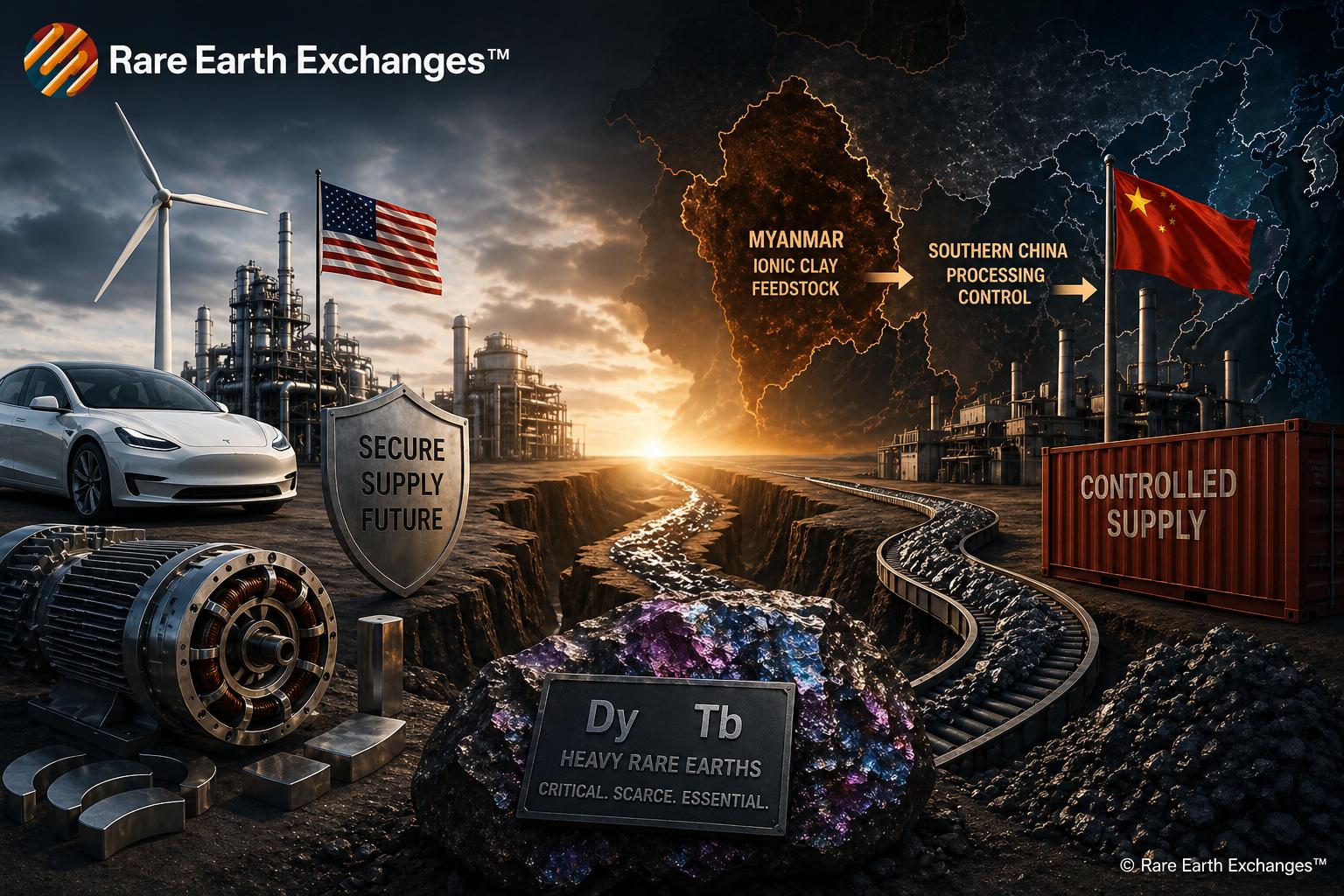
The Bottleneck Isn’t Where You Think
Here’s the paradox shaping the next decade: the West can build separation plants—but it cannot easily supply them. Heavy rare earth feedstock is locked in a narrow corridor stretching from southern China to Myanmar, flowing through systems China already dominates. Even the most ambitious Western projects—Lynas, Iluka, Carester—depend on fragile supply chains, uncertain timelines, and unproven scaling. Yes, Brazil remains a great opportunity, but how long will it take to achieve that material efficiency effectively? Between now and 2030, the market doesn’t gradually rebalance—it jumps suddenly, and only if a handful of projects execute perfectly. Miss one, and the system breaks as Rare Earth Exchanges™ shares in a report for subscribers.
The Shock Is Already Coming—Most Investors Aren’t Ready
Demand for Dy/Tb is set to surge as EV penetration accelerates, wind turbines scale, and defense supply chains tighten under new rules. Supply, meanwhile, remains constrained, fragmented, and geopolitically exposed. The result is a looming imbalance that will define pricing, access, and strategic leverage for years to come. This is not a theoretical shortage—it is a structural one.
REEx subscribers get the full Dy/Tb supply curve, demand shock modeling, and the companies that actually matter before the market catches on. Subscribe now to stay ahead.


0 Comments
No replies yet
Loading new replies...
Moderator
Join the full discussion at the Rare Earth Exchanges Forum →