
Highlights
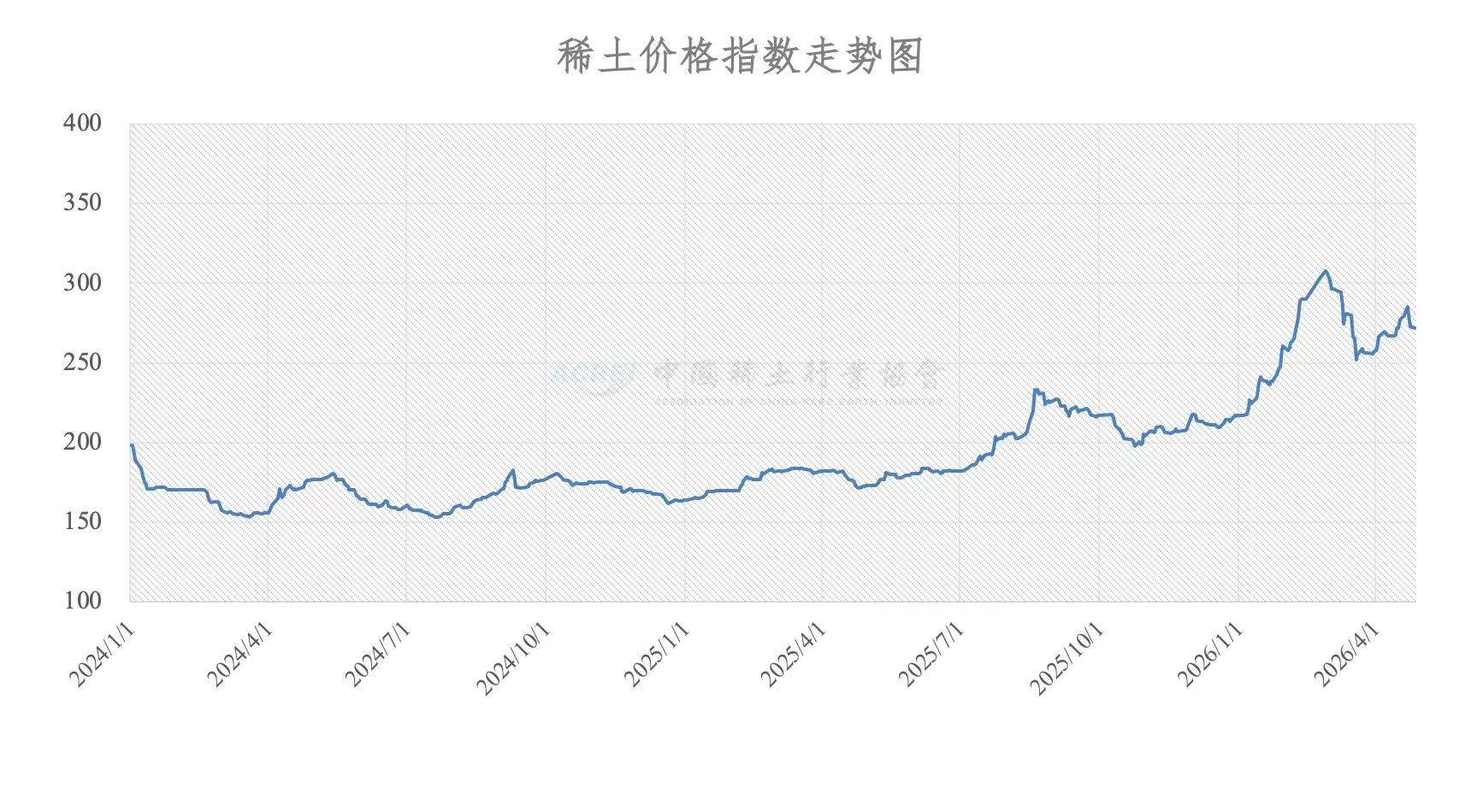
- China's rare earth price index reached 271.8 on April 27, 2026, reflecting a controlled rise rather than market-driven volatility as Beijing stabilizes pricing at elevated levels across critical materials like neodymium and dysprosium.
- Two distinct pricing systems are emerging: China's state-controlled market versus nascent ex-China pricing driven by Western policy—neither represents true free market dynamics as decoupling remains incomplete.
- Heavy rare earths (dysprosium ~$200/kg, terbium >$1,100/kg) remain strategically elevated while NdPr sits at ~$135-140/kg, reinforcing China's pricing power where supply concentration is highest.
China’s official rare earth price index reached 271.8 (base year 2010 = 100) on April 27, 2026, continuing a steady climb following volatility in 2025. While individual rare earth prices appear mixed—some rising, some flat, some declining—the broader signal is clear: pricing is being stabilized at elevated levels. For Western buyers, this is less about daily fluctuations and more about persistent structural dependence on a state-influenced system. Rare Earth Exchanges™ reminds readers that two rare earth pricing markets are emerging, the Chinese (state-controlled system) and ex-China nascent pricing driven in part by national policy in the United States, Japan, Europe, Australia, and the like. Neither option represents a true free market at this point. China is a state-distorted market, and the ex-China prices remain part of an early-stage decoupling, not fully independent yet.
The Index Climbs—Quietly but Intentionally
China’s rare earth price index, derived from domestic transaction data, has moved into the high-200 range after holding closer to ~160–180 through much of 2024. The trajectory shows a controlled rise rather than a sudden spike, suggesting coordinated market management rather than reactive price discovery.
This is not volatility—it is calibration.
Key Prices: RMB to USD (April 27, 2026 Conversion)
(Using 1 USD = 6.8363 RMB)
Magnet Materials (Core to EVs, Wind, Defense)
- Neodymium Oxide (Nd₂O₃, ~75% Nd₂O₃ basis): ¥758.8–778.8/kg → $111.00–$113.93/kg ↓
- Praseodymium-Neodymium Metal (PrNd, Nd ~75%): ¥938.0–958.0/kg → $137.22–$140.15/kg ↓
Heavy Rare Earths (Strategic Leverage)
- Dysprosium Oxide: ¥1,355–1,395/kg → $198.21–$204.07/kg → stable
- Dysprosium Metal: ¥1,720–1,740/kg → $251.61–$254.55/kg → stable
- Terbium Oxide: ¥7,525–7,625/kg → $1,100.75–$1,115.40/kg → stable
- Terbium Metal: ¥6,085–6,145/kg → $890.11–$898.91/kg → stable
Other Notables
- Gadolinium Oxide: ¥405.5–425.5/kg → $59.33–$62.25/kg ↑
- Lanthanum Oxide: ¥4.1–6.1/kg → $0.60–$0.89/kg ↑
- Cerium Oxide: ¥4.1–6.1/kg → $0.60–$0.89/kg ↑
Interpretation for Investors
At current FX levels, NdPr sits firmly in the $135–140/kg range, while heavy rare earths—dysprosium ($200/kg oxide) and terbium (>$1,100/kg oxide)—remain structurally elevated.
This reinforces a critical structural truth:
- Light rare earths behave cyclically (supply/demand swings)
- Heavy rare earths behave strategically (concentrated control, limited substitutes)
Even with recent softness in NdPr, the broader market structure remains intact—pricing power persists where supply concentration is highest. Prices may move—but control has not.
What’s Really Happening Beneath the Surface
There is no dramatic breakout in individual prices. That is the signal.
China appears to be:
- Stabilizing prices after prior volatility
- Maintaining elevated price floors for critical materials
- Avoiding sharp disruptions while preserving long-term leverage
This pattern aligns with a managed market structure—not a fully transparent, market-driven one.
Why This Matters for the West
Western markets often look for price signals. China is sending policy signals.
Stable pricing at higher levels suggests:
- Confidence in sustained demand (EVs, wind, defense, AI infrastructure)
- Continued export discipline and supply coordination
- A long-term strategic posture rather than a short-term market reaction
At the same time, ex-China pricing remains fragmented and opaque, largely based on private contracts and limited spot activity—far from true global price discovery.
This is not a market finding equilibrium. It is an actively managed system.
Prices may look calm—but control is tightening.
Critical Pricing Disclaimer
- These prices are based on Chinese industry-reported data and reflect a state-influenced domestic market, not a transparent global benchmark.
- China lacks a fully open, liquid futures market for rare earths; pricing is shaped by policy, quotas, and internal coordination.
- Ex-China pricing remains nascent, based on bilateral contracts and limited spot transactions—useful as a reference, but not yet a reliable mechanism for price discovery—at least not yet.
Source Disclaimer: This report is based on information published by the China Rare Earth Industry Association, a state-linked entity. Data should be independently verified.


0 Comments
No replies yet
Loading new replies...
Moderator
Join the full discussion at the Rare Earth Exchanges Forum →