
Highlights
- China's planned removal of 4.65 million tonnes of sulphuric acid exports by May 2026 extends its influence beyond rare earth mining into the critical chemical inputs required for processing.
- Lindian Resources' Kazakhstan-based sulphuric acid access at US$100-130 per tonne represents strategic positioning but relies on another state-controlled system rather than true supply sovereignty.
- The rare earth battlefield is shifting from extraction to chemical dependency control—without sulphuric acid access, Western rare earth projects cannot economically process materials regardless of mining capacity.
Lindian Resources’ (opens in a new tab) latest announcement (opens in a new tab) is not really about sulfuric acid—it’s about control. As China moves to restrict exports of a foundational industrial chemical, the rare earths battlefield is shifting again: away from ore and magnets, and toward the reagents that make processing possible.
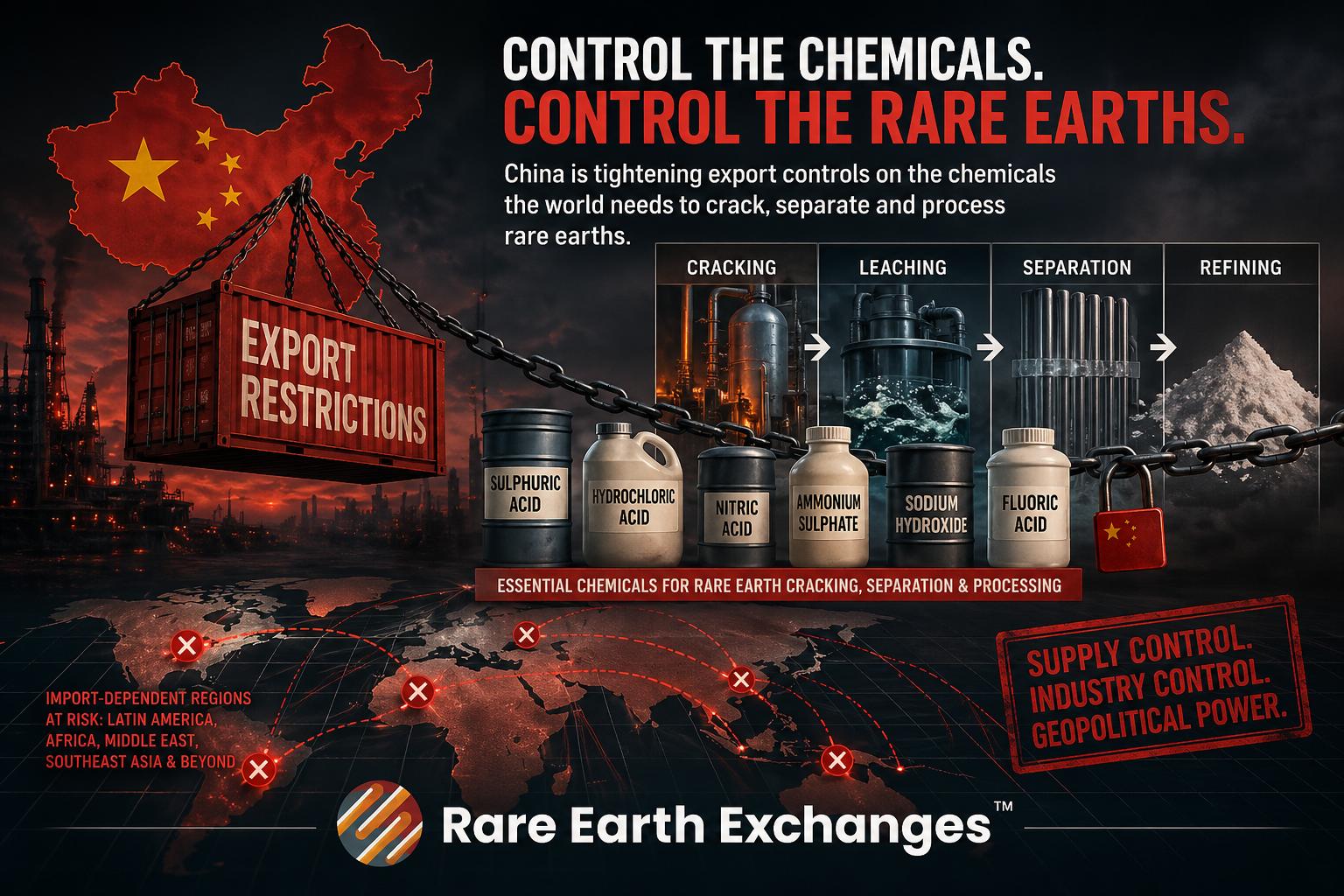
The Real Story Isn’t Mining—It’s Chemistry
Lindian frames its Kazakhstan-based sulphuric acid access as a cost advantage. That is accurate—but incomplete.
The deeper signal is strategic. China is no longer exerting influence solely over rare earth extraction or separation. It is extending control into the chemical inputs required to make processing possible.
The company notes that China is set to remove approximately 4.65 million tonnes of sulphuric acid exports beginning May 2026, tightening global supply and pressuring import-dependent regions.
This is not a side development. It is the development.
Are Reagents the New Rare Earths?
Rare earth processing—particularly monazitecracking—depends heavily on sulphuric acid. Lindian’s own flowsheet requires approximately 1.2–1.4 tonnes of acid per tonne of concentrate.
The implications seem straightforward enough:
- No acid → no processing
- No processing → no separation
- No separation → no supply chain
This is the hidden dependency most Western strategies still underestimate.
By constraining sulphuric acid exports, China is not just influencing markets—it is extending leverage upstream into ex-China projects that, on paper, appear independent.
Lindian’s Position: Smart, But Not Sovereign
Lindian’s access to domestic Kazakh supply—via a state-backed producer—represents a credible strategic hedge :
- Estimated costs of US$100–130 per tonne, below many Western benchmarks
- Reduced exposure to global supply shocks
- Logistical advantages from co-location with processing
This positioning is smart. It improves resilience and cost structure.
But it is not sovereignty. It is alignment with another state-controlled industrial system—a distinction that matters in a tightening geopolitical environment.
The Bigger Pattern: Control the Inputs, Control the Industry
The pattern is becoming unmistakable: China is moving beyond rare earth dominance into chemical dependency control.
This is Great Powers Era 2.0 in motion:
- First: dominate mining
- Then: dominate separation
- Now: influence reagents
The West continues to focus on upstream extraction. China is quietly consolidating control over everything required to make those assets economically viable.
Bottom Line
Lindian’s update reads like a supply chain optimization. In reality, it is a signal of a deeper structural shift.
In the rare earth economy, control is no longer defined by what you dig—it is defined by what you can process, and increasingly, by what chemicals you can secure.


0 Comments
No replies yet
Loading new replies...
Moderator
Join the full discussion at the Rare Earth Exchanges Forum →