
Highlights
- Capital is flooding visible supply chain assets like mines and factories, but critical gaps in separation, refining, and alloying remain unfunded, creating inventory without functional infrastructure.
- Misallocated investment chases “first production” optics while opportunity costs mount—money that could build solvent extraction, metallization know-how, and recycling loops instead funds incomplete systems.
- Strategic funding must shift to element-by-element programs tied to throughput and qualification, not announcements, while investors should map complete systems rather than buying stories.
There’s a familiar smell in the air—equal parts urgency, patriotism, and fresh capital. When financiers and politicians lock arms to “rebuild” a strategic supply chain, the story writes itself: big promises, bigger valuations, and timelines that bend just enough to fit the next funding round.
The danger isn’t the ambition—it’s the sequence. Capital is rushing to the visible edges: mines with glossy decks, factories with ribbon-cuttings, and anything that fits neatly into a “mine-to-magnet” narrative. But supply chains don’t run on narratives. They run on chemistry, process control, and painful qualification cycles. And increasingly sound national and regional and global supply chain policy. Skip a step—separation, refining, alloying—and you don’t have a supply chain. You have inventory with a press release.
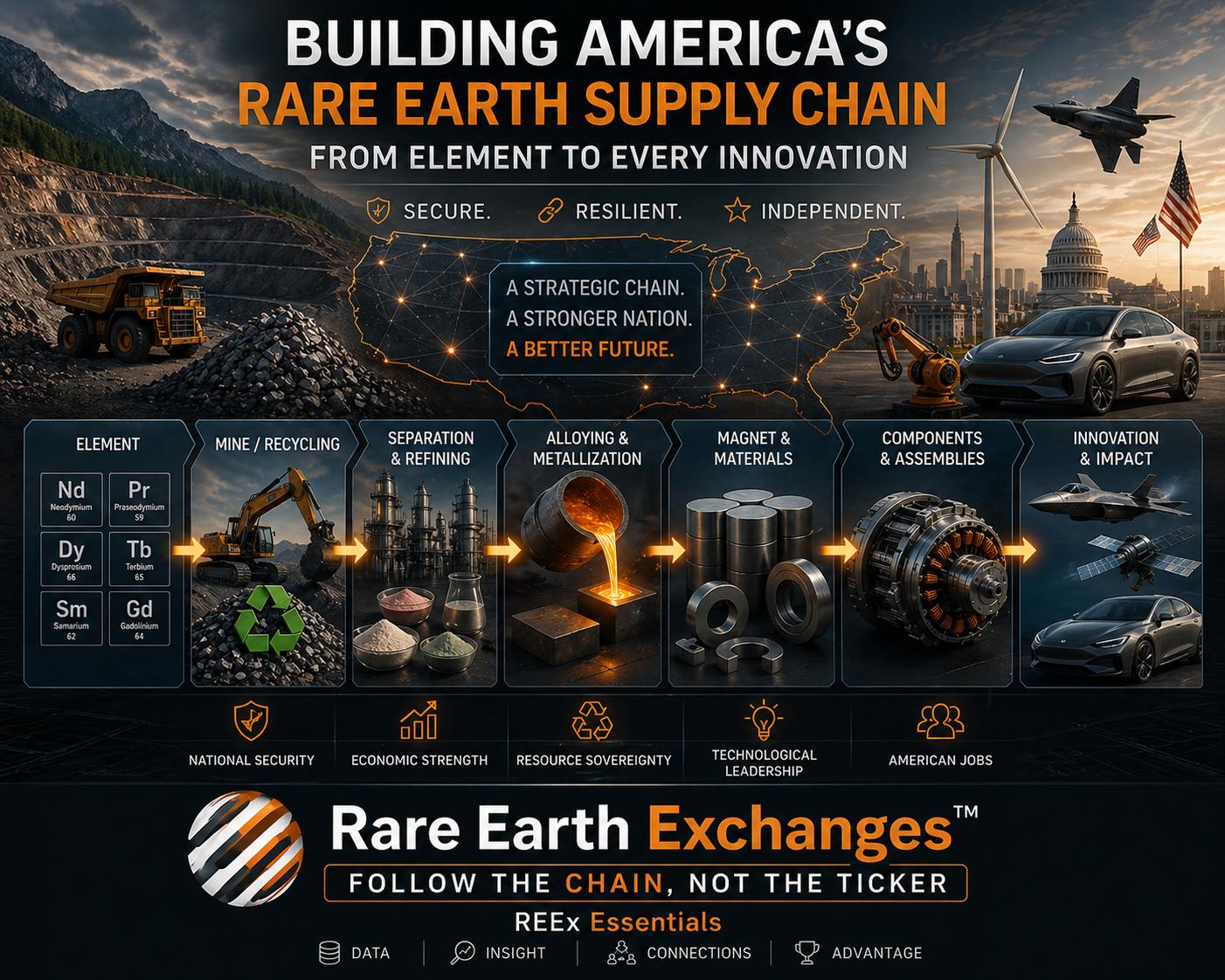
What happens when money moves faster than engineering? You get misallocation. Tens, even hundreds of millions into upstream assets that can’t feed a refinery that doesn’t exist, or downstream capacity starved of consistent inputs.
Opportunity cost piles up quietly: capital that could have built solvent extraction lines, funded metallization know-how, or scaled recycling loops instead chases the optics of “first production.” The result is a system that looks complete on paper and stalls in practice.
Sorry for the cynicism: the only thing getting separated faster than dysprosium is retail investors from their cash.
And yet—this is the moment. The U.S. should spend more, not less. But spend differently. Targeted, directed programs that move element-by-element through the chain: feedstock (including recycling), separation and purification, metallization and alloying, and finally magnets and components. This includes all the necessary related inputs from chemicals and technology to know-how. Tie funding to throughput, yields, and customer qualification—not announcements. Build redundancy where it matters: heavies, not just lights.
For investors, the takeaway is simple: stop buying stories; start mapping systems. Platforms like Rare Earth Exchanges (REEx Insights and Essentials) emphasize exactly this—track the chain, not just the ticker. The winners won’t be the loudest. They’ll be the ones who can actually make atoms move—reliably, repeatedly, and at scale.


0 Comments
No replies yet
Loading new replies...
Moderator
Join the full discussion at the Rare Earth Exchanges Forum →