
Highlights
- China's rare earth price index reached 273.7 on April 29, 2026, reflecting policy-enforced stability rather than organic market discovery, with controlled quotas and supply tightening driving recent volatility.
- Heavy rare earths remain strategically elevated with dysprosium at ~$190-195/kg and terbium at ~$700-730/kg, creating sustained high plateaus that signal long-term supply control rather than cyclical peaks.
- With China controlling ~90% of refining and ~98% of heavy rare earth processing, true global price discovery remains impossible until Western separation and refining capacity scales independently.
On April 29, 2026, the China Rare Earth Industry Association reported a rare earth price index of 273.7 (base year 2010 = 100). The index is derived from daily domestic transaction data—effectively a state-influenced composite, not a transparent global benchmark.
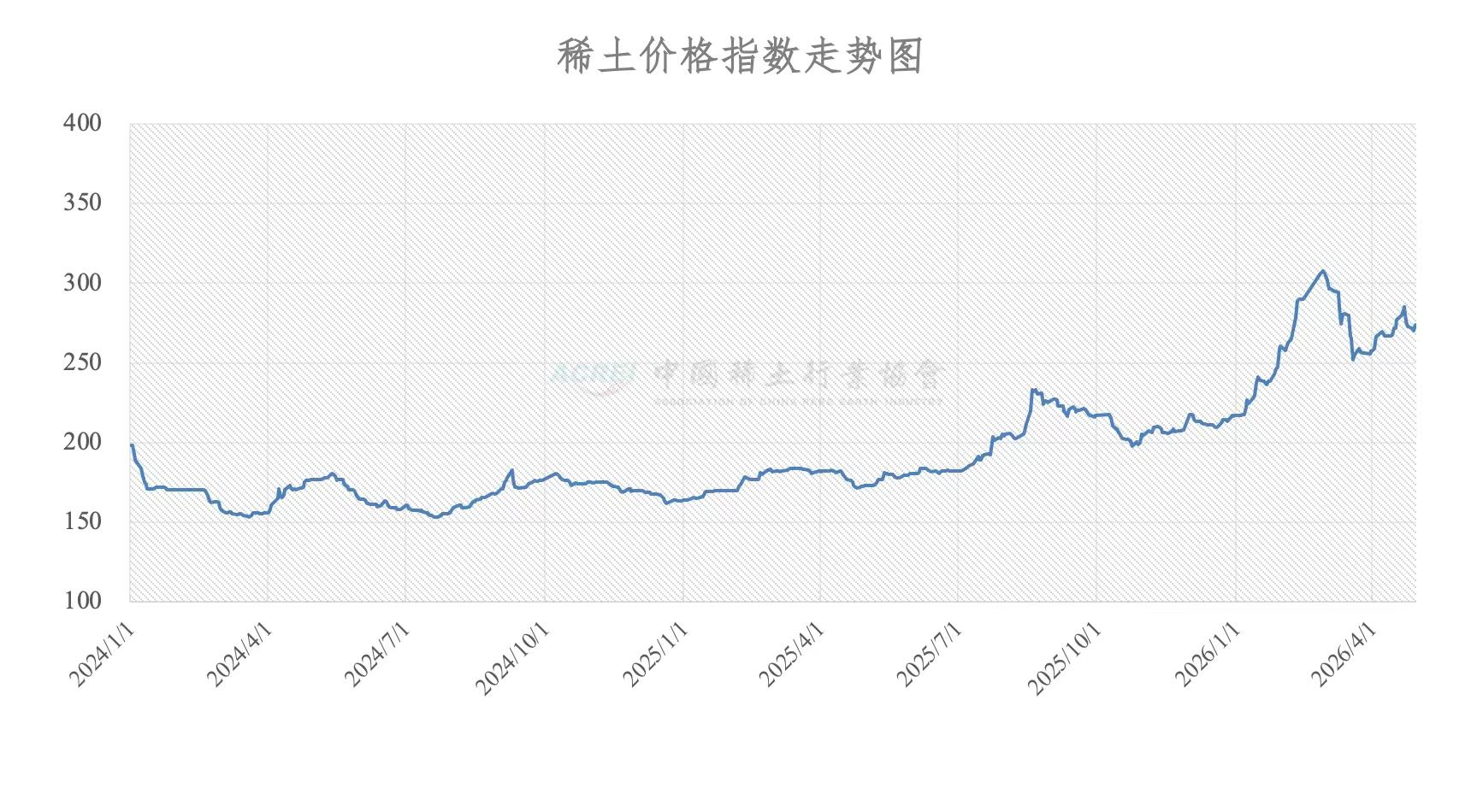
The chart reveals the real story. Prices were largely range-bound through 2024 and early 2025, then stepped higher into late 2025 and early 2026, with sharper volatility. This is not organic price discovery—it is a managed system reacting to quotas, policy shifts, and supply tightening.
Light Rare Earths—Stable, But Engineered Stability
Core magnet inputs remain controlled:
- PrNd oxide (≥99%): 243–263 RMB/kg (~$34–$37/kg)
- PrNd metal (≥99%): 1034–1054 RMB/kg (~$145–$148/kg)
- Ceriumoxide (≥99.5%): 4.1–6.1 RMB/kg (~$0.6–$0.85/kg)
- Lanthanum oxide (≥99%): low single-digit RMB/kg range, broadly similar to cerium
Most are marked flat. This is not market calm—it is policy-enforced equilibrium.
Heavy Rare Earths—Strategically Elevated, Quietly Tight
The real signal lies in the heavies:
- Dysprosium oxide (≥99%): 1355–1395 RMB/kg (~$190–$195/kg) — flat
- Terbium oxide (≥99.99%): 5000–5200 RMB/kg (~$700–$730/kg) — flat, but high
- Gadolinium oxide (≥99.99%): 167–187 RMB/kg (~$23–$26/kg) — flat
- Holmium oxide (≥99.5%): 540–560 RMB/kg (~$75–$78/kg) — flat
No spike—but no relief either. These are strategically elevated plateaus, not cyclical peaks.
Notably, upward moves appear in select intermediates and NdPr-linked materials, suggesting pressure building upstream rather than in headline oxides.
The Illusion of “Global Pricing”
Two realities Western investors must confront:
- China’s pricing is policy-shaped, influenced by quotas, export controls, and industrial coordination, overall state oversight.
- Ex-China pricing is fragmented, derived from bespoke contracts and thin market surveys—not a true benchmark.
With ~90% of refining—and ~98% of heavy rare earth processing—inside China,
global price discovery remains structurally incomplete.
Why This Matters Now
No breakthrough—but a clear signal: China continues to anchor global pricing power, especially in heavies tied to defense and advanced magnets. For the U.S. and Europe: Until separation and refining scale outside China, pricing power will not shift.
Disclaimer: This report is based on data published by the China Rare Earth Industry Association, a state-affiliated entity. The information is for reference only and should be independently verified. Prices reflect a controlled domestic system with limited transparency and may not represent a free or global market.


0 Comments
No replies yet
Loading new replies...
Moderator
Join the full discussion at the Rare Earth Exchanges Forum →