
Highlights
- China's rare earth price index at 273.7 signals firm, elevated market conditions with magnet materials like mixed Pr-Nd metal and neodymium oxide showing upward pressure or stability.
- Magnet feedstocks remain structurally tight despite flat overall pricing, with China controlling ~90% of global separation/refining and ~98% of heavy rare earth processing.
- U.S. industrial policy responses include DOD-backed $110/kg NdPr price floors with MP Materials, highlighting fragmented global pricing and lack of transparent price discovery mechanisms.
Chinese index shows stability, but not weakness. The April 30 release from the China Rare Earth Industry Association puts the domestic rare earth price index at 273.7, based on average daily transactions from Chinese producers against a 2010 baseline of 100. In practical terms, this signals a firm, elevated market rather than any meaningful price correction.
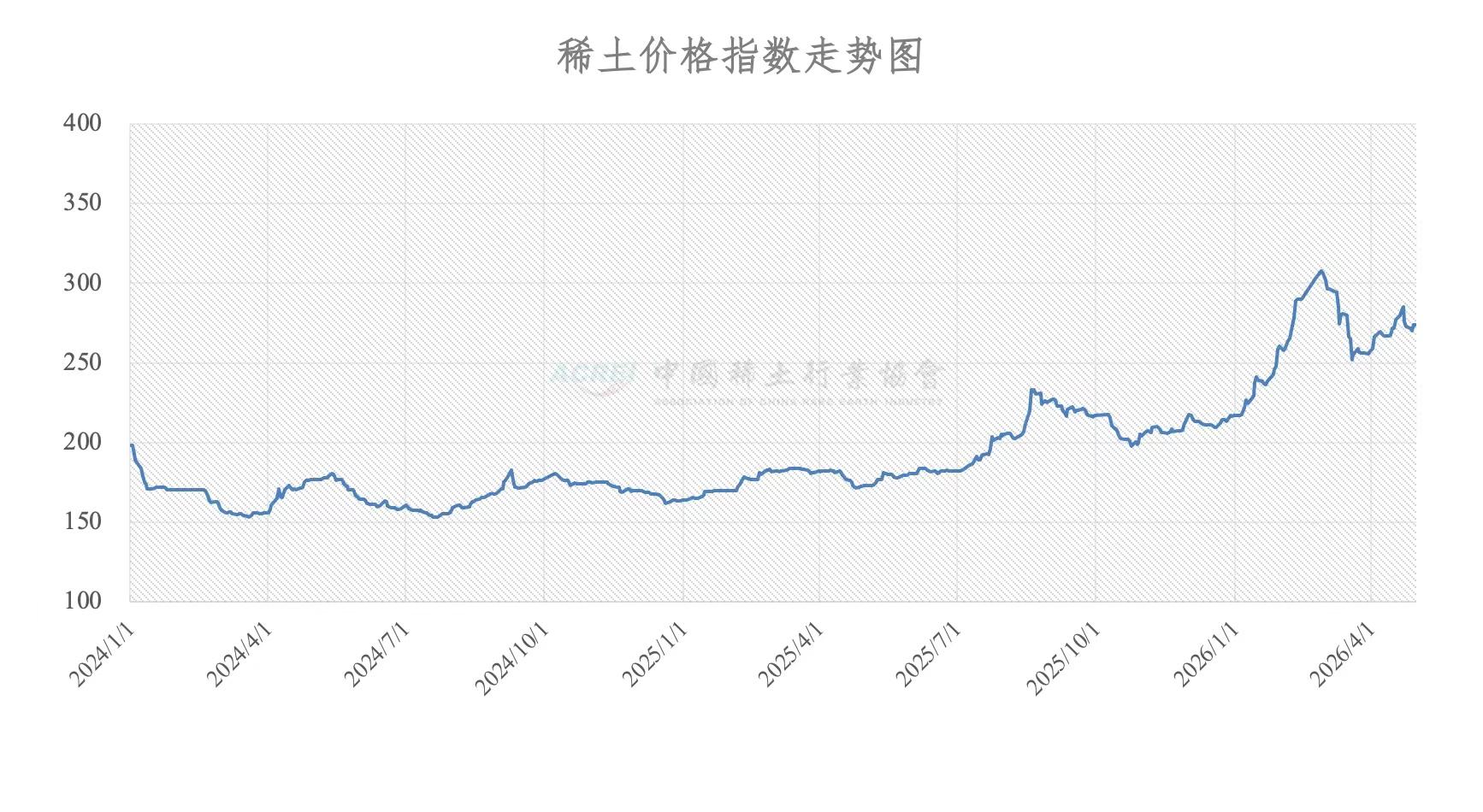
Magnet Materials Show Upward Pressure
All quoted prices are reference ranges in yuan per kilogram. Using the April 30 midpoint of RMB 6.8628 per US$1, key magnet inputs show resilience:
- Mixed rare earth oxide (Nd₂O₃ ~75%): RMB 761.8–781.8/kg ($111.0–$113.9/kg) ↑
- Mixed Pr-Nd metal: RMB 938–958/kg ($136.7–$139.6/kg) ↑
- Neodymium oxide: RMB 839–859/kg ($122.3–$125.2/kg)
- Dysprosium oxide: RMB 6,085–6,145/kg ($886.7–$895.4/kg)
- Terbium oxide: RMB 5,000–5,200/kg ($728.6–$757.7/kg)
By contrast, cerium oxide remains structurally oversupplied at just RMB 4.1–6.1/kg ($0.60–$0.89/kg), and holmium oxide was the only major line marked lower.
The Real Story: Flat Market, Strategic Tightness
Most categories were marked “flat”, reinforcing a stable pricing environment. However, incremental gains in NdPr-linked materials suggest continued tightness in magnet feedstocks—the part of the supply chain that actually matters for EVs, defense systems, and advanced electronics. This aligns with broader April trends: modest month-over-month cooling, but prices still materially elevated versus last year.
Why It Matters for the West
China continues to dominate the system: roughly ~90% of global rare earth separation and refining and ~98% of heavy rare earth processing. These price signals are therefore not just market data—they are policy-adjacent signals.
In the U.S., industrial policy is shaping outcomes. The Department of Defense-backed arrangement with MP Materials—including a $110/kgNdPr price floor—highlights a critical reality: there is still notrue global price discovery mechanism. Pricing remains fragmented, opaque, and often governed by bilateral contracts.
Read the Fine Print
This data originates from a Chinese industry association operating within a state-managed system. Prices are reference ranges, not transparent spot market clears, and should be independently verified. Chinese pricing reflects internal transaction reporting under government oversight. Meaning this is not a free market. Outside China, pricing can diverge significantly, often trading at a premium due to scarcity, logistics, specific bespoke contractual negotiation, and geopolitical risk. Pricing ex-China is helped along by nascent industrial policy (e.g. NdPr price floors, etc.).
Bottom Line
No breakthrough. No shock. But a clear signal: magnet metals remain structurally tight—and China still sets the tone.


0 Comments
No replies yet
Loading new replies...
Moderator
Join the full discussion at the Rare Earth Exchanges Forum →