
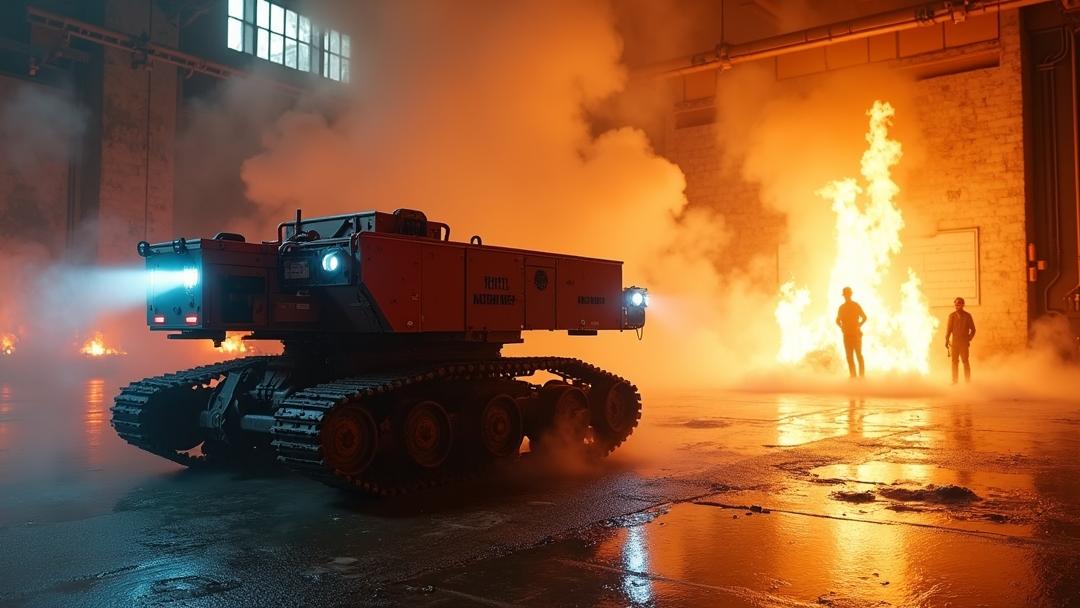
Firefighting robots have transformed emergency response by allowing crews to operate from safer distances while maintaining effective suppression capabilities. These rugged, teleoperated platforms rely heavily on rare earth elements (REEs) to deliver the compact power, heat resistance, and sensor performance needed in extreme environments. This guide explains how REEs enable critical robot subsystems, maps the supply chain from mine to deployment, and examines the operational realities and future outlook for these life-saving technologies.
Table of Contents
How did firefighting robots change emergency response—and why do rare earths matter?
Before firefighting robots emerged, firefighters had no choice but to physically enter the most dangerous areas during structure fires and industrial incidents. Crews pushed deep into high-heat zones with limited visibility to apply water or foam, monitor conditions, and clear debris. This direct exposure put them at constant risk of flashover events, toxic smoke inhalation, structural collapse, and explosions.
The introduction of firefighting robots fundamentally shifted this risk equation. Teams can now deploy tracked platforms to project hose streams from hundreds of feet away, scout dangerous areas with thermal cameras, and manipulate objects without stepping into harm's way. These machines fit into standard incident command structures while keeping firefighters at safer standoff distances.
Modern firefighting robots depend heavily on compact, high-torque electric motors and rugged sensor systems to function in extreme environments. Rare earth elements enable the specialized magnets, optics, phosphors, and alloys that make these systems smaller, stronger, and more heat-tolerant than conventional alternatives would allow.
This technology works through a combination of advanced drivetrains, wireless communications, thermal imaging cameras, and various payload systems like water monitors and manipulator arms. Understanding these components helps explain both the capabilities and constraints that fire departments encounter during real incidents.
Rare Earth Role in firefighting robots
Which elements are used and why
Neodymium and praseodymium form the foundation of most firefighting robot motor systems. These elements create NdFeB permanent magnets that deliver exceptional power in compact packages, improving torque density while extending battery runtime. Without these materials, robots would need much larger motors that would compromise mobility and operational time.
Dysprosium and terbium serve a critical role in high-temperature operations. These heavy rare earths can be added through grain-boundary diffusion to increase coercivity, helping magnets resist demagnetization when robots operate near radiant heat sources or hot pump housings. This addition becomes essential for maintaining performance during prolonged fire suppression activities.
Samarium-cobalt magnets offer an alternative for the most extreme heat conditions. While more expensive and brittle than NdFeB options, SmCo magnets maintain their magnetic properties at temperatures that would destroy other magnet types. Fire departments often find these in actuators positioned closest to heat sources.
Display and optical systems rely on different rare earth elements. Yttrium, europium, terbium, and cerium appear in phosphors that create readable displays and status indicators. These materials ensure operators can see critical information even in smoke-darkened command posts or bright outdoor scenes.
How it works
The drive motor system starts with NdFeB magnets containing neodymium and praseodymium, often enhanced with dysprosium or terbium. These magnets generate higher magnetic flux and coercivity than traditional materials. The result is a smaller, lighter motor that produces the same torque, reducing overall robot weight while maintaining the power needed to climb inclines and navigate debris fields.
Gimbal systems (opens in a new tab) for water nozzles and camera masts use either SmCo or high-temperature NdFeB magnets. The superior temperature stability of these materials ensures steady aim even under heat soak and vibration conditions. This stability directly improves water placement accuracy and thermal imaging usability during critical operations.
The thermal imaging display chain incorporates rare earth phosphors in backlights and indicators. These phosphors, particularly those containing yttrium, europium, and terbium, produce efficient visible light emission. Clear operator feedback becomes possible even in challenging visibility conditions that firefighters commonly encounter.
Heat constraints drive careful magnet grade selection throughout the robot. Engineers must balance dysprosium and terbium content or consider SmCo substitution to achieve adequate demagnetization resistance. This selection process reduces mid-incident failures but introduces cost and sourcing challenges for the heaviest rare earth elements.
Journey from Mine to Product
Supply chain steps
The path from raw materials to finished firefighting robot begins at rare earth mines. Mining operations extract ore containing rare earth elements, which gets upgraded to concentrate through physical separation processes. Chemical plants then separate this concentrate into individual oxides like Nd₂O₃, Pr₆O₁₁, and Dy₂O₃ before converting them into metals and alloys.
Magnet production follows a precise sequence. The process runs from oxide to metal, then to alloy formation for either Nd-Fe-B or Sm-Co compositions. Manufacturers create powder from these alloys, press it into shapes, and sinter the material at high temperatures. After machining and coating for corrosion resistance, magnets receive their magnetic charge before motor assembly begins.
Optical and phosphor components follow a different pathway. These materials require extensive purification before controlled crystal growth or phosphor synthesis can occur. Manufacturers then coat and package these materials for integration into displays, indicators, or sensor modules. Final robot assembly incorporates all these components before qualification testing validates performance.
Typical chokepoints
Separation and refining capacity creates the most common bottleneck in the supply chain. This stage demands specialized chemistry knowledge, comprehensive waste handling systems, and stringent process controls to achieve the purity specifications required for high-performance magnets and phosphors.
Heavy rare earth elements like dysprosium and terbium present particular challenges. Their lower natural abundance and extraction difficulty tightens availability for the high-temperature magnet grades that firefighting robots need for harsh environment operation.
Manufacturing processes including sintering, coating, and precision machining can create unexpected delays. When demand rises simultaneously across defense, automotive, and industrial automation sectors, lead times for specialized component qualification stretch significantly. Shock, vibration, and ingress protection testing add weeks or months to delivery schedules.
Statistics & Societal Impact
Quantitative snapshot
The global firefighting robot market reached $1.5 billion in 2022 and is projected to grow at 13.7% CAGR through 2030. This growth reflects increasing adoption by municipal fire services, airports, ports, and industrial facilities seeking to reduce personnel exposure to dangerous conditions.
Major fire departments worldwide have documented over 200 operational deployments, with municipal services in Paris, Los Angeles, and Tokyo leading adoption efforts. Industrial sites account for approximately 40% of current installations, focusing on petrochemical facilities and warehouses storing hazardous materials.
Typical firefighting robots contain 2-5 kilograms of rare earth magnets, distributed across drive motors, actuators, and auxiliary systems. (opens in a new tab) A medium-sized platform with manipulator arm and high-flow monitor might use 3 kilograms of NdFeB magnets plus additional SmCo magnets in heat-exposed actuators.
Operational metrics from after-action reports show meaningful improvements. Unmanned nozzle operations commonly achieve 300-foot standoff distances. Robots maintain continuous operation in hot zones for 2-4 hours depending on battery configuration. Most importantly, departments report 60-80% reductions in direct firefighter exposure time during initial attack phases.
Downstream effects
Correct deployment of firefighting robots significantly reduces personnel time in immediately dangerous to life or health (IDLH) environments. This applies during initial suppression, reconnaissance missions, and overhaul operations. The technology improves safety margins without removing human judgment from critical command decisions.
Operational continuity improves through earlier reconnaissance capabilities using thermal and visual sensors. Robots enable sustained unmanned stream application when water supply, access routes, and communications infrastructure support their use. Departments must engineer these factors into their operational plans from the beginning.
The societal impact centers on risk transfer and risk reduction rather than elimination. Some dangerous tasks shift from humans to machines, but robots introduce their own failure modes. Successful departments manage these new risks through comprehensive training programs and detailed operating procedures that account for mechanical failures, communication losses, and environmental limitations.
Innovators & History
Key breakthroughs
The development of samarium-cobalt magnets in the 1970s and neodymium-iron-boron magnets in the 1980s revolutionized mobile robotics. These high-energy permanent magnets enabled the compact motors and actuators that make rugged firefighting robots practical at usable payload capacities.
Uncooled microbolometer technology transformed thermal imaging capabilities. This advancement eliminated the need for cryogenic cooling systems, dramatically reducing size, power consumption, and maintenance requirements for thermal cameras mounted on mobile platforms.
The maturation of industrial remote-control systems, ruggedized electronics, and ingress protection standards created the foundation for modern firefighting robots. These technologies allowed robots to operate reliably around water spray, foam, vibration, and debris rather than being limited to clean factory floors.
From lab to product
Early prototypes evolved into commercial systems as fire services and industrial buyers defined specific requirements. Departments needed robots capable of handling standard hose flows, climbing stairs and curbs, undergoing decontamination, and receiving routine maintenance. These demands pushed designs toward tracked chassis configurations, high-visibility tethering options, and standardized fire service fittings.
Commercialization typically progressed through established defense and industrial robotics suppliers before reaching fire-rescue applications. High-consequence facilities drove initial procurement, including petrochemical plants, ports, and large municipal departments with specialized technical rescue capabilities. These early adopters established operational protocols that smaller departments could later adapt.
Why It Matters Now
Current drivers
Industrial expansion and urban infrastructure densification increase the potential consequences of large fires and hazardous material releases. Modern warehouses storing lithium batteries, chemical facilities near population centers, and high-value logistics hubs create scenarios where traditional firefighting approaches carry unacceptable risk levels. Departments need tools that reduce responder exposure while maintaining effective suppression capabilities.
Technological improvements in batteries, motor efficiency, and thermal imaging have lowered barriers to fielding practical platforms. Simultaneously, robotics training programs make repeatable operator qualification achievable for typical fire department personnel. The combination of better hardware and structured training creates conditions for wider adoption.
Climate-driven extreme weather events and increasingly complex incidents push agencies toward standoff capabilities. Large warehouse fires, electric vehicle incidents, and mixed hazardous materials scenarios require departments to add unmanned reconnaissance and remote stream application options to their tactical playbooks.
Security & policy context
Rare earth processing concentration creates significant procurement and lifecycle risks. Material availability directly affects delivery schedules, spare parts supplies, and long-term sustainment planning for public safety agencies. Fire departments must consider these factors when developing multi-year procurement strategies.
Governments are investing in domestic processing capabilities, recycling infrastructure, and alternative supply chains. Trade restrictions and export controls can affect pricing and lead times for critical materials and components. Departments should monitor these developments when planning major equipment purchases.
Compliance requirements shape deployment timelines and operational capabilities. Radio spectrum regulations, public procurement rules, and safety certifications determine what equipment can be deployed and how quickly. These requirements particularly affect municipalities and critical infrastructure operators who must follow strict procurement guidelines.
Future Outlook
Materials & design trends
Magnet manufacturers are actively pursuing dysprosium and terbium reduction strategies through grain-boundary diffusion techniques. These approaches aim to maintain high-temperature performance while reducing dependence on the scarcest heavy rare earth elements. Success in this area could significantly improve supply chain resilience.
Design engineers are evaluating selective material substitution strategies. Some subsystems may transition to ferrite magnets where size and torque density matter less. Premium actuators near heat sources might continue using SmCo to avoid demagnetization risks. This targeted approach balances performance needs with material availability.
Recycling and urban mining of rare earth magnets shows promise for future supply augmentation. However, achieving scale depends on establishing efficient collection networks, developing cost-effective disassembly processes, and creating competitive separation technologies. Large industrial equipment offers better recycling economics than mixed consumer electronics waste.
5–10 year scenario
Demand for firefighting robots will likely track broader robotics adoption in emergency response alongside general magnet demand from electric vehicles and wind turbines. Supply chain pressures may intensify during demand surges even though firefighting applications remain a relatively small market segment.
Critical bottlenecks will likely concentrate in midstream processing, particularly for alloying capacity, sintering facilities, and high-temperature grade production. Mitigation strategies should focus on multi-sourcing arrangements, conservative spare parts planning, and design-for-service approaches rather than assuming constant component availability.
Operational evolution will favor incremental autonomy features over full automation. Assisted driving, obstacle detection, and stabilized aiming systems will become standard while maintaining human responsibility for tactical decisions, personnel accountability, and safety management. The chaotic nature of fireground operations ensures humans remain central to incident command for the foreseeable future.
Conclusion
Firefighting robots represent a critical application of rare earth technology in public safety, where compact power, heat resistance, and sensor performance directly translate to saved lives and reduced injuries. As these systems become more prevalent, understanding their REE dependencies helps agencies plan for procurement, maintenance, and long-term sustainment. While supply chain challenges and technical limitations remain, continued innovation in materials science and robotics engineering promises to expand the capabilities and accessibility of these life-saving tools. Success will depend on balancing operational needs with supply chain realities while maintaining focus on the ultimate goal: protecting both responders and communities from unnecessary risk.
FAQs
What are firefighting robots in practical terms?
Firefighting robots are rugged mobile machines—usually tracked—that carry high-flow nozzles, cameras (often thermal), lights, and sometimes manipulators to push debris or open doors. Most are remotely operated by trained responders with assisted features like stabilized cameras or speed limiting rather than fully autonomous decision-making.
Do firefighting robots replace firefighters?
In most deployments, they do not replace crews but shift high-risk tasks like initial reconnaissance, exposure protection, and unmanned stream application so people can operate from safer positions. Humans still set strategy, manage water supply, coordinate ventilation and entry, and handle rescue, medical care, and accountability under incident command.
Where are firefighting robots used most effectively?
They excel where heat, toxicity, or explosion risk makes close approach dangerous, including industrial facilities, tank farms, chemical warehouses, tunnels, ports, and aircraft/ship incidents. They're also valuable for post-knockdown overhaul reconnaissance and monitoring hotspots with thermal imaging when collapse risk remains.
What are common limitations and failure modes?
Mobility limitations include stairs, tight doorways, soft ground, and clutter. Heat can damage electronics or demagnetize motors if platforms exceed rated thermal envelopes. Communications loss is a real risk in reinforced concrete, steel structures, and underground areas, requiring procedures for link degradation, retrieval, and fallback tactics.
Why do rare earths matter for firefighting robots specifically?
Rare earth magnets enable compact, powerful motors and actuators that let robots move and aim payloads without excessive weight. Heavy REEs or SmCo improve performance near high temperatures. REE-related optics and phosphors support readable displays and sensor performance, while supply-chain concentration influences lead times, spares availability, and long-term sustainment planning.
