
Highlights
- China's official rare earth price index stood at 269.6 on May 12, 2026, with critical magnet materials like neodymium oxide at US$61-64/kg and terbium oxide at US$892-901/kg, but these Chinese domestic prices significantly understate true ex-China costs facing Western buyers.
- Heavy rare earth elements like yttrium experienced extreme volatility, with high-purity yttrium oxide prices surging from under US$8/kg to as high as US$120-320+/kg—a roughly 1,500% increase—driven by Chinese export controls and Western dependence on Chinese supply (approximately 94% for the U.S.).
- Global rare earth pricing increasingly reflects industrial policy, export controls, and strategic security considerations rather than transparent market fundamentals, with ex-China pricing remaining fragmented and opaque due to limited non-Chinese refining capacity and confidential bilateral contracts.
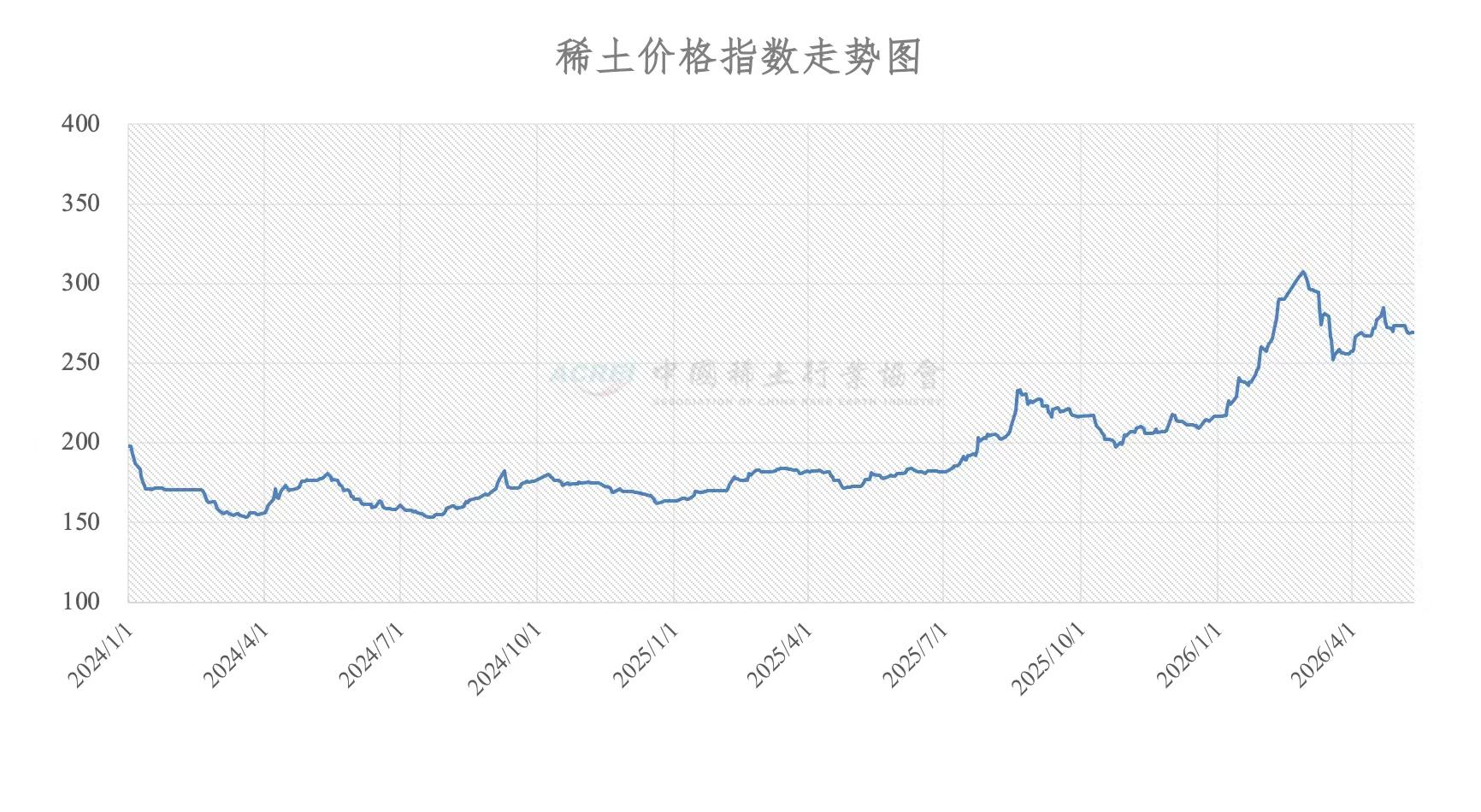
China’s official rare earth price index stood at 269.6 on May 12, 2026, according to the China Rare Earth Industry Association, far above the 2010 baseline of 100. The chart shows the index remains below its early-2026 spike above 300 but still elevated by historical standards. For Western investors, the story is not merely that Chinese prices remain firm. The deeper issue is that China’s domestic rare earth prices are not clean market-discovery signals, while ex-China prices remain fragmented, opaque, and often much higher for strategic heavy rare earth elements.
Magnet Metals Remain Strategic and Expensive
Several magnet-critical materials remained elevated. Neodymium oxide was quoted at 418–438 yuan/kg, or approximately US$61–64/kg using a 0.147 USD/CNY conversion rate. Praseodymium-neodymium metal traded at 914.5–934.5 yuan/kg, or roughly US$134–137/kg. Dysprosium oxide—essential for high-temperature EV, aerospace, drone, and defense magnets—stood at 1,315–1,355 yuan/kg, or about US$193–199/kg. Terbium oxide, one of the most strategically important heavy rare earth materials, was quoted at 6,070–6,130 yuan/kg, or approximately US$892–901/kg.
Based on a Rare Earth Exchanges™ review, most major products flat on the day, with gadolinium oxide and gadolinium metal rising, while holmium oxide and certain mixed rare earth products declined.
Heavy Rare Earths: The Real Stress Point
The most important Western takeaway concerns heavy rare earths. Chinese domestic quotes for materials such as yttrium oxide—listed at 61–65 yuan/kg, or roughly US$8.50–9.00/kg—may significantly understate the effective cost faced by ex-China buyers. In Western or non-China supply chains, heavy rare earth elements such as yttrium can trade at several times Chinese domestic reference levels depending on purity, form, origin, availability, compliance requirements, and contract structure.
So why this extreme difference? The yttrium market experienced extraordinary volatility driven largely by Chinese export controls, tightening trade restrictions, and extreme Western dependence on Chinese supply. High-purity yttrium oxide prices reportedly surged from under US$8/kg at the end of 2024 to as high as US$120–320+/kg in certain spot and specialty markets—a dramatic increase of roughly 1,500% at peak levels. At the same time, lower-grade commercial yttrium metal products traded far lower, often around US$30–40/kg, underscoring the enormous pricing differences tied to purity, form, and contract structure. The United States remains heavily dependent on China for yttrium imports—reportedly sourcing approximately 94% from Chinese supply chains—leaving Western manufacturers vulnerable to export restrictions and geopolitical disruption.
The widening price dislocations have also intensified interest in alternative supply development outside China, including projects in regions such as South Africa. As Rare Earth Exchanges™ continues to chronicle, rare earth pricing overall remains highly unstable and increasingly shaped by industrial policy, trade controls, and strategic security considerations rather than traditional commodity market fundamentals.
The Pricing Trap Investors Must Understand
China’s prices are not pure free-market price discovery. They sit inside a state-influenced system shaped by quotas, export controls, state-owned enterprises, environmental enforcement, strategic stockpiling, bilateral contracts, and national security policy.
But ex-China pricing is also immature. Only a small share of rare earth refining occurs outside China, and many transactions are confidential bilateral contracts with bespoke terms. Pricing agencies often see only partial snapshots. The U.S. government’s MP Materials deal established a US$110/kg floor for NdPr products, but that floor applies to that specific arrangement—not necessarily the entire Western market.
Why This Matters
Rare earth prices increasingly reflect industrial policy, security strategy, and supply-chain control—not ordinary commodity economics.
China’s May 12, 2026, rare earth pricing data underscores a growing reality that global rare earth prices are becoming increasingly distorted by geopolitics, export controls, industrial policy, and opaque bilateral contracting rather than transparent commodity-market fundamentals. While the Chinese industry association reported relatively stable domestic pricing—including NdPr oxide at roughly US$61–64/kg and dysprosium oxide near US$193–199/kg using a 0.147 USD/CNY conversion—these Chinese reference prices should not be interpreted as true global spot-market discovery as the ex-China market starts to take off. A handful of firms are attempting to report on ex-China prices based on de-identified surveys and the like.
China’s market remains heavily shaped by quotas, state-owned enterprises, strategic stockpiling, export restrictions, and broader national policy objectives. Meanwhile, so-called “ex-China” pricing remains highly fragmented and difficult to verify because only a small share of global rare earth refining occurs outside China and many transactions involve confidential bilateral contracts with bespoke purity, qualification, and delivery terms.
In stressed Western markets, especially for heavy rare earth elements such as yttrium, dysprosium, and terbium, actual ex-China transaction pricing can reportedly reach several multiples of Chinese domestic reference levels depending on purity and supply availability. Importantly, widely cited Western price spikes for yttrium often involve ultra-high-purity or specialty-grade materials rather than standard Chinese domestic industrial grades, highlighting how difficult apples-to-apples pricing comparisons remain across the global rare earth ecosystem.
Disclaimer: This report is based on pricing data published by the China Rare Earth Industry Association. The association states that the data is collected from industry participants for reference only and does not constitute investment advice. All pricing should be independently verified.


0 Comments
No replies yet
Loading new replies...
Moderator
Join the full discussion at the Rare Earth Exchanges Forum →