
Highlights
- Jack Lifton, a six-decade veteran of the technology metals sector, warns that America cannot simply spend its way out of the rare earth crisis—the real bottleneck is lost industrial knowledge, not geology or financing.
- Western governments fundamentally misunderstand rare earth industrialization: between mining and finished magnets lies a complex chain of processes requiring specialized engineers and expertise that America outsourced to China over decades.
- Even with secured financing, China increasingly controls the industrial machinery, process knowledge, and technical expertise needed for competitive rare earth production—the solution requires rebuilding STEM education and cultivating industrial talent over years, not just funding headlines.
In an era when Washington speaks confidently about “reshoring” critical minerals and rare earth elements and rebuilding domestic supply chains, few voices cut through the noise like Jack Lifton. Blunt, historically grounded, and deeply technical, Lifton has spent more than six decades inside the rare earth and technology metals sectors—long before most policymakers understood what neodymium or dysprosium even were.
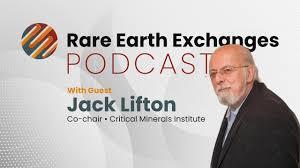
Speaking on the latest Rare Earth Exchanges™ podcast (opens in a new tab), Lifton delivered a stark warning: America cannot simply spend its way out of the rare earth crisis. The real bottleneck is not geology. It is industrial knowledge.
Lifton, co-chair of the Critical Minerals Institute (and contributor to Tracy Hughes’ Investing News) helped popularize the concept of “technology metals” decades ago. His career stretches back to the Sputnik era when the United States aggressively cultivated scientists and engineers to compete with the Soviet Union. By 1962, Lifton was already working with rare earth chemistry and ultra-high-purity materials, eventually contributing to early solid-state memory cell development.
Today, he argues America faces a different kind of strategic shock.
“The focus in Washington has become financialization,” Lifton explained. “People think you dig a hole in the ground and suddenly you have magnets. That’s not how it works.” According to Lifton, Western governments fundamentally misunderstand the complexity of rare earth industrialization. Mining is only the beginning. Between ore extraction and finished magnets lies a brutally difficult industrial chain involving beneficiation, chemical cracking, solvent extraction, oxide conversion, fluorination, metallization, alloying, precision magnet manufacturing, and years of qualification testing for commercial and military applications.
And that, he argues, is where the West lost its footing.
“The United States is still good at mining,” Lifton said. “What we gave away were all the other steps.”
Lifton described how decades of outsourcing hollowed out America’s industrial memory. Engineers who once understood molten-salt electrolysis, rare-earth metallurgy, and magnet manufacturing either retired or passed away, while China spent generations building technical capacity, training engineers, and vertically integrating supply chains.
His criticism was particularly sharp toward what he called “wish factories”—projects that announced ambitious mine-to-magnet visions without the personnel, timelines, or operational experience to execute them. “People think building a magnet plant is like plugging in a machine from a box,” Lifton warned. “It doesn’t work that way.”
Perhaps most alarming was his warning that, even if the West secures financing, China increasingly controls the industrial machinery, process knowledge, and technical expertise required to build competitive rare-earth ecosystems at scale. For Lifton, the solution is neither quick nor politically convenient: rebuild STEM education, cultivate industrial talent over the next few years, and reconnect government with experienced operators rather than purely, or mostly, financial actors.
Otherwise, America may continue funding headlines while China quietly controls the future. Follow the link to watch the podcast (opens in a new tab).


1 Comment
1 reply
Loading new replies...
Active member
Join the full discussion at the Rare Earth Exchanges Forum →