
Highlights
- Hyundai repositioned Boston Dynamics from a research showcase to a strategic industrial asset, committing to purchase tens of thousands of robots for manufacturing and logistics operations.
- Electric humanoid robots like Atlas require dozens of high-torque actuators with sintered NdFeB magnets containing dysprosium and terbium—materials China overwhelmingly controls.
- The humanoid robotics race may depend less on AI advancement than on securing rare earth magnet supply chains independent of Chinese dominance.
When Hyundai Motor Group (opens in a new tab) acquired an 80% stake in Boston Dynamics (opens in a new tab) from SoftBank Group in 2021 for roughly $1.1 billion, many observers still viewed the Massachusetts robotics firm as a viral-video laboratory famous for dancing humanoids and robotic dogs. Five years later, the picture looks very different. Boston Dynamics increasingly sits near the center of Hyundai’s industrial automation, AI robotics, and future manufacturing strategy.
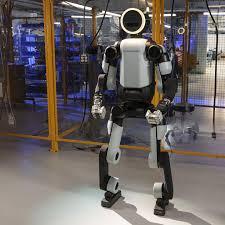
Hyundai’s Quiet Robotics Industrial Strategy
Since the acquisition, Hyundai has steadily repositioned Boston Dynamics from research showcase to strategic industrial asset. In 2025 Hyundai publicly committed to purchasing “tens of thousands” of robots while integrating Atlas and Spot into factories, logistics, and advanced manufacturing operations. Major media increasingly frame Atlas not as a science experiment, but as part of Hyundai’s long-duration manufacturing strategy.
The lineup is now commercially coherent:
- Boston Dynamics Spot — quadruped industrial inspection robot;
- Stretch — warehouse container-unloading robot;
- Atlas — next-generation humanoid industrial automation platform.
The transition from the hydraulic Atlas to the fully electric Atlas in 2024 marked a major turning point. Electrification radically increases dependence on high-performance motors, batteries, semiconductors, sensors, and—critically—rare earth permanent magnets. Electric humanoids effectively compress many of the same supply-chain dependencies found in EV drivetrains into smaller, higher-torque, precision-controlled actuator systems.
The Hidden Rare Earth Engine Inside Humanoid Robotics
Boston Dynamics does not publicly disclose its exact motor architectures or magnet suppliers. However, patents, actuator designs, and broader robotics engineering literature strongly suggest the company likely relies on high-torque-density brushless permanent magnet servo systems.
Why? Because humanoid and quadruped robots require extreme torque density, responsiveness, thermal stability, and compactness simultaneously. Those are precisely the conditions where sintered NdFeB magnets dominate globally.
The deeper issue is heat.
Advanced robotics actuators operating under dynamic loads often require elevated coercivity protection at higher temperatures. That often introduces heavy rare-earth elements such as dysprosium (Dy) and terbium (Tb) via grain-boundary diffusion or related doping techniques. Boston Dynamics has not confirmed Dy/Tb usage publicly, but industry practice in high-performance robotics and electric motors suggests some actuator classes may require heavy rare earth enhancement to maintain coercivity under elevated thermal loads.
China Still Owns the Chokepoint
China still dominates global sintered rare earth magnet manufacturing and maintains overwhelming control over heavy rare earth separation capacity, particularly dysprosium and terbium processing. This matters because humanoid robots are not merely software products. They are mineral-intensive electromechanical systems.
A single advanced humanoid may require:
- dozens of precision actuators;
- high-specification magnets;
- lithium-ion batteries;
- copper-intensive wiring;
- semiconductors;
- thermal imaging systems;
- advanced sensing stacks.
The supply chain quickly traces back to neodymium, praseodymium, dysprosium, terbium, nickel, cobalt, lithium, graphite, gallium, germanium, and specialty magnetic alloys. China’s 2025 export controls on medium and heavy rare earths exposed precisely how fragile these downstream robotics ecosystems remain.
Can Hyundai Escape the Trap?
Hyundai appears increasingly aware of the risk. The Korean automaker reportedly accumulated roughly a year’s worth of rare-earth inventory and has invested in rare-earth-free motor research, recycling initiatives, and diversified procurement channels.
Meanwhile, Japan’s Sojitz-Lynas alliance, MP Materials, Noveon Magnetics, and Proterial’s heavy-rare-earth-free magnet developments all represent emerging attempts to build non-China magnet ecosystems. But none have yet fully solved the scaling problem.
The uncomfortable reality is this: the humanoid robotics race may ultimately depend less on AI models than on whether the West can secure enough dysprosium, terbium, and sintered NdFeB magnet capacity to industrialize robotics at scale. That is the real supply chain story buried beneath Atlas doing cartwheels.


0 Comments
No replies yet
Loading new replies...
Moderator
Join the full discussion at the Rare Earth Exchanges Forum →