
Highlights
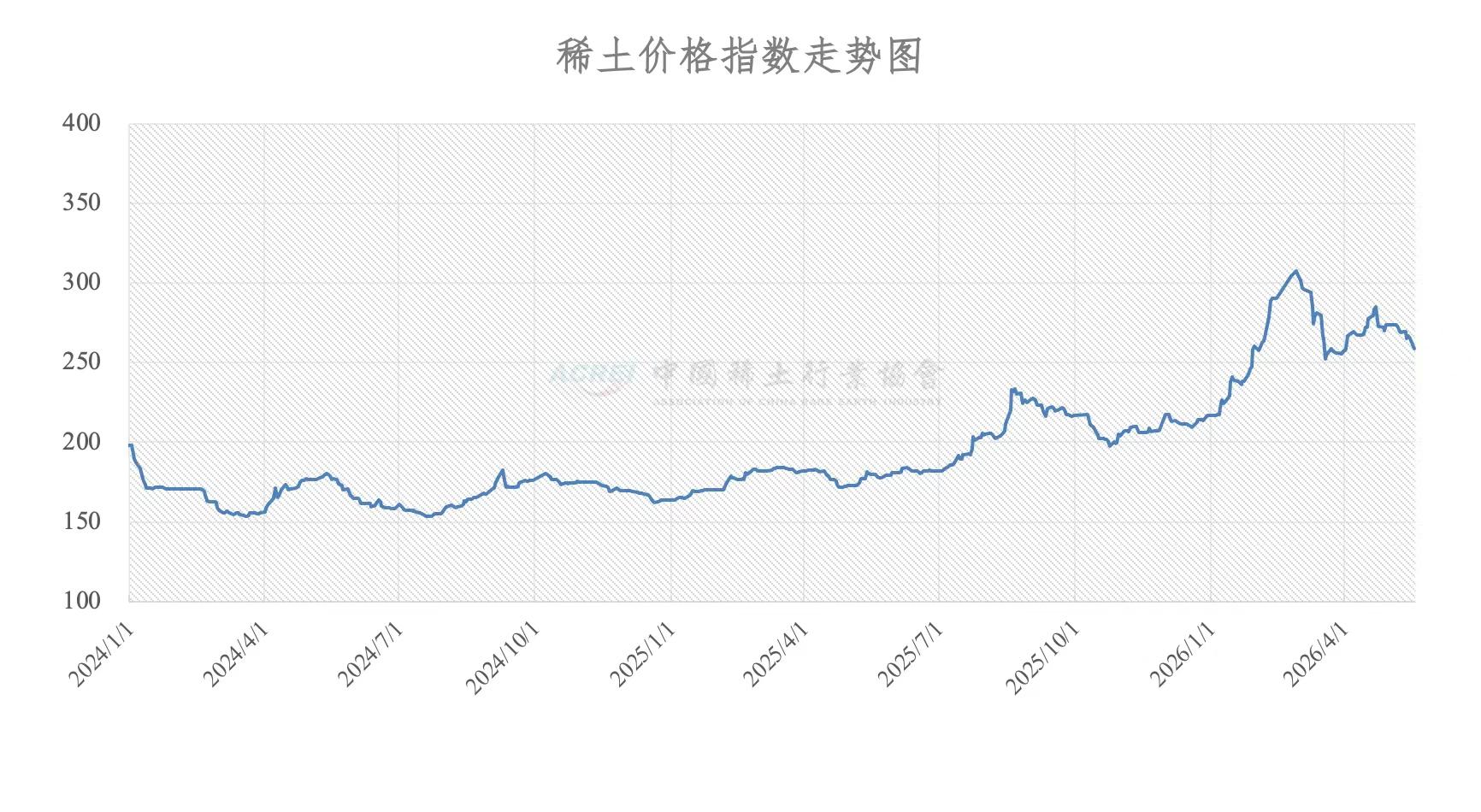
- China's rare earth price index fell to 258.7 on May 18, 2026, after rallying above 300 earlier this year, but prices remain shaped by state intervention rather than free market forces.
- Heavy rare earths like dysprosium and terbium remain historically elevated, while roughly 90% of global refining occurs in China within a controlled market architecture.
- Rare-earth pricing now serves as a geopolitical signal, reflecting supply chain power over critical technologies, including EVs, semiconductors, AI infrastructure, and defense systems.
China’s official rare earth price index slipped to 258.7 on May 18, 2026, retreating from the sharp rally that pushed the index above 300 earlier this year. The index uses 2010 transaction data as its baseline value of 100 and is calculated from daily transaction data collected from Chinese rare earth enterprises. The broader chart tells the real story: after trading mostly sideways through 2024, rare earth pricing accelerated aggressively through late 2025 and early 2026 before recently consolidating. But investors should be careful. These are not truly “market-discovery” prices in the Western commodity sense.
The Rare Earth Market Is Not Really a Market
China remains the center of global rare earth pricing. Yet the domestic market operates inside a dense architecture of state intervention, production quotas, export controls, strategic stockpiling, industrial policy, environmental restrictions, and national security priorities. In other words, Beijing is not merely observing the rare earth market. It is actively shaping it. And it’s anything but free.
Meanwhile, the so-called ex-China market remains thin, opaque, and still emerging. Roughly 90% of rare-earth refining continues to occur in China. Most ex-China transactions remain bilateral agreements with confidential terms, customized pricing formulas, strategic financing arrangements, minimum purchase commitments, and long-duration offtake structures.
Pricing agencies therefore provide snapshots—not universally discoverable global spot prices.
Even the widely discussed U.S. Department of Defense-linked support framework surrounding MP Materials — often interpreted as implying a roughly US$110/kg NdPr floor price — may not necessarily extend to the broader industry. But there is an indication that, given Australia is also adopting the price point, it emerges as a floor at least for NdPr.
Heavy Rare Earths Remain Historically Elevated
Several strategic heavy rare earth products weakened modestly on the day but remain historically elevated by long-term standards.
- Dysprosium oxide: 1,290–1,330 yuan/kg (US$193.5–199.5/kg)
- Terbium oxide: 6,055–6,115 yuan/kg (US$908.3–917.3/kg)
- Neodymium oxide: 425.2–445.2 yuan/kg (US$63.8–66.8/kg)
- Gadolinium oxide: 167–187 yuan/kg (US$25.1–28.1/kg)
(Approximate conversion using 1 Chinese yuan = US$0.15)
Great Powers Era 2.0: Prices as Geopolitical Signals
The deeper story is not simply pricing volatility. Rare-earth pricing increasingly reflects geopolitical leverage, industrial strategy, and supply-chain power. China continues dominating the industrial chokepoints that matter most: separation, refining, metallization, alloying, and magnet manufacturing.
Those industrial layers underpin EVs, robotics, semiconductors, drones, AI infrastructure, wind turbines, and advanced defense systems. In the emerging Great Powers Era 2.0, rare earth prices are no longer merely commodity indicators.
They are signals emanating from the architecture of industrial civilization itself.
Disclaimer: This pricing update originates from the China Rare Earth Industry Association (CREIA), a state-linked industry body. The information should be independently verified before being relied upon for investment, policy, or commercial decisions.


0 Comments
No replies yet
Loading new replies...
Moderator
Join the full discussion at the Rare Earth Exchanges Forum →