
Highlights
- China's Ministry of Commerce reports a "positive consensus" from U.S.-China trade talks tied to Trump's 2026 Beijing visit, with rare earths and critical minerals now central to formal bilateral economic negotiations.
- Beijing offers to "jointly study solutions" on rare earth shortages while maintaining export controls, suggesting tactical flexibility rather than structural concessions on strategic mineral governance.
- Investors should monitor U.S. policy toward Taiwan and Middle East conflicts, as America's military-industrial complex and clean energy goals remain dependent on China-controlled critical mineral supply chains.
China’s Ministry of Commerce has released a lengthy readout describing what it calls “positive consensus” from recent U.S.-China trade negotiations tied to President Donald Trump’s May 2026 state visit to Beijing. The statement spans tariffs, agriculture, aviation, investment, export controls, and industrial policy. But for global manufacturers, one issue stands out: rare earths and critical minerals have moved into the center of formal bilateral economic negotiations.
That is a positive signal. It suggests both governments understand that rare earth instability can ripple through defense, autos, electronics, energy, aviation, and advanced manufacturing. But the source matters. The readout was circulated by the China Rare Earth Industry Association and sourced from Chinese state media. It should be read as both a policy signal and a strategic narrative from Beijing—not as a neutral settlement document.
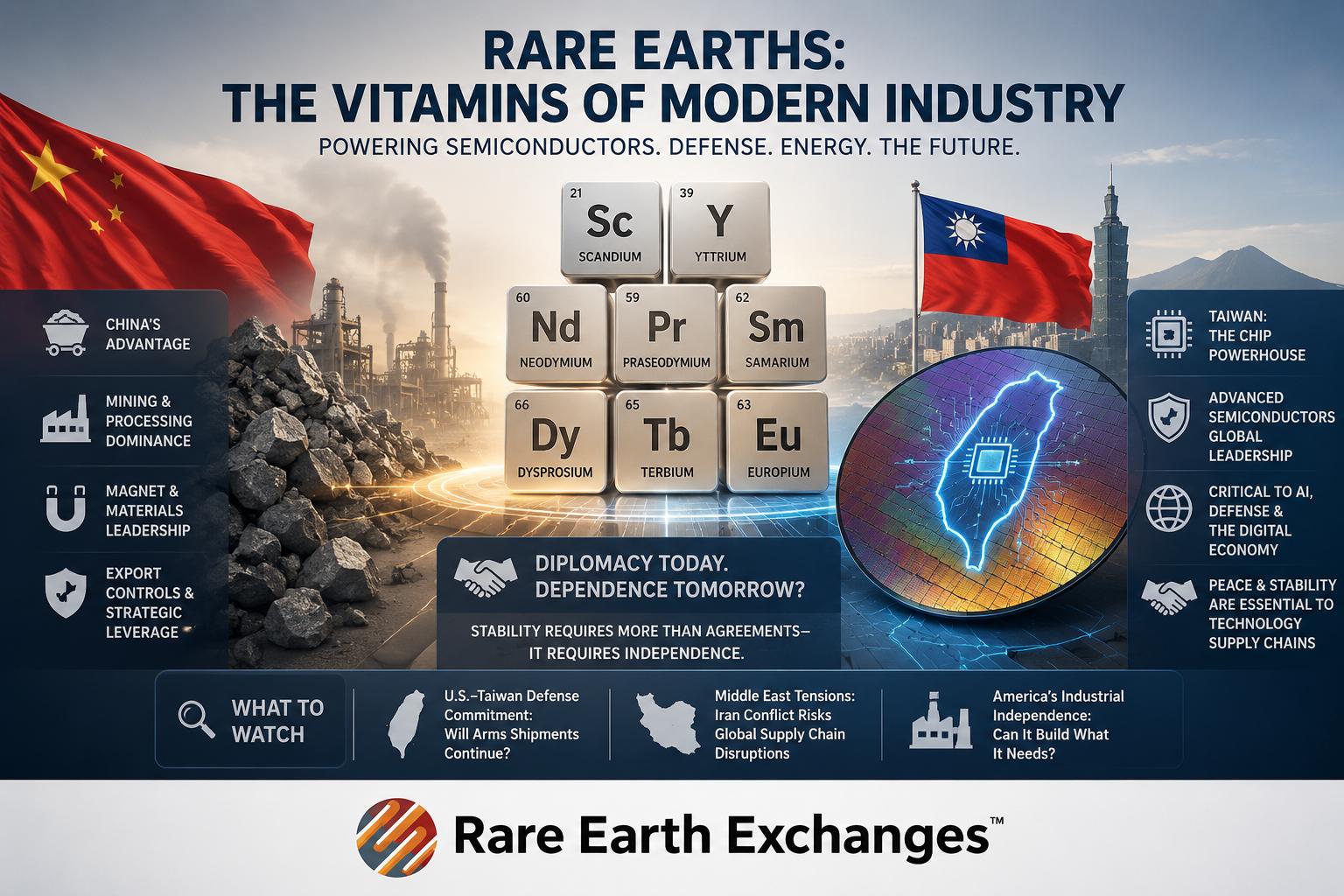
Rare Earths Enter the Negotiating Room
One of the most consequential sections addressed U.S. concerns over shortages of rare earths and critical minerals, including yttrium, scandium, neodymium, and indium. It also referenced U.S. concerns about restrictions on the sale of rare earth production and processing equipment and technology.
China’s response was carefully worded. According to the Ministry of Commerce, both sides agreed to “jointly study solutions” to each side’s “reasonable and legitimate concerns.” Beijing reiterated that its export controls on rare earths and critical minerals are lawful, regulatory, and subject to license review. It said compliant civilian-use applications would be examined and that China is willing to help maintain stable global industrial supply chains.
That language does not mean China is abandoning export controls. It suggests Beijing may selectively ease pressure where it serves broader diplomatic or commercial goals, while preserving its role as gatekeeper.
Tariffs, Trade Councils, Boeing, and Agriculture
The broader readout also points to a temporary stabilization effort. China says the two sides agreed in principle to establish intergovernmental Trade and Investment Councils, moving disputes from “crisis-style response” toward more institutionalized management. The statement also references reciprocal tariff-reduction discussions covering $30 billion or more in goods, possible Most Favored Nation treatment, and efforts to extend prior tariff and non-tariff standstill arrangements.
Beijing also confirmed China’s aviation sector would introduce 200 Boeing aircraft under commercial principles, with the U.S. expected to support engines and parts supply. Agriculture received major attention as well, including dairy, seafood, poultry, bonsai plants, beef exporter registrations, avian influenza restrictions, and drug-residue compliance reviews.
The Caveat Western Investors Should Not Miss
This is not a rare-earth peace treaty. It is a managed pause inside a larger strategic contest. The readout suggests tactical flexibility, not structural concession. Beijing still treats rare earths as regulated strategic assets embedded in national industrial policy. Nothing here indicates China intends to relinquish control over separation, metallization, magnet manufacturing, processing equipment, or downstream technology.
For the U.S. and Europe, the lesson is clear: diplomacy may reduce near-term disruption, but it does not replace industrial rebuilding. Rare earth security still requires mines, separation, metals, alloys, magnets, qualified customers, and independent technical know-how.
What to Watch
Rare Earth Exchanges™ believes investors should now closely monitor what Washington actually does—not merely what negotiators say. First and foremost: does the United States continue shipping billions of dollars in advanced weapons systems to Taiwan at current levels, or does policy subtly soften as industrial dependence pressures intensify? That question may increasingly sit at the uncomfortable intersection of geopolitics and industrial survival.
In blunt terms, some critics may begin asking whether America risks gradually “throwing Taiwan under the bus” to secure what increasingly resembles the vitamins of modern industry: rare earths, magnets, advanced materials, and strategic mineral supply chains. Readers must remember that Taiwan has been independent of the mainland for several decades now. Second, investors should watch the trajectory of any expanding Middle East conflict, particularly involving Iran. A wider regional war could simultaneously stress global shipping, energy markets, defense supply chains, and industrial production—precisely when the West remains heavily dependent on China-linked critical mineral ecosystems.
America remains in a precarious position, to say the least. Its military-industrial system, clean energy ambitions, AI infrastructure buildout, and advanced manufacturing goals all still intersect with supply chains where China maintains substantial leverage.
Disclaimer: This article is based on statements released through Chinese state-affiliated media, the Chinese Ministry of Commerce, and the China Rare Earth Industry Association. These claims may reflect Beijing’s preferred framing. Specific trade commitments, tariff arrangements, aircraft purchases, export-control treatment, and implementation outcomes should be independently verified through U.S., company, and third-party sources.


0 Comments
No replies yet
Loading new replies...
Moderator
Join the full discussion at the Rare Earth Exchanges Forum →