
Highlights
- China's rare earth price index dropped to 251.4 on May 20, 2026, down from early-2026 highs but still dramatically elevated compared to the 2010 baseline of 100, reflecting ongoing supply tensions and export controls.
- Heavy rare earth prices declined modestly, with dysprosium oxide at $188-194/kg and terbium oxide at $905-914/kg, while light rare earths like neodymium remained stable around $25-28/kg.
- Chinese rare earth prices don't reflect true market dynamics but are shaped by state-directed quotas, export controls, and strategic policy, while the ex-China market remains opaque, with 90% of refining still occurring in China.
China’s official rare earth price index slipped to 251.4 on May 20, 2026, according to new data released by the China Rare Earth Industry Association. The index, benchmarked to 2010 transaction levels set at 100, shows prices remain dramatically elevated versus historical norms despite recent pullbacks from early-2026 highs.
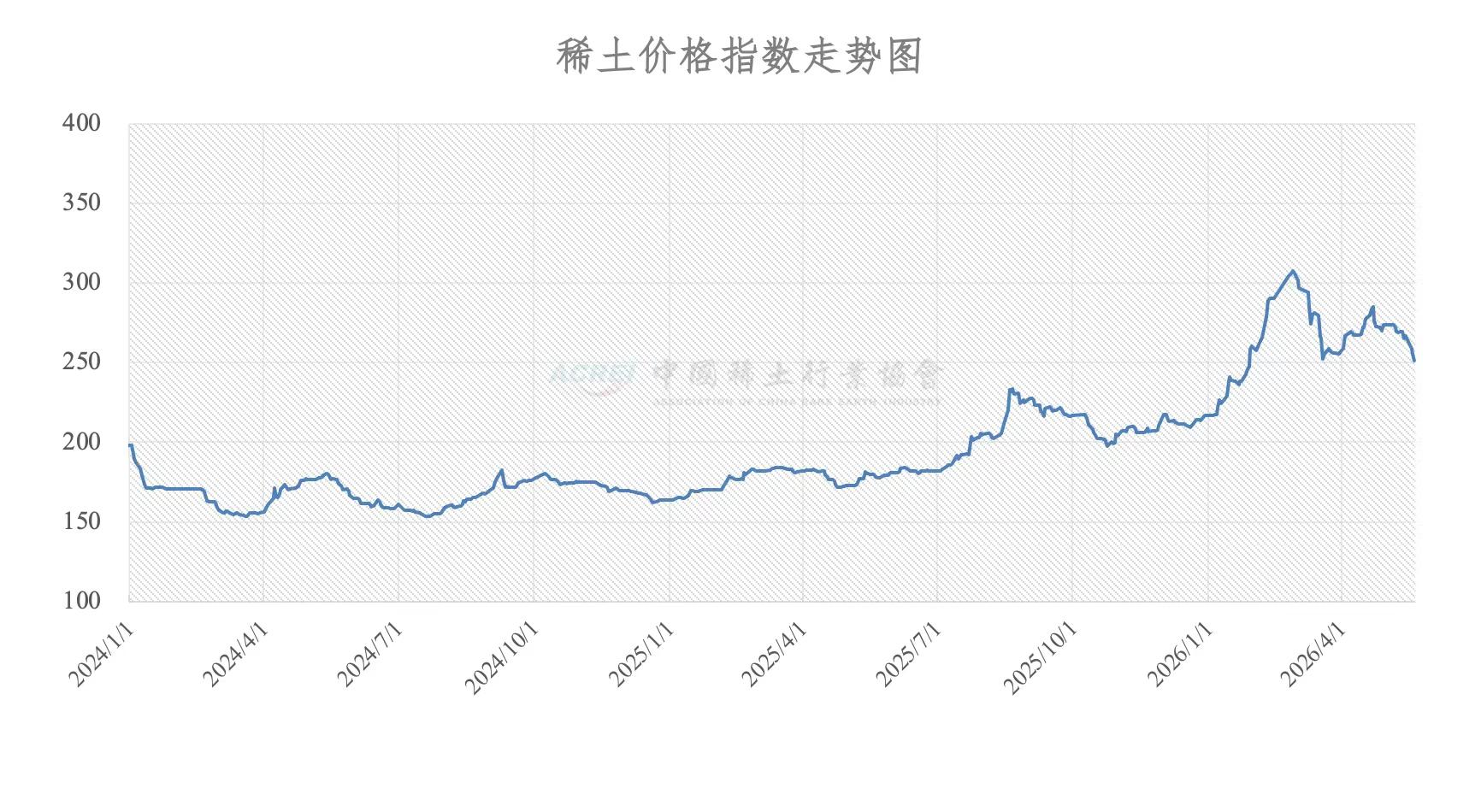
The broader chart tells the story. China’s rare earth index surged sharply through late 2025 and early 2026 before moderating in recent months, reflecting continued market anxiety around export controls, geopolitical tensions, and tight heavy rare earth supply conditions.
Key Rare Earth Prices: Heavy Elements Remain Elevated
Using an approximate exchange rate of 1 Chinese yuan ≈$0.15 USD, several strategically important products remain historically high:
- Neodymium oxide: ¥167–187/kg ($25–28/kg) — flat
- Praseodymium-neodymium oxide (NdPr oxide): ¥688–708/kg ($103–106/kg) — down slightly
- Dysprosium oxide: ¥1,250–1,290/kg($188–194/kg) — down
- Dysprosium metal: ¥1,635–1,655/kg ($245–248/kg) — down
- Terbium oxide: ¥6,035–6,095/kg ($905–914/kg) — down
- Gadolinium oxide: ¥13.7–15.7/kg ($2.06–2.36/kg) — flat
- Lanthanum oxide: ¥4.1–6.1/kg ($0.62–0.92/kg) — flat
Most heavy rare earth categories weakened modestly on the day, while many light rare earth products remained stable.
The Critical Caveat: These Are Not Pure “Market” Prices
Western readers should be careful not to interpret Chinese rare-earth prices as genuine free-market discovery mechanisms.
China’s rare earth sector operates inside a highly managed industrial system shaped by:
- State-directed consolidation
- Production quotas
- Export controls
- Strategic stockpiling
- Environmental regulation
- National security policy
- Opaque bilateral contracting
In other words, China’s rare earth prices are deeply intertwined with state-backed industrial strategy and geopolitical objectives—not simply supply and demand.
The “Ex-China” Market Remains Murky Too
Ironically, the so-called ex-China market is also difficult to price accurately.
Roughly 90% of global rare-earth refining and separation still occurs in China, meaning truly independent spot markets remain thin. Most non-Chinese transactions occur through confidential bilateral agreements with bespoke pricing terms, qualification requirements, delivery conditions, and strategic considerations. Pricing agencies, therefore, capture only partial snapshots of a fragmented market. The United States effectively established a rough NdPr floor near $110/kg through strategic support arrangements involving


0 Comments
No replies yet
Loading new replies...
Moderator
Join the full discussion at the Rare Earth Exchanges Forum →