
Highlights
- China's rare earth price index registered 252.6 on May 21, 2026, retreating from early-2026 spikes above 300 but remaining structurally elevated compared to 2024-2025 levels in the 150-180 range.
- Key magnet materials show sustained premium pricing: NdPr oxide at $102-105/kg, Pr-Nd metal at $125-128/kg, and critical heavies like terbium oxide at $886-895/kg reflect managed market dynamics.
- China's pricing operates within a controlled industrial system shaped by quotas, export controls, and state policy, while ex-China supply chains remain fragmented with limited transparent price discovery.
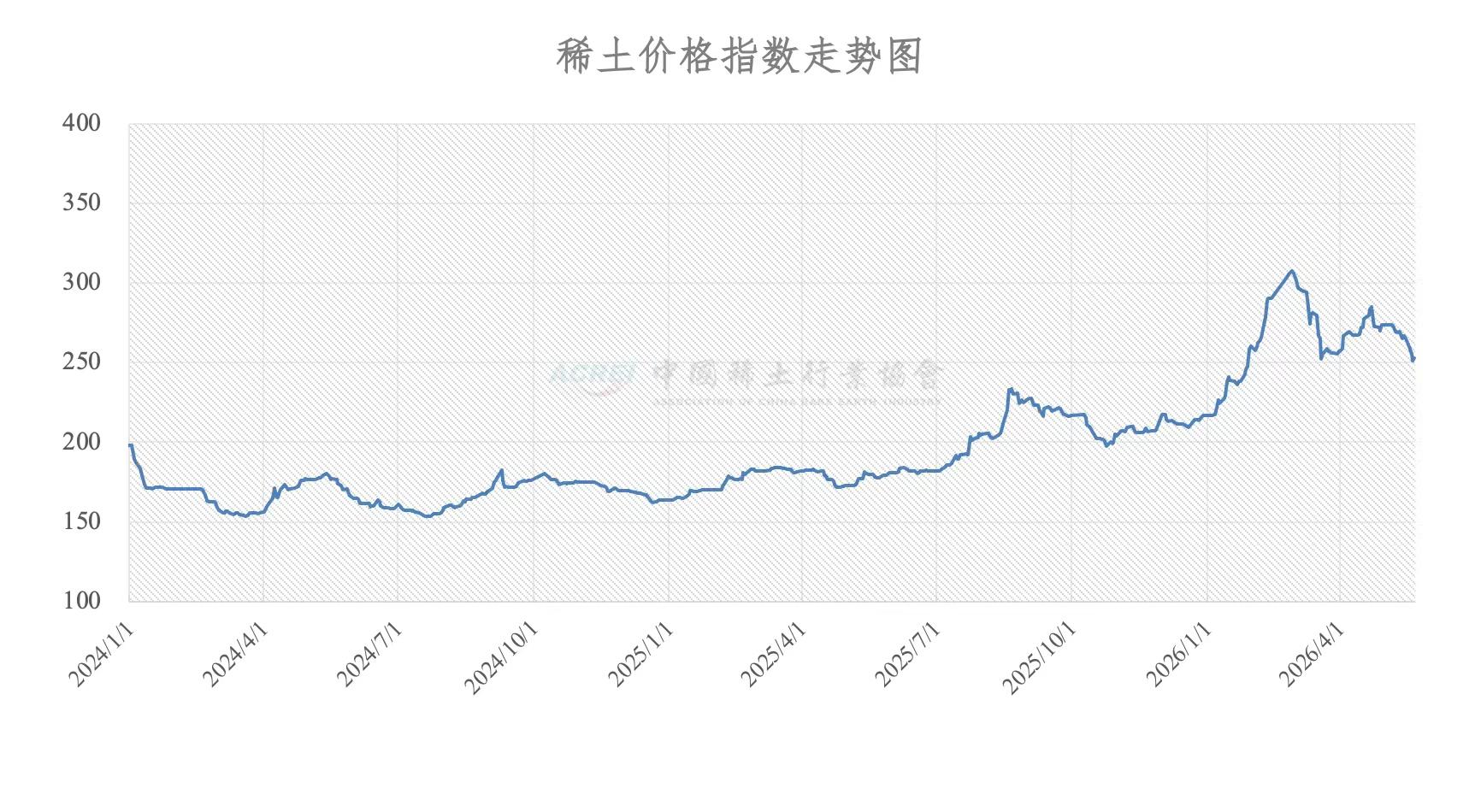
China’s Rare Earth Industry Association reported its rare earth price index at 252.6 on May 21, 2026. The index remains far above 2024–2025 levels, even after retreating from an early-2026 spike. The update matters because elevated rare earth pricing continues to signal stress around magnet materials, export controls, industrial policy, and the widening gap between China’s managed market and the still-fragmented ex-China supply chain.
The Chart Is Hot—But Not Simple
China’s rare earth price index stood at 252.6, using 2010 = 100 as its baseline. The chart shows a clear climb from roughly the 150–180 range in 2024–2025 to above 300 earlier in 2026, before easing back toward the 250s. That still matters. Even after the pullback, the index remains structurally elevated. Using an approximate exchange rate near USD/CNY 6.80, or about $0.147 per yuan, several key domestic China reference prices translate as follows: NdPr oxide at ¥694–714/kg equals about $102–105/kg; Pr-Nd metal at ¥852–872/kg equals about $125–128/kg; dysprosium oxide at ¥765–785/kg equals about $112–115/kg; terbium oxide at ¥6,025–6,085/kg equals about $886–895/kg. Current FX references put USD/CNY near 6.80.
Prices With a Political Shadow
These are not clean free-market signals. China’s rare earth prices operate inside a managed industrial system shaped by quotas, state-linked enterprises, export controls, environmental enforcement, stockpiling, and national security priorities. These figures are useful, but they should not be treated as pure market-discovery prices.
The ex-China market is not fully transparent either. Only a small share of rare earth refining occurs outside China. Most contracts remain bilateral, confidential, and customized. Pricing agencies capture snapshots, not a deep global spot market.
The Western Floor Question
The U.S. support structure around MP Materials and Australia’s support for a $110/kg NdPr floor may influence investor expectations. But Rare Earth Exchanges™ remains cautious: that does not automatically create an industry-wide global floor.
Disclaimer: This pricing update originates from the China Rare Earth Industry Association, a state-linked industry source. Figures should be independently verified before investment use.


0 Comments
No replies yet
Loading new replies...
Moderator
Join the full discussion at the Rare Earth Exchanges Forum →