
Highlights
- China's official rare earth price index eased to 248.2 on May 25, retreating from highs above 300, with dysprosium and terbium showing modest domestic softening.
- Outside China, Western buyers face supply uncertainty, opaque negotiations, delivery delays, and sharply elevated costs for heavy rare earths like dysprosium and terbium.
- Roughly 90% of rare earth refining and 98% of heavy rare earth separation still occur inside China, making CREIA benchmark prices unreliable as true global spot indicators.
- The U.S. Department of Defense-backed MP Materials arrangement implied an NdPr pricing floor near $110/kg, but analysts warn this does not broadly reflect ex-China market realities.
- The widening gap between China's managed internal pricing and stressed Western procurement markets signals growing fragmentation of the global rare earth economy.
China's official rare earth price index eased to 248.2 on May 25, retreating from recent highs above 300 reached earlier this year. On the surface, the latest pricing sheet from the China Rare Earth Industry Association (CREIA) suggests modest cooling across parts of the domestic Chinese heavy rare earth market.
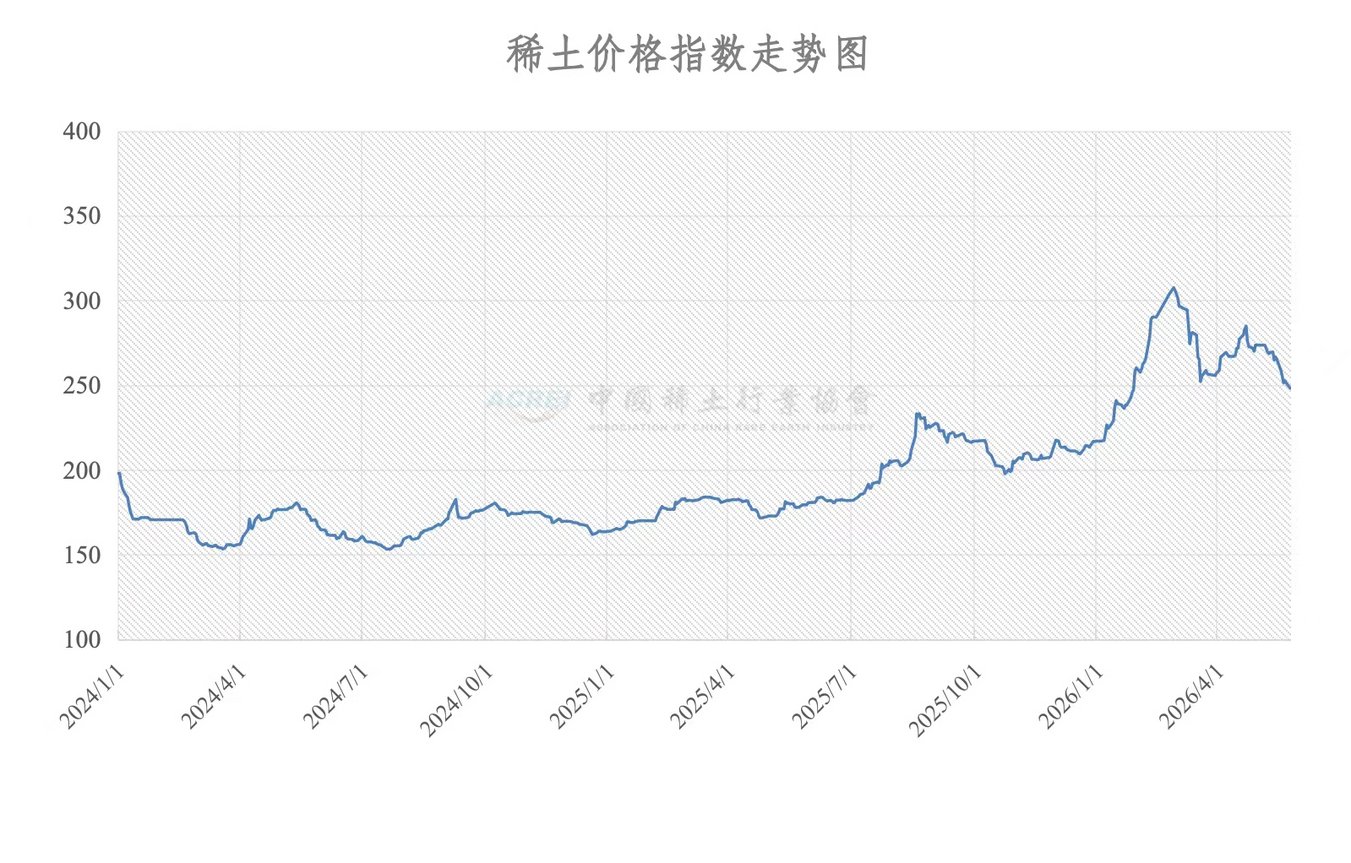
But outside China, many Western buyers are experiencing the opposite reality entirely. The result is increasingly surreal: two rare earth economies operating simultaneously under radically different business conditions.
At Least Perceived Calm Inside China, Stress Outside China
China's benchmark NdPr oxide—the foundational material for permanent magnets used in EVs, robotics, drones, semiconductors, wind turbines, and advanced defense systems—was quoted at:
- 675.3–695.3 yuan/kg
- Approximately $101.30–$104.30/kg USD
NdPr alloy traded at:
- 834.1–854.1 yuan/kg
- Approximately $125.10–$128.10/kg USD
Meanwhile, several strategic heavy rare earth products softened modestly inside China's domestic benchmark system:
Dysprosium Oxide
- 1,245–1,285 yuan/kg
- Approximately $186.75–$192.75/kg USD
- Trend: ↓ Down
Dysprosium Metal
- 1,625–1,645 yuan/kg
- Approximately $243.75–$246.75/kg USD
- Trend: ↓ Down
Gadolinium Oxide
- 197.2–217.2 yuan/kg
- Approximately $29.58–$32.58/kg USD
- Trend: ↓ Down
Praseodymium Metal
- 930.5–950.5 yuan/kg
- Approximately $139.58–$142.58/kg USD
- Trend: ↓ Down
Terbium oxide remained comparatively resilient:
- 5,000–5,200 yuan/kg
- Approximately $750–$780/kg USD
- Trend: Flat
The Great Rare Earth Divergence
The most important story is not the daily price movement itself. It is the growing divergence between China's internal benchmark pricing and actual ex-China procurement reality. Inside China, pricing increasingly reflects a managed strategic industrial ecosystem shaped by:
- state intervention,
- production quotas,
- export licensing,
- stockpiling,
- environmental controls,
- and broader national security policy.
This is not a conventional transparent commodity market. It is not a market as we know it in the West.
Meanwhile, outside China, heavy rare earth buyers often face:
- severe supply uncertainty,
- opaque bilateral negotiations,
- delivery delays,
- licensing risk,
- force majeure concerns,
- and sharply elevated replacement costs.
In practical terms, a Chinese domestic buyer may still transact near official benchmark prices, while a Western magnet producer may struggle to secure separated dysprosium or terbium units at all. If they do access product, they'll likely pay exponentially more. These are now effectively two different markets.
The "China Price" Is Not the Global Price
Western investors should be cautious about interpreting CREIA benchmark prices as true global spot discovery.
Roughly:
- 90% of rare earth refining
- approximately 98% of heavy rare earth separation
- and roughly 85–90% of NdFeB magnet manufacturing
still occur inside China.
Outside China, pricing remains fragmented and immature. Most contracts are confidential bilateral agreements with highly customized purity specifications, delivery obligations, tolling arrangements, qualification standards, and strategic conditions. Pricing agencies therefore provide only partial snapshots of a very thin ex-China market.
America's Emerging Price Floor
One increasingly important Western development remains the U.S. Department of Defense-backed arrangement involving MP Materials, which effectively implied an NdPr pricing floor near $110/kg in one strategic procurement context. Australia has advanced similar assumptions through critical minerals financing frameworks.
However, many market participants likely overestimate how broadly those pricing assumptions apply across the industry.
Why This Matters
The modest softening in China's domestic benchmark prices does not signal easing strategic vulnerability for the West. If anything, the widening divergence between relatively stable Chinese internal pricing and increasingly stressed ex-China heavy rare earth procurement markets may signal growing fragmentation of the global rare earth economy itself.
Disclaimer: This pricing information originates from the China Rare Earth Industry Association, operating within China's state-directed industrial framework. The information should be independently verified where possible. CREIA itself states the data is for reference purposes only and does not constitute investment advice.


0 Comments
No replies yet
Loading new replies...
Moderator
Join the full discussion at the Rare Earth Exchanges Forum →