
Highlights
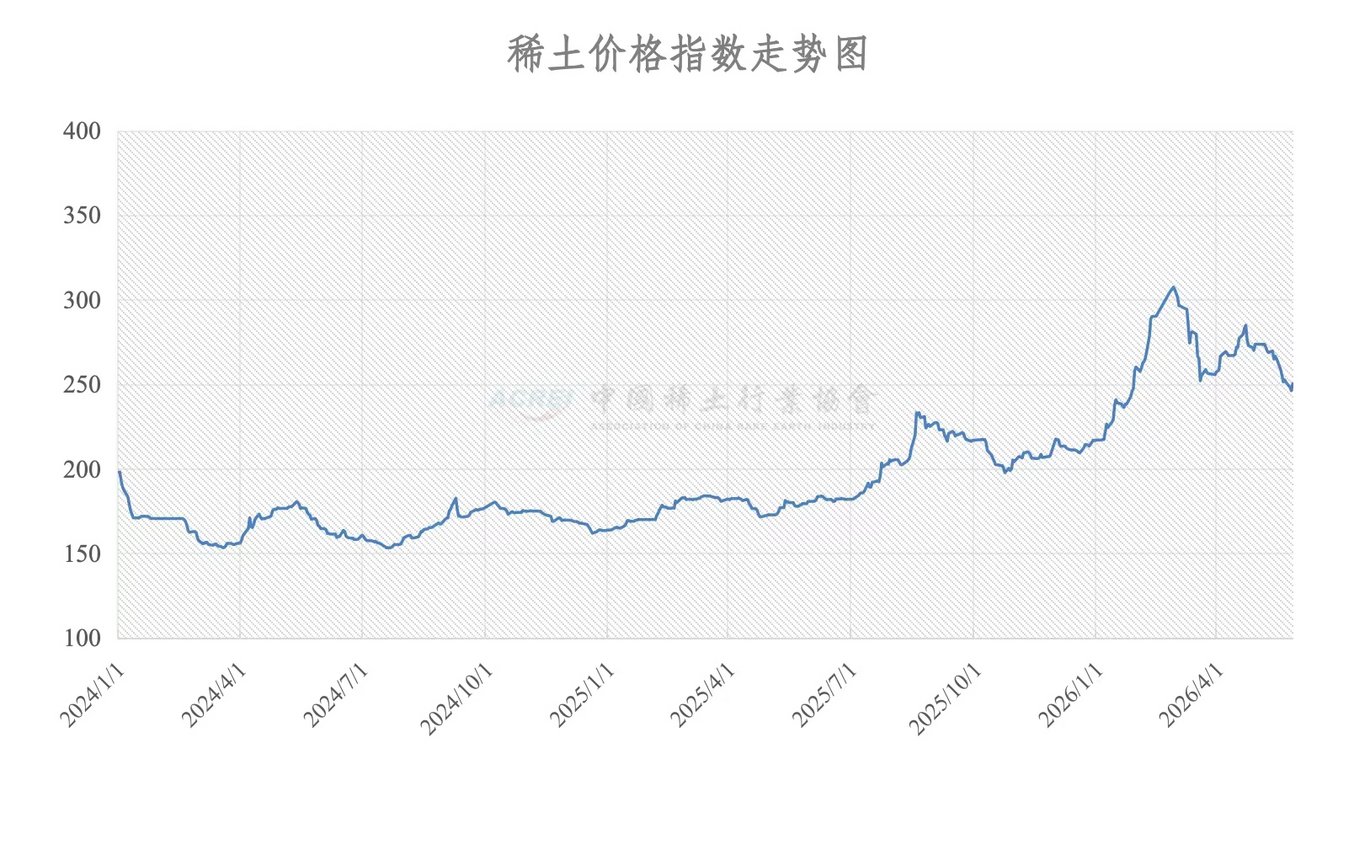
- China's rare earth price index stands at 250.4 on May 27, 2026, well above 2024 and early 2025 levels despite pulling back from a recent spike above 300.
- NdPr oxide and NdPr alloy prices rose on the day, sustaining pressure on core light rare earth inputs critical for high-performance NdFeB magnets used in EVs, drones, and defense systems.
- Heavy rare earths dysprosium and gadolinium were flat to lower, while terbium oxide held steady, indicating uneven pressure across the magnet material supply chain.
- China's rare earth pricing operates within a state-controlled system of quotas, export controls, and industrial policy, making transparent global price discovery extremely difficult.
- The U.S. MP Materials strategic procurement floor of roughly $110/kg for NdPr is not a universal industry benchmark, leaving ex-China pricing largely bilateral and opaque.
China’s rare earth market remains elevated and strategically sensitive, with the China Rare Earth Industry Association reporting a May 27, 2026 rare earth price index of 250.4. The index uses 2010 as a baseline of 100 and is calculated from reported transaction data collected from domestic Chinese rare earth enterprises. While the index has pulled back from its recent spike above 300, it remains well above much of 2024 and early 2025, signaling continued pressure across key rare earth inputs.
Magnet Materials Send the Real Signal
The most important data points are not broad averages. They are the magnet-facing materials tied to defense systems, drones, EV motors, robotics, wind turbines, and advanced manufacturing.
Key May 27 Chinese domestic prices included:
Dysprosium oxide: ¥1,230–1,270/kg, or $184.50–$190.50/kg — down Dysprosium metal: ¥1,595–1,615/kg, or $239.25–$242.25/kg — down Terbium oxide: ¥5,000–5,200/kg, or $750–$780/kg — flat PrNd oxide: ¥686–706/kg, or $102.90–$105.90/kg — up PrNd alloy: ¥835.7–855.7/kg, or $125.36–$128.36/kg — up Gadolinium oxide: ¥193.5–213.5/kg, or $29.03–$32.03/kg — down
The notable move is not a uniform heavy rare earth surge. Several heavy rare earth products were flat or lower on the day. The sharper business signal is that NdPr oxide and NdPr alloy rose, keeping pressure on the core light rare earth inputs used in high-performance NdFeB magnets.
Why the West Should Care
This is not just a pricing story. It is an industrial control story.
China’s rare earth prices do not represent clean, transparent commodity price discovery. They sit inside a system shaped by state ownership, quotas, export controls, environmental enforcement, industrial policy, and national security priorities. The ex-China market is also difficult to price cleanly. Only a small share of rare earth refining occurs outside China. Most transactions remain bilateral, confidential, and customized around purity, delivery, qualification, offtake terms, and strategic financing. The U.S. government-backed MP Materials framework established a roughly $110/kg NdPr floor price in one strategic procurement context. Some investors assume that benchmark applies across the industry. That is far from certain.
The Bottom Line
The May 27 data suggest a rare earth market still under strategic tension, especially around magnet materials. But this news originates from China’s state-linked rare earth industry media and should be independently verified before being treated as a definitive global market signal.


0 Comments
No replies yet
Loading new replies...
Moderator
Join the full discussion at the Rare Earth Exchanges Forum →