
Highlights
- China filed 19,994 rare-earth patent families from 2014–2024, roughly 23 times Japan's 861 and over 50 times South Korea's 380, using EPO DOCDB family methodology.
- China controls an estimated 94% of rare-earth permanent magnet production, tightly linking its patent dominance to real manufacturing and export-control leverage.
- Japan remains the strongest non-Chinese patent power, with firms like Sumitomo, Shin-Etsu, and TDK holding high-citation, high-value sintered magnet intellectual property.
- Germany appears as a structurally dependent downstream consumer rather than a patent leader, with Siemens holding only 22 rare-earth patent families in the dataset.
- Chinese universities alone account for roughly a quarter of all rare-earth patent families, reflecting an academic-industrial fusion the U.S. and Europe have yet to replicate.
The MP Materials–USA Rare Earth dispute may be dramatic, but it risks obscuring the larger strategic problem: the center of gravity in rare-earth magnet intellectual property is not in Texas, Oklahoma, or even Europe. It is in China, with Japan the clear runner-up outside China. In a recent European Patent Office's Patent Statistical Database (EPO PATSTAT)-based patent landscape using DOCDB simple patent families, researchers identified (opens in a new tab) 22,040 rare-earth-related patent families filed from 2014 to 2024; China accounted for 81% of them. The same study flagged magnets as one of the largest technical sub-areas in the landscape, with 2,341 magnet-related applications under H01F. In other words, the West is arguing over individual trade secrets while China has built an entire patent continent.
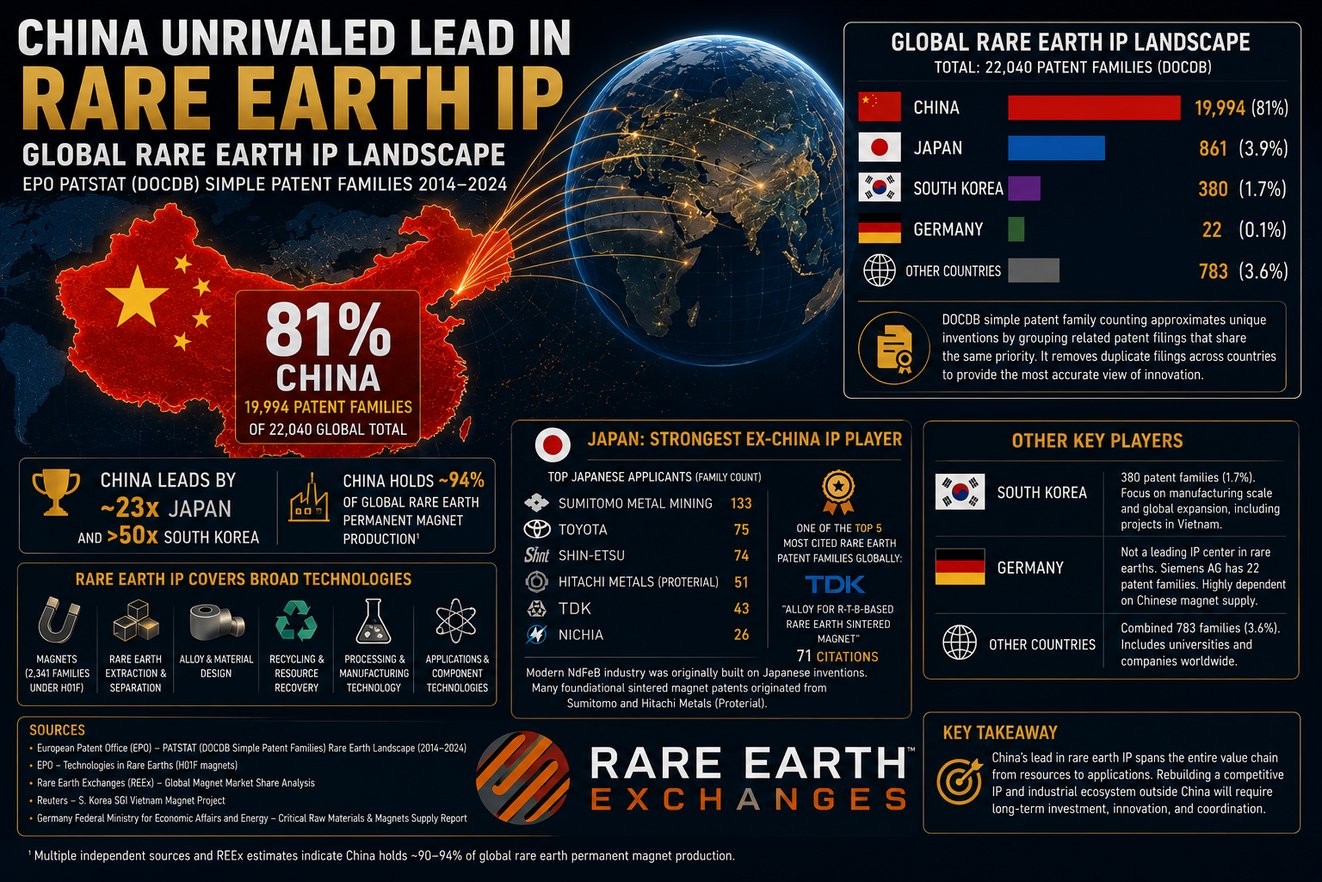
A note: China dominates current patent volume, but the modern NdFeB industry was originally built on Japanese inventions, and many foundational sintered magnet patents originated from Sumitomo and Hitachi Metals (Proterial).
Why China’s lead is harder to dismiss than usual
The key point is methodological. These figures are not raw patent-publication counts, which can exaggerate national leads. They use the EPO’s DOCDB simple patent family standard, which approximates unique inventions by grouping related filings sharing a common priority. On that family basis, China’s lead is still enormous. In the same dataset, China had about 19,994 patent families versus 861 for Japan and 380 for South Korea. On those figures, China’s family count is roughly 23 times Japan’s and more than 50 times South Korea’s. That is not a narrow lead. It is industrial separation.
This patent advantage aligns with real manufacturing power. According to multiple Rare Earth Exchanges™ (REEx) accounts, China holds a 94% market share in rare-earth-containing permanent magnets. Some reports found China supplied 90%+ of the world’s magnets in 2023, while Vietnam produced 1%, underscoring how tightly patenting and production are intertwined. China’s edge is not just in ideas on paper; it is embedded in furnaces, processing lines, supplier networks, and export-control leverage.
Japan is still the only serious ex-China patent pole
Japan is the strongest non-Chinese player by a wide margin, especially where magnet technology is concerned. In the same PATSTAT study, Japanese corporations dominated the international applicant landscape outside China. Sumitomo Metal Mining led with 133 families, followed by Toyota with 75, Shin-Etsu with 74, Hitachi Metals with 51, TDK with 43, and Nichia with 26. The report explicitly notes that Japanese firms dominate the international rare-earth landscape outside China and are concentrated in permanent magnets and related processing.
Japan also appears to punch above its weight on patent quality, not just quantity. In the same landscape, one of the five most cited rare-earth patent families globally was TDK’s “Alloy for R-T-B-based Rare Earth Sintered Magnet,” with 71 citations. That is a useful corrective to the simplistic view that patent volume alone decides technological leadership. China dominates count and system scale, but Japan still holds crucial high-value magnet know-how, especially in sintered magnet chemistry and engineering.
South Korea matters, but it is not in Japan’s league
South Korea is a real participant, but it is not a top-tier patent power in this field based on the public family-based data reviewed by REEx. Korea’s filing authority accounted for 380 rare-earth patent families over 2014–2024, well below Japan’s 861. REEx reporting suggests Korean firms are responding pragmatically by building manufacturing footholds in places like Vietnam rather than contesting China head-on from a dominant intellectual-property position. For example, in Reuters, South Korea’s SGI said its Vietnam project (opens in a new tab) targeted 5,000 tons per year of high-end NdFeB magnets, a meaningful industrial move, but also an illustration of how Korean strategy is becoming geographically adaptive rather than patent-hegemonic.
So in practical terms, the rare-earth magnet pecking order is: China first by a mile, Japan second, South Korea a distant third, and available evidence suggests Germany is not among the leading patent centers in rare-earth magnets and appears behind both China and Japan. That last Germany ranking is partly an inference, but it is a cautious one grounded in the available numbers.
Germany looks more like a dependent industrial customer than a patent pole
Germany is a formidable engineering nation, but in rare-earth magnets it does not show up as a first-rank patent center in the public data reviewed here. In the international top-ten applicant list, Siemens AG is the only clearly German name, with 22 patent families. That is respectable, but it is tiny compared with the leading Japanese firms and minuscule relative to the Chinese leaders. Germany’s economy ministry has estimated China supplied 90% of permanent magnets used not only in wind power but also in electric cars, machine building, and military industries. That is the profile of a highly exposed downstream user, not a country setting the global IP tempo.
SmCo matters, but NdFeB and sintered magnets are where the modern patent war sits
Samarium-cobalt magnets still matter strategically, especially in high-temperature and defense-adjacent uses, but we did not find a clean, country-by-country breakout for SmCo-only patent families comparable to the broader rare-earth family counts above. What the data do show is that the current strategic race is centered on NdFeB, rare-earth sintered magnets, alloy design, grain-boundary engineering, recycling, and tightly integrated process know-how. That is exactly where Japan’s best international patents and China’s massive filing volume intersect. The public data also show that Chinese universities and research institutes are deeply embedded in this system: universities alone account for roughly a quarter of all rare-earth patent families, and the top twenty applicants are entirely Chinese entities. That kind of academic-industrial fusion is something the United States and Europe still lack in magnet materials.
What the West should Conclude
The strategic lesson is blunt. China’s advantage is not just that it mines more rare earths or processes more oxides. It has accumulated a patent estate of extraordinary scale, backed by manufacturing dominance and now reinforced by export controls. Japan remains the one ex-China country with a serious legacy and continuing relevance in sintered magnet know-how, but even Japan is operating at a far smaller scale. South Korea is capable and adaptive, yet secondary. Germany is technologically sophisticated but structurally dependent.
So while U.S. magnet companies fight each other in court, the wider patent map suggests the real contest is not MP Materials versus USA Rare Earth. It is the United States and Europe versus a Chinese system that already owns the volume game, while Japan still holds some of the highest-value ex-China magnet knowledge.
Open questions and limitations
The biggest gap in the public record is the absence of a high-confidence, source-consistent country breakout for SmCo-only and purely sintered NdFeB-only patent families across China, Japan, South Korea, and Germany. The strongest public data found are broader rare-earth family counts plus magnet-specific applicant and citation slices. That is enough to establish the overall ranking and strategic direction, but not enough to claim an exact national patent total for SmCo alone. The PATSTAT study itself also notes scope limitations, including search-strategy constraints and incomplete 2024 data due to publication lag.


0 Comments
No replies yet
Loading new replies...
Moderator
Join the full discussion at the Rare Earth Exchanges Forum →