
Highlights
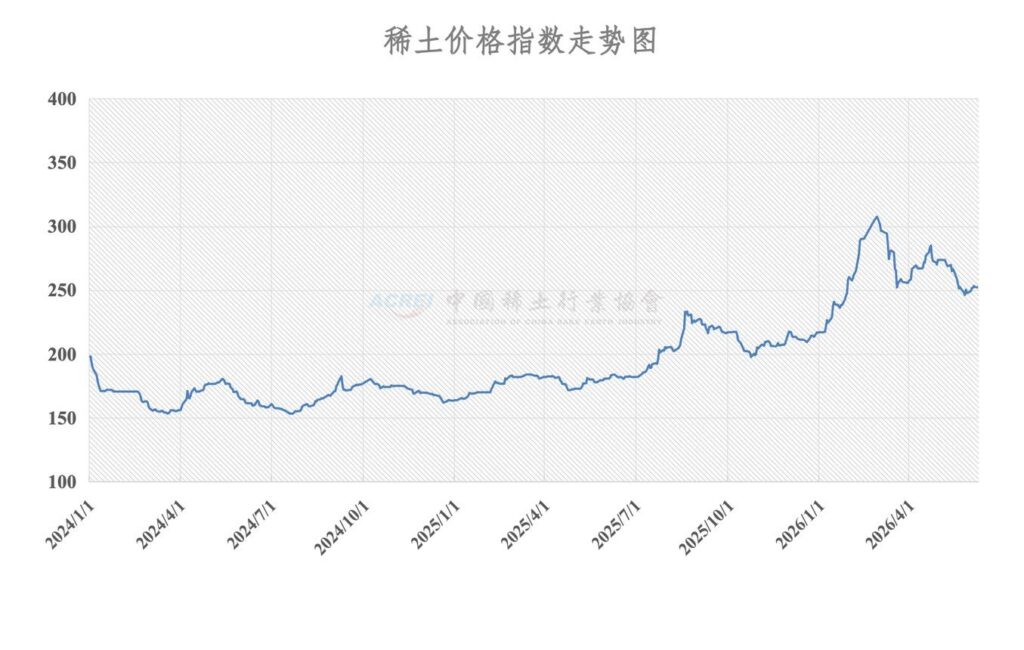
- China's Rare Earth Price Index stood at 252.2 on June 8, 2026, more than 2.5 times above the 2010 baseline after surging past 300 earlier this year.
- Dysprosium and yttrium remain critical bottlenecks in ex-China supply chains, with defense and tech buyers prioritizing availability over posted pricing.
- Roughly 90% of global rare earth refining capacity is concentrated in China, leaving the ex-China market fragmented and reliant on confidential bilateral contracts.
- A U.S. government-backed agreement with MP Materials established an effective NdPr price floor near $110/kg, potentially influencing future Western market contracts.
- Rare earth pricing is increasingly driven by geopolitics, industrial policy, and supply-chain security rather than traditional commodity market dynamics.
China's Rare Earth Price Index stood at 252.2 on June 8, 2026, indicating prices remain more than two-and-a-half times higher than the 2010 baseline used to calculate the index. According to the China Rare Earth Industry Association (CREIA) chart today, the index has climbed significantly over the past two years, rising from levels near 150–180 during much of 2024 and early 2025 before surging above 300 earlier this year. Although prices have retreated from those highs, they remain well above historical averages.
Heavy Rare Earths Continue to Command Premiums
The highest-value materials remain the heavy rare earths that underpin advanced magnets, defense systems, semiconductors, aerospace applications, and other strategic technologies. Among the notable daily movements, dysprosium metal strengthened modestly while NdPr products and several gadolinium products weakened slightly.
Dysprosium and Yttrium Remain Strategic Bottlenecks
Perhaps more important than today's quoted Chinese prices is the continuing scarcity of certain heavy rare earth elements outside China.
Dysprosium and yttrium remain among the most strategically constrained materials in the emerging ex-China supply chain. Commercial production outside China remains limited, supply chains are still developing, and buyers increasingly report difficulty securing dependable long-term volumes. For defense contractors, magnet manufacturers, and advanced technology firms, availability often matters more than posted pricing.
This reality helps explain why governments across North America, Europe, Australia, and Japan continue investing heavily in alternative supply chains despite recent market volatility.
Why Rare Earth Prices Are Difficult to Interpret
The reported figures provide useful insight into conditions within China, but they should not be confused with globally discovered spot-market prices. China's rare earth market operates within a framework of production quotas, export licensing requirements, environmental controls, strategic stockpiling programs, industrial policy objectives, and national security considerations. Domestic pricing therefore reflects both market forces and state influence.
At the same time, the ex-China market remains underdeveloped. Roughly 90% of global rare earth refining capacity remains concentrated in China, leaving relatively little independently traded material available elsewhere. Most transactions occur through confidential bilateral agreements that include customized specifications, delivery terms, purity requirements, volume commitments, and pricing formulas.
As a result, no single pricing agency captures the full picture of rare earth pricing outside China.
The Emerging Battle Over Price Discovery
One of the most consequential developments in the Western market remains the U.S. government-backed agreement with MP Materials, which established an effective long-term NdPr price floor of approximately $110/kg for qualifying material under that arrangement. Many market participants assume this benchmark could influence future contracts across the industry, although it remains unclear whether similar support mechanisms will be extended more broadly.
For investors, the larger takeaway is clear: rare earth pricing is increasingly influenced by geopolitics, industrial policy, and supply-chain security considerations rather than traditional commodity market dynamics alone.
Disclaimer: This report is based on pricing information published by the China Rare Earth Industry Association, a state-linked industry organization operating within China's rare earth regulatory framework. The information should be independently verified and should not be considered investment advice. Chinese domestic prices may not reflect realizable transaction prices in international markets, while ex-China pricing remains fragmented, opaque, and highly dependent on private contractual arrangements.
Register today: REEx Marketplace™ (opens in a new tab)
Discover companies, projects, pricing intelligence, and opportunities across the global rare earth value chain at the REEx Marketplace: https://marketplace.rareearthexchanges.com/signup (opens in a new tab)


0 Comments
No replies yet
Loading new replies...
Moderator
Join the full discussion at the Rare Earth Exchanges Forum →