

At a Glance
Before wearable robotics, soldiers relied on physical strength, pack design, and training to carry heavy loads and perform repetitive lifting. This often reduced speed and endurance while increasing fatigue and injury risk in the knees, hips, and lower back.
Military exoskeletons shift part of that burden into frames, motors, and sensors. (opens in a new tab)However, reliability in mud, salt fog, and extreme heat remains a major barrier to wider use.
Rare earth elements support many of the compact motors, sensors, displays, and specialty materials used in these systems. Their availability and processing can affect performance, cost, maintenance, and supply chain risk.
This article examines where military exoskeletons help in 2026, where they still fall short, and why rare earth supply matters.
Table of Contents
What Do Military Exoskeletons Look Like?
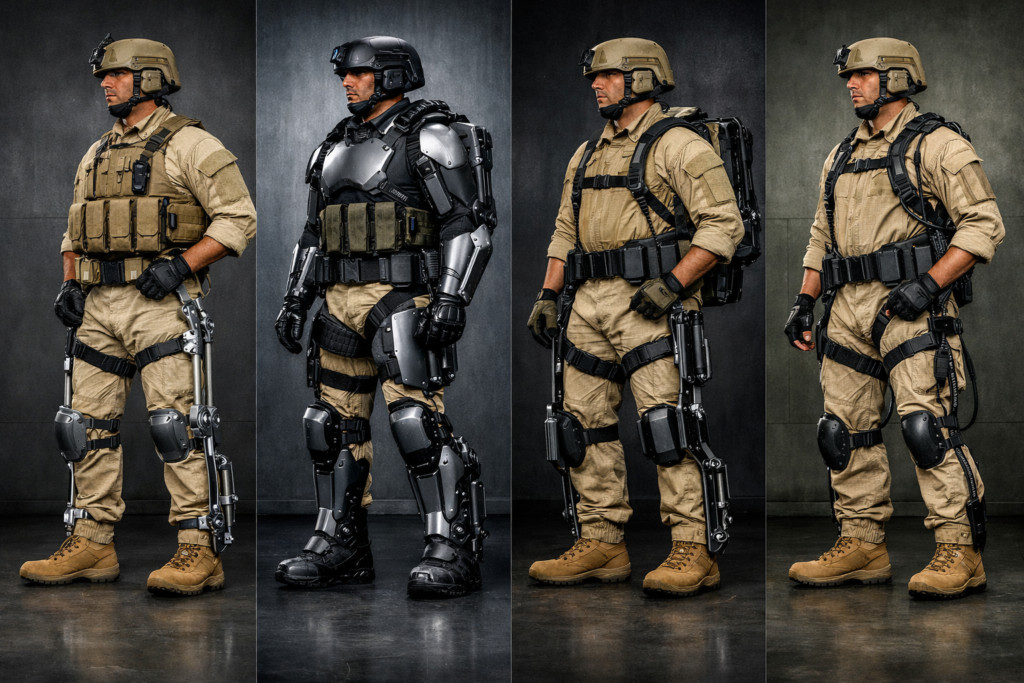
Military exoskeletons are worn over or alongside the body. Most attach at the waist, hips, legs, back, or shoulders using straps, braces, and padded contact points. Rigid models can look like an external frame, with mechanical joints positioned beside the wearer’s knees and hips. Softer exosuits use textiles, cables, and elastic elements, so they resemble specialized load-bearing gear more than a metal suit.
Passive systems use springs, dampers, or mechanical linkages to redirect weight and reduce strain. Powered systems add motors, batteries, sensors, and controls that assist movement in real time. In both cases, the goal is to transfer part of the physical load away from the wearer’s muscles and joints.
How Did Military Exoskeletons Change Soldier Load Carriage — and Why Do Rare Earths Matter?
For decades, carrying heavy loads on foot was simply a matter of strong backs, well-designed packs, and physical conditioning. Soldiers accepted that moving ammunition, supplies, or equipment over rough ground would cost them speed, endurance, and often their joints. Research published by the U.S. Army Natick Soldier Center and the U.S. Army Research Laboratory has consistently documented how repetitive load carriage drives overuse injuries in the knees, hips, and lower back — injuries that account for a significant share of non-combat medical evacuations.
Military exoskeletons offer a different approach. These wearable systems — ranging from passive frames that redirect load forces around the body to powered devices with motors and sensors — shift some of the physical burden from the human musculoskeletal system into engineered structures. The idea is straightforward: let a machine absorb peak forces so the person inside can work longer, lift more safely, or move with less fatigue.
But making these systems small enough to wear, strong enough to help, and tough enough to survive mud, salt fog, and desert heat is a serious engineering problem. NATO STO human performance research and U.S. Department of Defense test reporting have repeatedly flagged reliability in harsh environments as a gating factor for adoption. And buried inside those compact motors, sensors, and displays are materials that most people never think about — rare earth elements.
Rare earth elements matter here because the high-torque, lightweight electric actuation that makes a wearable exoskeleton practical often depends on permanent magnets built from neodymium, praseodymium, dysprosium, and other REEs. Phosphors for displays and optical coatings use yttrium, europium, and cerium. Polishing compounds and catalysts that shape manufacturing quality rely on cerium and lanthanum. According to U.S. Geological Survey mineral commodity summaries and Department of Energy critical materials assessments, (opens in a new tab)these elements sit at the intersection of performance requirements and supply chain risk.
This article explains what military exoskeletons are in 2026, where they genuinely help, where they still fall short, and why the availability and processing of rare earth elements can shape cost, sustainment, and program risk for the organizations that build and field these systems.
Rare Earth Role in Military Exoskeletons
Which Elements Are Used and Why
The motors inside a powered exoskeleton need to produce high torque in a very small package. That requirement points directly at rare earth permanent magnets.
Neodymium and praseodymium form the backbone of NdFeB magnets, the strongest commercially available permanent magnets. According to DOE Critical Materials assessments and magnet industry reporting cited by IEEE Spectrum, NdFeB magnets allow actuator designers to shrink motor diameter while maintaining the same output torque. For a device strapped to a person's hip or knee, that size and weight savings is not optional — it is fundamental to usability.
Dysprosium and terbium appear in smaller quantities, but they solve a specific problem. Electric motors generate heat, and NdFeB magnets lose their magnetic strength — a property called coercivity — as temperature rises. Adding small amounts of Dy or Tb raises the temperature at which demagnetization begins. Peer-reviewed magnet metallurgy literature and DOE materials briefs describe this tradeoff in detail. Without these additions, a motor working hard under load in a hot environment could permanently weaken its own magnets.
Samarium supports an alternative magnet chemistry: samarium-cobalt. SmCo magnets tolerate higher temperatures and resist corrosion better than many NdFeB grades. Materials engineering references used by defense electromechanical suppliers describe SmCo as a choice for sustained, high-load duty cycles where thermal margins matter more than peak magnetic strength.
Beyond magnets, rare earths show up in supporting components. Yttrium, europium, terbium, and cerium are used in phosphors for display backlights, status indicators, and some augmented reality vision components. Cerium and lanthanum serve as polishing compounds and catalysts during precision manufacturing of optical and electronic parts. The U.S. Geological Survey mineral commodity summaries describe these roles across multiple product categories.
How It Works
The connection between rare earths and exoskeleton performance follows a clear chain. In a joint actuator designed to assist the hip or knee, NdFeB or SmCo motor magnets create a stronger magnetic field per unit volume. That stronger field translates to higher torque density, which means the motor can be smaller and lighter while still delivering meaningful assistance. The result is an actuator that fits against the body without making the wearer feel like they are carrying an extra piece of equipment.
In the power electronics and sensor systems, REE-enabled miniaturized components — including magnetic elements and some optical emitters — improve signal quality and packaging density. This leads to more stable control loops, which is not just an engineering nicety. U.S. Army and NATO STO evaluations have noted that when assistance feels laggy or unpredictable, users instinctively fight the machine, increasing rather than decreasing their effort.
When a helmet-mounted or chest-mounted display is integrated, phosphors based on yttrium, europium, or terbium convert electrical energy into light more efficiently. Brighter output at lower power consumption extends battery life at the margin — a factor that matters when every watt-hour carried has weight consequences.
There is also a thermal constraint that shapes material choices. In hot environments or tightly enclosed motor housings, magnet temperatures can approach demagnetization thresholds. Engineers may select Dy/Tb-enhanced NdFeB or switch to SmCo despite higher cost and supply risk. DOE criticality discussions and motor design handbooks treat this as a recurring design decision rather than a rare edge case.
Journey from Mine to Product
Supply Chain Steps
The path from raw ore to a functioning exoskeleton actuator involves several distinct stages, each with its own industrial base and geographic concentration.
Rare earth ores are first mined and mechanically upgraded into mineral concentrates. These concentrates then undergo chemical separation — a complex, multi-stage process that isolates individual rare earth oxides from one another. The U.S. Geological Survey and the International Energy Agency have both highlighted separation as a strategically important and geographically concentrated step. (opens in a new tab)
Once separated, oxides are reduced into metals, then combined into alloys. For magnets, alloys are processed through powder metallurgy — typically sintering — to produce finished NdFeB or SmCo magnet blocks. These blocks are machined to precise dimensions, coated to resist corrosion, and then integrated into motor assemblies. Phosphors and optical materials follow a different but similarly specialized path from oxide to functional component.
Final assembly of a military exoskeleton brings together actuators, controllers, harness and fit systems, environmental seals, and onboard electronics. Quality assurance testing at this stage typically includes ingress protection checks, vibration testing, salt fog exposure, and thermal cycling, consistent with MIL-STD-oriented practices described by defense suppliers and test agencies.
Typical Chokepoints
Three chokepoints deserve attention from procurement and engineering planners:
- Separation capacity requires specialized chemical plants, waste handling infrastructure, and process know-how that cannot be built quickly. DOE and IEA supply chain analyses have repeatedly identified this step as a bottleneck.
- Heavy rare earth availability, particularly dysprosium and terbium, constrains production of high-temperature magnet grades more than light REE supply does. Price volatility at this stage flows directly into motor bills of material, according to USGS and DOE summaries.
- Magnet finishing — sintering, coating, and precision machining — involves yield and quality sensitivities. Failures at this stage can appear downstream as corrosion, chipping, or demagnetization under thermal cycling, as discussed in industrial magnet reliability literature.
Each of these chokepoints represents a point where delays, quality problems, or geopolitical disruption can cascade into program schedules and sustainment costs.
Statistics and Societal Impact
Quantitative Snapshot
Market estimates for wearable robotics relevant to defense and industrial assist vary depending on scope. Analyses from IDTechEx and Frost & Sullivan place the broader global exoskeleton and exosuit market in the low single-digit billions of dollars for 2025–2026, but the specifically military segment remains a fraction of that total. It is important to separate broad market projections — which include medical rehabilitation and industrial ergonomics — from actual defense procurement spending.
Deployment numbers in 2026 still reflect a technology in transition. According to U.S. Army DEVCOM updates and USSOCOM public technology demonstrations, most military exoskeleton activity centers on formal evaluations, limited pilots, and task-specific trials rather than sustained, large-scale fielding. NATO STO experimentation reports echo this picture across allied nations.
Powered-assist endurance remains a practical constraint. Manufacturer technical sheets and peer-reviewed evaluation studies — drawing on data from systems developed by companies such as Sarcos and from Lockheed Martin legacy program documentation — typically cite mission-relevant endurance in the range of two to eight hours, depending heavily on assist level, terrain, load, and ambient temperature. Those numbers shift significantly under real-world conditions compared to controlled lab testing.
Rare earth content per system is modest in absolute terms but significant in context. Motor magnets in a multi-joint powered exoskeleton may contain anywhere from tens of grams to a few hundred grams of NdFeB or SmCo material, depending on motor count and size. Engineering handbooks and magnet material density references support this range as a reasonable estimate, though exact figures are typically proprietary.
Downstream Effects
When these systems work as intended, the benefits are measurable. Peer-reviewed biomechanics research and NATO STO human performance studies report reductions in peak joint loading and perceived fatigue during repetitive lifting tasks. For logistics units, maintenance crews, and shipyard workers, that can translate into fewer overuse injuries and higher task throughput over a shift. Occupational safety research in industrial settings has begun to quantify these gains, and the results inform military adaptation.
When systems are poorly fitted, too heavy, or unreliable, they can make things worse. Controlled studies and DoD-oriented human factors evaluations have noted that added mass, altered gait patterns, and heat retention can increase perceived exertion and introduce new injury risks that the device was supposed to prevent. This is not a theoretical concern — it is a pattern observed in multiple evaluation cycles.
Innovators and History
Key Breakthroughs
The story of military exoskeletons sits at the intersection of several technology streams that matured over decades.
The commercialization of NdFeB permanent magnets in the 1980s — followed by later formulations incorporating dysprosium and terbium for improved high-temperature performance — made compact, high-torque electric motors feasible at sizes compatible with wearable devices. Materials science histories and DOE critical materials backgrounders chronicle how these magnet developments opened up design space that simply did not exist with earlier ferrite or alnico magnets.
On the systems side, DARPA-supported programs beginning in the early 2000s and U.S. Army research into load carriage and human performance framed the requirements problem. These efforts established that any useful exoskeleton had to balance mobility, endurance, and reliability — and they produced the test methods and biomechanical baselines that later programs would build on. DARPA program histories and Army research publications document this foundational work.
Advances in lightweight composites, inertial measurement units, force sensors, and model-based control algorithms gradually reduced the "laggy" feel that plagued early prototypes. Milestones in sensor fusion and real-time control are reflected in IEEE robotics conference proceedings and peer-reviewed wearable robotics journals. Standards development through ISO, ASTM, and national laboratory participation also began to provide safety and performance language relevant to defense applications.
From Lab to Product
The transition from laboratory demonstration to fieldable hardware has followed a recognizable pattern. Biomechanical concepts are proven in controlled lab settings first. Actuators and harnesses are then ruggedized for environmental exposure. Finally, systems are engineered for maintainability — with replaceable modules, onboard diagnostics, and standardized interfaces. U.S. Army R&D transition reporting describes this pathway and its frequent stumbling points.
Commercial industrial exoskeleton vendors have contributed meaningfully to this process by maturing fit systems, comfort features, and training protocols. Defense prime contractors, meanwhile, have focused on integrating exoskeletons with communications systems, power distribution, and the broader soldier-worn equipment ecosystem, as described in company technical briefs and defense trade reporting.
Why It Matters Now
Current Drivers
In 2025–2026, the most realistic near-term value proposition for military exoskeletons is not combat transformation. It is readiness and sustainment throughput. Faster loading and unloading of supplies, reduced injury downtime during vehicle and ship maintenance, and safer handling of heavy ordnance components — these are the tasks where wearable assist systems are gaining traction. This framing aligns with public DoD modernization messaging and NATO logistics readiness discussions.
Battery energy density and motor efficiency have improved enough to make short-duration powered assist practical for defined tasks. But the operational math still depends on charging infrastructure, spare battery availability, and maintenance labor. DoD electrification and power strategy discussions consistently emphasize that introducing a new battery-dependent system into a unit creates logistical demands that must be resourced, not assumed away.
Human factors progress has also helped. Better fit adjustment mechanisms, reduced pressure points, and more transparent control responses make training time and user acceptance more manageable. They are still not trivial, however. Occupational and defense wearable robotics evaluations note that even improved systems require meaningful training to use effectively and safely.
Security and Policy Context
The supply chain question is unavoidable. A large share of global rare earth separation capacity and magnet manufacturing has historically been concentrated in China, a point reiterated in assessments by the U.S. DOE, USGS, and IEA. This concentration creates a supply risk that defense procurement planners must account for, even when individual systems use relatively small quantities of REE material.
Onshoring and allied-nation sourcing initiatives are active. The United States, European Union, Japan, and Australia have all launched or expanded investments in rare earth processing, magnet manufacturing, and recycling pilot programs, often framed explicitly around defense industrial base resilience. Government industrial strategy releases and oversight reporting from bodies such as the U.S. Government Accountability Office provide context on the scale and pace of these efforts.
Export controls and compliance considerations also intersect with exoskeleton programs. Advanced motors, sensors, and integrated control software may face export restrictions that affect international collaboration and allied procurement. Magnet and material sourcing intersects with traceability expectations under DoD supply chain risk management guidance, adding another layer of procurement complexity.
Future Outlook
Materials and Design Trends
Several materials trends are reshaping the cost and supply equation for exoskeleton actuators.
On the magnet side, grain-boundary diffusion techniques allow manufacturers to concentrate dysprosium and terbium at grain surfaces rather than distributing them throughout the magnet bulk. This approach maintains high-temperature coercivity while using less heavy REE material per magnet. Peer-reviewed magnet manufacturing literature and DOE technology roadmaps describe this as a meaningful step toward reducing heavy REE dependence without sacrificing motor performance.
Substitution strategies are also evolving. Some exoskeleton joints can use ferrite magnets where torque density requirements are lower, or designers can replace powered actuators entirely with passive mechanisms — springs, clutches, or elastic elements — that require no rare earths at all. Industrial exoskeleton manufacturers and robotics researchers have reported design choices along these lines.
Recycling of rare earth magnets from machining waste and end-of-life motors is technically feasible and receiving investment, but collection logistics and quality assurance remain hurdles. IEA and DOE commentary on midstream recycling constraints suggests this will be a supplemental source rather than a primary one for the foreseeable future.
For phosphors and optical materials, incremental efficiency gains and improved ruggedization continue, with attention to supply stability for yttrium, europium, and terbium and to qualification under vibration and thermal cycling relevant to defense environments.
Five-to-Ten-Year Scenario
Over the next five to ten years, demand for military exoskeletons is most likely to grow first in sustainment, logistics, and specialized units where tasks are repetitive, infrastructure for charging and maintenance exists, and the operational environment is at least partially controlled. Broad combat fielding remains constrained by power, heat dissipation, and mobility penalties that current technology has not fully resolved. NATO STO experimentation narratives and U.S. Army modernization reporting reflect this graduated adoption pattern.
Bottlenecks will likely center on three areas: high-quality magnet supply in sufficient volume, production capacity for ruggedized actuators that meet defense environmental standards, and maintainable battery logistics at the unit level. Critical minerals analyses and defense sustainment lessons learned point to each of these as areas requiring sustained investment.
Mitigation pathways exist. Diversified sourcing across allied nations, modular system designs that can accept components from multiple motor and magnet suppliers, and qualification of alternative magnet grades all reduce single-point-of-failure risk. Paired with policy support for midstream processing capacity and magnet recycling, these approaches can improve program resilience — though none eliminates supply risk entirely.
Glossary
NdFeB (neodymium-iron-boron): A family of permanent magnets offering the highest magnetic strength commercially available. They are widely used in compact motors but are vulnerable to corrosion and lose performance at high temperatures unless modified with dysprosium or terbium.
SmCo (samarium-cobalt): A permanent magnet family that tolerates higher temperatures and resists corrosion better than standard NdFeB grades, but costs more and uses cobalt, which has its own supply chain considerations.
Coercivity: A measure of a magnet's resistance to losing its magnetism. Higher coercivity means the magnet can withstand stronger opposing fields and higher temperatures before demagnetizing.
Demagnetization: The permanent loss of magnetic strength, often caused by excessive heat or opposing magnetic fields. In an exoskeleton motor, demagnetization means reduced torque output and potential system failure.
Grain-boundary diffusion: A manufacturing technique that concentrates heavy rare earths like dysprosium at the boundaries between crystal grains inside a magnet, achieving high coercivity with less total rare earth material.
Phosphor: A material that absorbs energy at one wavelength and emits light at another. Rare earth phosphors based on yttrium, europium, and terbium are used in displays and indicators for efficient, tunable light output.
Sintering: A process that compresses and heats powdered metal alloy into a dense solid without fully melting it. Sintered magnets are strong but brittle, and manufacturing yield depends on tight process control.
TRL (Technology Readiness Level): A scale from 1 to 9 used in defense acquisition to describe how mature a technology is, from basic research through operational deployment. Most military exoskeletons in 2026 sit between TRL 5 and TRL 7, depending on the system and application.
Frequently Asked Questions
What are military exoskeletons, and how are they different from exosuits?
Military exoskeletons generally use rigid frames that transfer loads through structural elements parallel to the wearer's skeleton. Exosuits, by contrast, are typically soft, textile-based systems that assist movement using cables, elastic bands, or pneumatic elements without a rigid external frame.
In practice, defense programs evaluate both categories, and the more meaningful distinction for planners is often powered versus passive assistance rather than rigid versus soft construction. Peer-reviewed wearable robotics reviews note that hybrid designs — combining rigid load-bearing elements with soft interfaces — are increasingly common and blur the traditional categories.
Are military exoskeletons deployed in real units in 2026?
Publicly documented activity in 2026 still centers on structured evaluations, limited pilot programs, and task-specific adoption, primarily in sustainment and logistics roles. U.S. Army DEVCOM updates and NATO STO experimentation reporting describe these efforts. Some devices may be in operational use in limited, specific contexts, but responsible reporting should distinguish clearly between systems that have been demonstrated, those under formal evaluation, and those procured at scale under documented contracts.
Where do they actually help today, and where do they still fail?
Military exoskeletons provide the clearest benefits in repetitive lifting, load handling, and physically constrained work — environments where the user can tolerate added bulk, and where charging, maintenance, and battery management infrastructure is available. Occupational and defense evaluations consistently support this picture.
They continue to struggle with long dismounted patrols over uneven terrain. Power limits, heat accumulation inside the system, don and doff time, interference with other carried equipment, and reliability in mud and water remain unresolved for extended field use. U.S. Army and NATO human factors research has documented these limitations across multiple evaluation cycles.
How does battery logistics shape powered exoskeleton usefulness?
A powered exoskeleton's practical value depends heavily on duty cycle. Short bursts of high assistance — loading trucks, lifting heavy components during maintenance — can work well with periodic battery swaps. Continuous powered assistance over an extended patrol or work shift, however, can make battery endurance and the weight of carried spares impractical. Manufacturer datasheets and field evaluation reports describe these tradeoffs in quantitative terms.
Units adopting powered systems also need chargers, spare batteries, cold-weather and hot-weather battery management procedures, and diagnostic tools. This shifts workload onto sustainment and training pipelines rather than eliminating it — a reality that planning staffs must account for before fielding decisions.
Do rare earth supply risks materially affect programs using military exoskeletons?
They can. High-performance motors typically depend on neodymium and praseodymium magnets, and systems designed for hot or high-load environments may require dysprosium or terbium additions. Price swings or availability disruptions at any point in the REE supply chain can affect cost estimates, production schedules, and the ability to qualify second sources. DOE and USGS critical material risk frameworks describe these dynamics.
That said, many near-term program risks are still dominated by engineering and human factors challenges — ruggedization, fit across body types, safety certification, and field maintainability. Rare earth supply risk is best understood as one important contributor within a broader picture of supply chain and lifecycle cost management, not as the single determining factor.
Conclusion
Military exoskeletons represent a meaningful but still maturing capability for soldier load carriage and sustainment work, with their greatest near-term value in repetitive logistics and maintenance tasks rather than broad combat fielding. Rare earth elements are foundational to the compact, high-torque motors and rugged sensing that make these systems viable, yet concentrated supply chains and heavy REE scarcity introduce cost and program risks that demand deliberate mitigation. As grain-boundary diffusion techniques, passive mechanism hybrids, magnet recycling, and diversified sourcing mature over the next five to ten years, the dependence on critical REEs may ease but will not disappear. Responsible development requires honest assessment of where exoskeletons genuinely reduce injury and increase throughput, transparent accounting of supply chain vulnerabilities, and sustained investment in both materials innovation and defense-grade qualification to ensure these systems deliver reliable value when and where they are needed most.
